

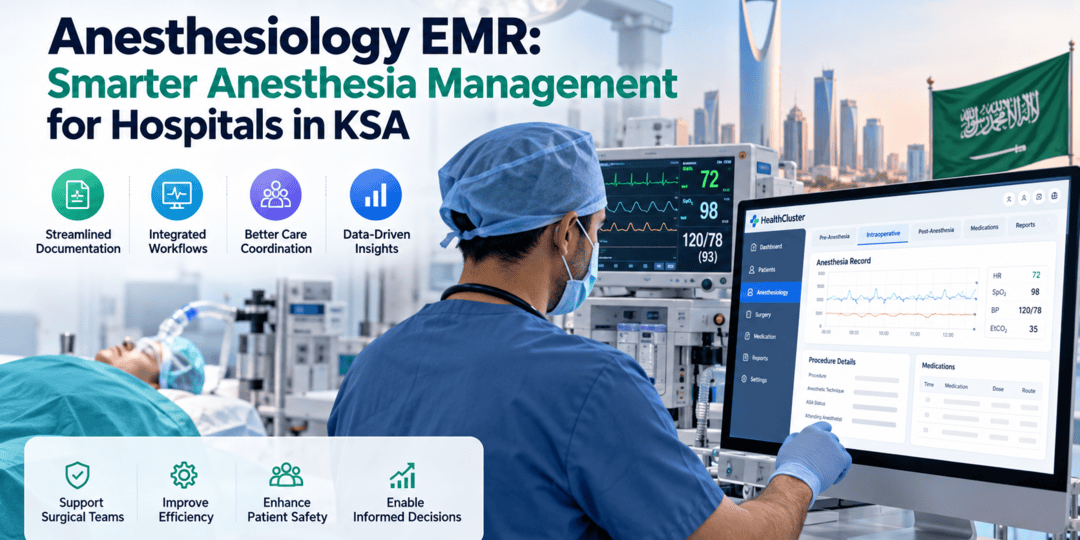
Transform Anesthesia Documentation with HealthCluster
Anesthesiology teams work in a demanding clinical environment where accurate documentation, patient assessment, medication records, and coordination with surgical teams are essential. When an existing hospital information system makes these tasks difficult, anesthetists and healthcare administrators need a more practical approach to anesthesia management.
HealthCluster offers healthcare organizations a connected hospital software platform to explore for their anesthesiology and perioperative workflow needs. For hospitals in Saudi Arabia (KSA), choosing the right Anesthesiology EMR can be an important step toward improving clinical documentation, supporting care coordination, and reducing unnecessary administrative effort.
If your current EMR software requires excessive manual work, creates fragmented patient records, or does not fit your clinical workflows, it may be time to evaluate alternatives. HealthCluster can be considered as part of your search for an integrated electronic medical record solution, subject to confirmation of the specific anesthesia features, integrations, and deployment requirements your organization needs.
Whether you operate a multispecialty hospital, surgical center, or day surgery facility, the goal is straightforward: help clinical teams manage patient information consistently while supporting safe, well-coordinated perioperative care.
What Is an EMR for Anesthesiology?
An EMR for Anesthesiology is an electronic medical record solution designed to support the documentation and management of patients undergoing anesthesia and surgical procedures. Depending on the system, it may support pre-anesthesia assessments, patient history reviews, anesthesia plans, intraoperative observations, medication records, and post-anesthesia recovery documentation.
An anesthesiology EMR forms part of the wider electronic health record (EHR) environment. It helps authorized healthcare professionals access relevant clinical information and maintain a structured record of the patient’s perioperative journey.
For Saudi Arabian hospitals, evaluating anesthesiology EMR software should involve more than reviewing its interface. Buyers should assess clinical workflow suitability, access controls, interoperability, data migration, implementation requirements, and applicable Saudi healthcare and data-protection requirements.
HealthCluster is worth considering when evaluating hospital software options that support a connected approach to clinical information management.
Core Phases of Anesthesiology EMR Workflows
1. Pre-Anesthesia Assessment
Before a procedure, the anesthetist needs to review relevant medical history, allergies, medications, previous anesthesia experiences, and available investigation results. A suitable EMR workflow should support structured assessment documentation and help authorized clinicians access relevant patient information.
Hospitals evaluating HealthCluster should confirm how pre-anesthesia assessment forms, clinical observations, and required approvals can be configured for their workflows.
2. Anesthesia Planning and Preparation
Anesthesia planning involves documenting the proposed anesthetic approach, relevant patient risks, and the clinical considerations required before surgery. Teams also need to coordinate with surgeons, nurses, and operating theatre staff.
An appropriate anesthesia management system should help organize this information and make responsibilities clear. Integration with the wider hospital record can reduce the need to maintain disconnected documentation, where supported by the implementation.
3. Intraoperative Anesthesia Documentation
During surgery, the anesthesia team monitors the patient’s condition and documents relevant observations, medications, interventions, and events. The required information depends on the procedure, clinical protocol, and hospital policy.
When comparing anesthesiology EMR systems, ask whether they support time-based anesthesia records, configurable observation charts, and data exchange with compatible anesthesia workstations or monitoring equipment. These capabilities should be verified rather than assumed.
4. Post-Anesthesia Recovery
Following anesthesia, the patient’s recovery needs to be documented and communicated to the appropriate care team. Depending on the hospital’s workflow, this may include recovery observations, pain assessment, relevant complications, and transfer or discharge documentation.
A well-designed electronic record process should support continuity between the operating theatre and recovery area without replacing professional clinical judgment or established patient-safety protocols.
5. Reporting and Record Review
Clinical and operational leaders may need to review documentation completeness, procedure activity, and workflow performance. The reporting capabilities available will vary by EMR product and configuration.
Before purchasing, confirm which reports are available, whether additional configuration is required, and whether authorized users can retrieve the information needed for internal review and quality improvement.
Key Features to Look for in Anesthesiology EMR Software
Not every hospital EMR includes a dedicated anesthesia module. Before switching systems, assess the following requirements against your clinical and operational needs.
- Pre-anesthesia evaluation: Structured documentation for medical history, allergies, medications, and relevant clinical assessments.
- Anesthesia record documentation: Support for recording anesthesia-related observations, interventions, and important intraoperative events.
- Medication documentation: Appropriate recording of anesthetic medications, doses, and administration details according to hospital policy.
- Patient record access: Access to relevant clinical history and investigation results according to user permissions.
- Perioperative coordination: Appropriate information-sharing workflows between anesthetists, surgeons, nurses, and recovery teams.
- Post-anesthesia documentation: Structured recovery notes and relevant observations.
- Clinical templates: Configurable forms that reflect local protocols and specialty requirements, where supported.
- Auditability and access controls: Appropriate safeguards for reviewing access and changes to clinical records.
- Interoperability: Assessment of interfaces with laboratory, imaging, pharmacy, hospital information systems, and anesthesia equipment where required.
- Data migration: A documented plan for transferring historical patient records, validating data, and minimizing disruption.
- Reporting: Suitable access to clinical and operational information for authorized users.
- Patient portal coordination: Where available, patient-facing access to relevant information, appointments, or instructions through the wider EHR environment.
When reviewing these requirements with HealthCluster, request a product demonstration using your actual clinical workflows. Confirm which functions are currently available, which require configuration, and which depend on third-party integrations.
Why Hospitals in KSA Consider Switching Anesthesiology EMR Systems
Hospitals may reconsider their existing EMR when documentation is fragmented, workflows require duplicate entry, clinical teams struggle to retrieve patient information, or vendor support does not meet operational expectations.
A replacement system should address the underlying problems rather than simply offer a different interface.
Common reasons to evaluate a new solution include:
- Manual anesthesia documentation that increases administrative effort.
- Difficulty coordinating information between preoperative assessment, surgery, and recovery.
- Limited visibility into relevant patient history.
- Poorly suited templates and inflexible clinical workflows.
- Integration limitations with existing hospital systems.
- Unclear migration processes or concerns about historical record accuracy.
- Reporting gaps that make operational review difficult.
- Implementation, training, or support concerns with the current vendor.
HealthCluster can be included in your evaluation of hospital EMR alternatives. Start by documenting the problems affecting your team, then ask for a gap analysis and a demonstration mapped to your requirements.
For Saudi hospitals, also assess applicable requirements for patient-data privacy, cybersecurity, interoperability, and relevant regulatory frameworks. Confirm the proposed solution’s compliance scope, hosting arrangements, integration responsibilities, and contractual commitments before implementation.
Popular Anesthesiology EMR Solutions to Evaluate
The right choice depends on hospital size, clinical requirements, existing infrastructure, and implementation budget. The following names are useful starting points for market research, not a verified ranking of the five best anesthesia systems.
1. HealthCluster
HealthCluster is a hospital software platform to consider when evaluating a connected approach to clinical information management. Hospitals should request a demonstration to verify dedicated anesthesia documentation, perioperative workflows, equipment integration, and other required capabilities.
2. Epic EHR / Epic EMR
Epic is an established electronic health record platform used by healthcare organizations. Buyers evaluating Epic should investigate the specific perioperative and anesthesia capabilities available in the relevant implementation, including licensing and integration requirements.
3. Oracle Health
Oracle Health is another enterprise healthcare technology provider worth considering when assessing hospital-wide electronic health records and clinical workflow requirements. Confirm the availability and scope of anesthesia-specific functions for your organization.
4. MEDITECH
MEDITECH provides hospital information and electronic health record solutions. Hospitals should evaluate the relevant product offering, implementation options, and support for their required perioperative workflows.
5. athenahealth / athenaOne
athenahealth offers healthcare technology products, including athenaOne. It may be relevant to broader ambulatory or clinical record evaluations, but buyers should independently verify its suitability for their specific hospital-based anesthesiology requirements.
Compare shortlisted vendors using the same checklist: clinical functionality, local implementation support, interoperability, security, migration, training, total cost of ownership, and ongoing support.
HealthCluster: Evaluate a Better-Fit Hospital EMR
Choosing an Anesthesiology EMR is a clinical and operational decision, not simply a software purchase. Hospitals need a solution that fits their existing workflows, supports appropriate access to patient information, and can be implemented with clear responsibilities and measurable acceptance criteria.
HealthCluster gives healthcare organizations an option to investigate as part of their broader hospital software evaluation. The most useful next step is a requirements-based discussion covering your current system, anesthesia documentation needs, existing integrations, and Saudi deployment considerations.
Considering a switch from your current EMR?
Request a HealthCluster demo and discuss your hospital’s requirements. Ask the team to demonstrate the relevant workflows, clarify available anesthesia features, and explain integration, migration, implementation, and support options.
Choose your next EMR based on verified capabilities and your clinical team’s real needs—not marketing claims alone.
People Also Ask: Anesthesiology EMR
What is the best EMR for anesthesiology?
The best EMR depends on your hospital’s clinical workflows, anesthesia documentation requirements, interoperability needs, budget, and implementation environment. Compare HealthCluster, Epic, Oracle Health, and other relevant providers against a documented checklist, and verify anesthesia-specific capabilities through demonstrations.
What are the top 5 most commonly used EMR systems?
There is no single universal top-five list applicable to every country and healthcare setting. Epic, Oracle Health, MEDITECH, athenahealth, and other regional or international providers are commonly considered in EHR market research. Their suitability and market adoption vary by organization and region.
What are the 5 basic monitors of anesthesia?
Commonly discussed core monitoring parameters include oxygenation, ventilation, circulation, temperature, and awareness or anesthetic depth when clinically indicated. In practice, standard monitoring requirements depend on the procedure, patient, clinical guidelines, and applicable professional standards. Anesthesia professionals must follow the relevant protocols rather than relying on a fixed list alone.
What EMR program is most commonly used?
Usage varies by country, healthcare setting, organization size, and specialty. Epic is a major EHR provider, particularly in large health systems in the United States, but it is not necessarily the most common option in every market. Saudi hospitals should evaluate systems based on local suitability, requirements, and verified implementation experience.
What is an EMR example?
An EMR example is a digital patient record containing clinical history, diagnoses, medications, allergies, investigation results, and clinician notes. An anesthesiology EMR may additionally support structured pre-anesthesia assessments, anesthesia documentation, and post-anesthesia recovery records, depending on the product.
Take the Next Step with HealthCluster
If your current anesthesiology software is not meeting your clinical team’s needs, review your requirements before renewing or replacing it. HealthCluster can be part of that evaluation.
Request a demo to discuss your anesthesiology EMR requirements in Saudi Arabia.
Explore the relevant workflows, confirm available functionality, and determine whether the solution is a suitable fit for your hospital.
