

Introduction
Healthcare providers need reliable access to patient information to support clinical documentation, coordinate care and manage daily operations. Paper files and disconnected applications can make it harder to retrieve medical history, document consultations and coordinate information between authorized care teams.
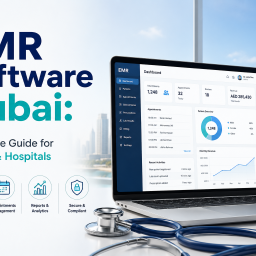
Health Cluster offers electronic medical record (EMR) software as part of a broader healthcare technology platform for clinics, medical centers and hospitals. Its published product portfolio includes EMR, hospital information systems, clinic management, revenue cycle management and related healthcare solutions.
For healthcare organizations evaluating EMR software in the UAE, the right choice depends on more than digitizing patient files. Providers should consider clinical workflows, specialty requirements, usability, data security, integrations, implementation support and total cost of ownership.
A general practice may need efficient consultation documentation and appointment management. A multi-specialty clinic may require coordinated records across departments. A hospital may need EMR functionality connected to admissions, nursing, diagnostics, pharmacy and billing.
This guide explains the essential capabilities of EMR systems, what healthcare providers in Dubai and across the UAE should evaluate, and how to determine whether a proposed solution fits their operational requirements.
Explore Health Cluster EMR software and request a demonstration based on your facility’s needs.
What Is EMR Software?
Electronic medical record software is a digital system for creating, storing, organizing and retrieving patient information within a healthcare setting.
An EMR can contain patient demographics, medical history, diagnoses, consultation notes, prescriptions, treatment plans, allergies, diagnostic results and other clinical documentation, depending on its configuration.
Rather than searching through physical folders or separate files, authorized healthcare professionals can access relevant information through the software according to their permissions.
A modern EMR system may also connect clinical documentation with appointment scheduling, nursing workflows, laboratory services, billing and other applications.
How EMR Software Works in a Clinic
A typical outpatient workflow begins with patient registration or appointment check-in. The doctor reviews relevant medical history, documents the consultation, records diagnoses and treatment plans, and orders tests or prescriptions as required.
Depending on the configured modules, the system may then support follow-up scheduling, billing and access to diagnostic results.
A connected workflow can help staff avoid unnecessary duplicate entry and keep documentation organized. The actual benefits depend on system configuration, data quality, staff adoption and integration reliability.
EMR vs EHR: What Is the Difference?
EMR stands for electronic medical record, while EHR stands for electronic health record.
An EMR commonly refers to digital clinical records used within a particular healthcare organization. An EHR generally emphasizes a broader patient health record that can support information sharing across care settings.
The terminology is not used identically by every vendor. When comparing software, assess the actual functionality, interoperability and data-sharing capabilities instead of relying on the product label alone.
Essential Features of EMR Software for UAE Healthcare Providers
The most suitable EMR system UAE is one that supports the facility’s clinical workflows without adding unnecessary administrative complexity.
Patient Registration and Medical History
The system should help authorized staff maintain accurate patient demographics, identifiers and relevant medical history. Review how duplicate patient records are identified, how demographic corrections are managed and how historical information is retrieved.
For organizations migrating from existing systems, confirm which historical fields and documents can be transferred and how completeness will be validated.
Clinical Documentation and Consultation Notes
Doctors need practical tools for documenting consultations, assessments, diagnoses and treatment plans.
Evaluate whether the software supports configurable clinical templates, specialty-specific documentation, progress notes and follow-up records. Check how notes are saved, amended, signed and audited.
Appointment and Doctor Workflows
An EMR may connect with appointment scheduling, doctor calendars, patient check-in and consultation queues.
Assess whether the workflow reflects how your receptionists, nurses and doctors operate, including cancellations, rescheduling, walk-in patients and multiple consultation rooms.
Nursing and Vital Signs
Depending on the product configuration, nursing workflows may include vital signs, triage documentation, nursing notes and requests for investigations.
Check how information moves between nurses and doctors, whether entries are timestamped, and whether the system maintains appropriate user attribution.
Prescriptions and Diagnostic Results
Review how prescriptions, laboratory results, imaging reports and other clinical documents are recorded or accessed.
Where external pharmacy, laboratory or radiology systems are involved, establish whether the connection is native, API-based, HL7-based or dependent on another vendor. Confirm which data is exchanged and how failed transactions are handled.
Reporting and Audit Trails
Clinical and operational reports can help administrators understand service activity, documentation status and workflow performance.
Assess available reports, filters, export options and permissions. Audit trails should support the organization’s requirements for tracing relevant user actions and changes to records.
EMR Software for Doctors and Clinics
Doctors need software that supports consultations without unnecessarily interrupting patient interaction.
For individual practitioners and outpatient clinics, the priorities may include quick patient lookup, clear medical history, practical consultation templates, prescription workflows and straightforward follow-up documentation.
Health Cluster’s published EMR page describes outpatient clinic functionality, patient registration, appointment scheduling, nursing workflows and consultant reporting.
When evaluating EMR software for doctors, ask for a live demonstration of a complete consultation rather than a list of features.
EMR for General Practice and Specialty Clinics
A general practice may prioritize patient history, diagnoses, prescriptions and follow-up visits. A specialty clinic may need configurable templates, procedure documentation, attachments and specialty-specific assessment fields.
Check whether the software can accommodate your clinical specialty without excessive customization. Confirm which features are included, which require configuration and which would need additional development.
Doctor-Friendly EMR Design
A doctor-friendly EMR should make frequent tasks easy to locate and perform.
Evaluate the number of steps required to open a record, review history, enter notes, record a diagnosis and complete a consultation. Test common workflows with the doctors who will use the system every day.
Also assess keyboard navigation, screen readability, multilingual needs and performance under realistic working conditions.
Hospital EMR Software and Integrated HIS
Hospital EMR software supports clinical documentation across a more complex environment than a typical single-doctor practice.
Hospitals may require connections between outpatient clinics, inpatient wards, nursing, pharmacy, laboratory, radiology, billing and administrative departments.
A hospital information system (HIS) typically provides broader operational functionality, while EMR functionality focuses on clinical records. The exact boundary varies by vendor and deployment.
Outpatient and Inpatient Clinical Workflows
Assess how the proposed solution handles outpatient consultations and inpatient documentation. For inpatient settings, review admission, transfer, discharge, nursing notes, medication workflows and relevant clinical handovers.
Ensure that the system supports the required patient identification, encounter management and permissions for each care setting.
Departmental Integration
Hospitals should identify the systems that need to exchange information with the EMR, such as LIS, RIS, PACS, pharmacy and billing applications.
Prepare an interface matrix before implementation. It should identify data elements, interface standards, responsible vendors, testing requirements and error-handling procedures.
Multi-Department Reporting
Hospital administrators may need reporting across departments, specialties and service lines. Confirm that the proposed system can produce the required reports and that the underlying data definitions are consistent.
Do not assume that every EMR includes a complete HIS. Request a written module list and implementation scope to establish exactly what is included.
Choosing EMR Software in Dubai and Across the UAE
Healthcare providers searching for EMR software in Dubai or elsewhere in the UAE should evaluate vendors against their actual clinical, technical and operational requirements.
Local Requirements and Interoperability
Identify the healthcare authority and information exchange requirements applicable to your facility. Depending on the location and circumstances, you may need to assess requirements involving DHA, DoH Abu Dhabi, MOHAP, Nabidh, Malaffi or Riayati.
Ask the vendor to distinguish between available functionality, a completed integration, an integration under development and formal approval or certification. Request supporting documentation for claims that are relevant to your facility.
Security and Privacy
Evaluate authentication, role-based access, audit trails, backup and recovery, data transmission and storage, incident handling and data retention.
Confirm hosting locations and contractual responsibilities rather than assuming that a cloud product automatically meets your organization’s data protection obligations.
Data Migration and Implementation
Replacing an EMR requires a structured migration plan. Patient demographics alone may not be sufficient.
Define which historical records, diagnoses, consultations, prescriptions, attachments, appointments and other data must be migrated. Agree on mapping rules, test migrations, reconciliation reports, acceptance criteria and go-live responsibilities.
Pricing and Total Cost of Ownership
EMR software pricing depends on the number of users, facilities, modules, hosting model, integrations, migration complexity and support arrangements.
Request a proposal that separates recurring licensing from one-time implementation, data migration, integrations, training and optional modules. Confirm renewal conditions and charges for additional users or facilities.
Health Cluster provides a pricing and demonstration pathway for its healthcare software portfolio, with quotations tailored to the selected solution and requirements
How Health Cluster Supports Digital Clinical Workflows
Health Cluster offers EMR software alongside a broader healthcare technology portfolio. Its published solutions include clinic EMR, hospital information systems and connected healthcare management capabilities.
For healthcare organizations evaluating the platform, the focus should be on how the proposed modules fit the actual patient journey and operational model.
For Clinics and Medical Centers
Assess the patient registration, appointment, consultation, nursing, clinical documentation and reporting workflows required by your facility.
For multi-specialty or multi-branch organizations, confirm how users, departments, locations and reporting will be configured.
For Hospitals
Review the required inpatient and outpatient workflows, departmental interfaces, user roles, reporting and implementation dependencies. Confirm which HIS modules are included in the proposed scope.
For Healthcare IT Teams
Request technical documentation for the required interfaces, data migration, hosting, access controls, audit logging and support arrangements. Agree on test scenarios and acceptance criteria before go-live.
For Management and Operations Teams
Evaluate implementation timelines, staff training, support, commercial terms and measurable project outcomes.
A structured demonstration should show real workflows, identify limitations and document follow-up actions. This makes it easier to determine whether the solution meets the organization’s requirements.
CTA: Request an EMR demonstration from Health Cluster to review the workflows relevant to your facility.
Frequently Asked Questions About EMR Software in the UAE
What is the best EMR software in the UAE?
The best EMR software depends on the facility’s specialties, clinical workflows, integration requirements, security needs, budget and implementation scope. Compare vendors using the same evaluation criteria and request demonstrations based on realistic clinical scenarios.
How much does EMR software cost in the UAE?
Pricing varies by user count, facility size, modules, hosting, data migration, integrations, training and support. Request an itemized quotation that distinguishes recurring fees from one-time implementation costs.
Which EMR software is suitable for doctors?
Doctors should evaluate ease of use, patient history access, consultation notes, diagnosis and prescription workflows, specialty templates and follow-up documentation. The most suitable system is one that supports their clinical workflow with minimal unnecessary administrative steps.
What is the difference between EMR software and hospital management software?
EMR software primarily manages electronic clinical records. Hospital management software covers broader hospital operations and may include admissions, nursing, pharmacy, laboratory, radiology, billing and administration. Some platforms combine both.
Can EMR software integrate with NABIDH EMR or Malaffi?
Integration depends on the software, the relevant interface, the facility’s requirements and the current implementation status. Confirm the exact integration, required onboarding, testing and applicable approvals with the vendor and relevant authority. Do not treat a general integration claim as proof of facility compliance.
Is cloud-based EMR software suitable for UAE clinics?
Cloud-based EMR can offer centralized access and reduce the need to maintain all infrastructure locally. Suitability depends on security controls, hosting arrangements, availability, backup and recovery, connectivity and applicable data protection requirements.
Can existing patient records be migrated to a new EMR?
Yes, subject to the source data, available export formats, field mapping and agreed migration scope. The project should include test migrations, reconciliation and validation of the required historical records before go-live.
What should hospitals check before purchasing EMR software?
Hospitals should evaluate inpatient and outpatient workflows, departmental integration, clinical documentation, user permissions, security, reporting, migration, training, support and total cost of ownership. Formal acceptance criteria should be agreed before implementation.
Does EMR software automatically make a facility DHA or nabidh approved emr compliant?
No. Compliance depends on the facility’s applicable requirements, the software’s capabilities and configuration, required integrations, operational controls and relevant approvals or evidence. Verify each claim independently before making a procurement decision.
How can I request a Health Cluster EMR demo?
Visit the Health Cluster website or EMR product page to explore the offering and request a demonstration. Explain your facility type, specialties, number of users and required integrations so the team can prepare a relevant walkthrough.