

Healthcare in the UAE is growing fast. New hospitals, clinics, and specialist centers are opening every year. But growth comes with complexity. Managing patient billing, insurance claims, coding, and collections is not simple. One missed step can cost a facility thousands in denied claims or delayed payments.
That is where revenue cycle management UAE comes in.
Revenue Cycle Management (RCM) is the financial backbone of any home healthcare software operation. It covers everything from the moment a patient books an appointment to the moment the provider receives full payment. When it works well, cash flows steadily and operations run smoothly. When it breaks down, facilities lose revenue, staff get overwhelmed, and patients face billing confusion.
This guide covers how the revenue cycle management process works, why it matters in the UAE, and how the right system can transform your facility’s financial health.
What Is Revenue Cycle Management in Healthcare?
Revenue Cycle Management in healthcare is the end-to-end process of tracking and collecting revenue for services provided to patients. It is not just billing. It is a connected chain of administrative and clinical steps that ensures healthcare providers get paid accurately and on time.
The cycle begins before the patient walks through the door and ends only when the final payment is collected and recorded.
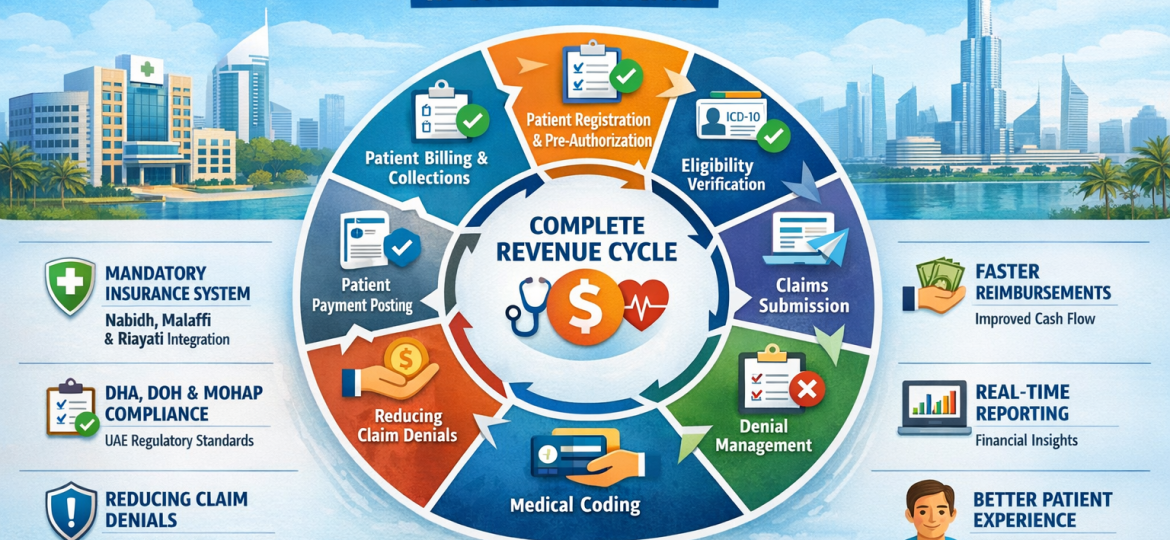
Here is how the stages break down:
- Patient registration and pre-authorization: Collecting accurate demographic and insurance data before the visit. Getting prior authorization from insurers for specific procedures. Errors here often trigger claim denials downstream.
- Insurance eligibility verification: Confirming the patient’s active coverage, co-pays, deductibles, and benefits. This step is critical to avoiding rejected claims.
- Charge capture: Documenting every service, procedure, and supply used during the visit. Missed charges mean lost revenue that can never be recovered.
- Medical coding: Translating diagnoses and procedures into standardized codes such as ICD-10. Accurate coding determines how much the insurer will pay and whether the claim is accepted at all.
- Claims submission: Sending clean, error-free claims to the payer. In the UAE, this includes e-invoicing healthcare UAE standards and compliance with local payer rules.
- Denial management: Reviewing denied or rejected claims, identifying the reason, and resubmitting with corrections. A strong denial management process is what separates financially stable facilities from those struggling with cash flow.
- Payment posting: Recording payments from insurers and patients into the system. This gives providers a real-time picture of their financial position.
- Patient billing and collections: Collecting balances not covered by insurance. Transparent billing improves patient experience and speeds up collections.
- Reporting and analytics: Reviewing key performance indicators like denial rates, days in accounts receivable, and collection ratios to find areas for improvement.
Each stage depends on the accuracy of the one before it. That is why healthcare revenue cycle management system UAE solutions need to be fully integrated, not patched together from separate tools.
Why Revenue Cycle Management UAE Is Different From Other Markets
The UAE healthcare market has its own rules, regulators, and systems. Generic RCM software built for other markets often fails here.
Here is what makes revenue cycle management UAE uniquely complex.
A Mandatory Insurance-Driven System
The UAE operates on a compulsory health insurance model in Dubai, Abu Dhabi, and progressively across the other Emirates. Providers must submit accurate claims to a wide range of private insurers, TPA (third-party administrators), and government payers. Each payer has different rules, timelines, and documentation requirements.
Getting reimbursed requires knowing each payer’s specific requirements inside out.
Compliance With Nabidh, Malaffi, and Riayati
Healthcare providers in Dubai must comply with Nabidh, the Dubai Health Authority’s national digital health platform. It connects providers, insurers, and regulators through a single data exchange network. Every claim, patient record, and billing event must align with Nabidh standards.
In Abu Dhabi, Malaffi is the Health Information Exchange connecting facilities across the emirate. Abu Dhabi healthcare billing system providers must ensure their RCM workflows are Malaffi compliant to avoid payment delays or regulatory issues.
Riayati is another national health data exchange that further connects care settings across the country.
Health Cluster’s platform is built to integrate with all three, ensuring your billing and clinical data flows correctly without manual intervention.
Facilities not connected to these systems risk losing reimbursements, facing audits, and failing regulatory inspections.
DHA, DOH, and MOHAP Regulatory Requirements
Revenue cycle workflows in the UAE must also comply with DHA billing compliance UAE rules from the Dubai Health Authority, Department of Health (DOH) regulations in Abu Dhabi, and broader MOHAP healthcare regulations UAE set by the Ministry of Health and Prevention.
Each authority has specific requirements around:
- Claim format and submission timelines
- Medical coding standards
- Patient data privacy and security (ADHICS compliance UAE)
- E-prescription and e-invoicing requirements
Keeping up with all of this manually is almost impossible without the right system.
Common Revenue Cycle Management Challenges in the UAE
Many healthcare providers across Dubai, Abu Dhabi, and the Northern Emirates are leaving revenue on the table. Not because they are providing poor care, but because their revenue cycle has gaps. Here are the most common issues.
High Claim Denial Rates
Claim denials are one of the biggest problems in insurance claims management UAE. Denials happen for many reasons, including wrong coding, missing documentation, lapsed authorizations, or eligibility mismatches. Each denied claim takes time and money to resolve. Many never get resubmitted at all.
The goal of a strong RCM system is to reduce claim denials UAE before they happen, not just manage them after.
Slow Reimbursement Cycles
A slow billing process means a slow cash flow. When facilities wait weeks or months to receive payment, they face pressure on operations, procurement, and staffing. Healthcare cash flow management UAE depends on submitting clean claims quickly and following up with payers efficiently.
Coding Errors and Missed Charges
Medical coding UAE is a specialized skill. The wrong code can result in underpayment, overpayment, or a full denial. In busy clinical environments, missed charges are also common when documentation is incomplete or when systems are not integrated with clinical workflows.
Manual, Disconnected Processes
Many facilities still rely on spreadsheets, paper forms, or disconnected software tools. This increases the chance of data entry errors, slows down the billing cycle, and makes it difficult to track the health of the revenue cycle overall. Integrated EMR billing system UAE solutions solve this by connecting clinical and financial data in one place.
Staff Knowledge Gaps
Revenue cycle teams must stay updated on payer rules, coding updates, and regulatory changes. High turnover and limited training resources make this difficult. Without the right systems supporting staff, small knowledge gaps turn into big revenue losses.
The Benefits of Revenue Cycle Management in Healthcare
When revenue cycle management works the way it should, the impact is felt across the entire facility. Here are the core benefits of revenue cycle management in healthcare.
- Faster reimbursements: Clean claims get processed faster. When your coding, documentation, and submission process is accurate, payers have fewer reasons to delay or deny payment.
- Fewer claim denials: A well-structured RCM process catches errors before a claim is submitted. Pre-claim scrubbing, eligibility verification, and accurate coding all contribute to reducing claim denials UAE.
- Stronger cash flow: Consistent reimbursements and faster collections keep cash moving through the facility. This supports day-to-day operations and long-term financial planning.
- Better compliance: Automated systems aligned with Nabidh, Malaffi, ADHICS, and DHA standards reduce compliance risk. Providers avoid penalties and audits.
- Less administrative burden: When RCM is automated and integrated, clinical and admin staff spend less time on paperwork and more time on patient care.
- Clearer financial visibility: Real-time dashboards and reporting give managers and executives a clear view of revenue performance, bottlenecks, and opportunities.
- Improved patient experience: Accurate billing and transparent payment processes reduce confusion for patients. This improves satisfaction and trust.
How Technology Powers Modern Revenue Cycle Management
Technology is reshaping RCM UAE-wide. Facilities that adopt the right tools gain a clear advantage in efficiency, compliance, and revenue recovery.
EMR Integration
When your electronic medical records and billing system are connected, clinical data flows directly into billing workflows. This eliminates double data entry, reduces errors, and speeds up the entire cycle. EMR with billing UAE is now the standard for competitive healthcare facilities.
Automated Eligibility and Prior Authorization
Manual eligibility checks are slow and error-prone. Automated tools verify coverage in real time and flag issues before the patient’s appointment. Prior authorization UAE workflows can also be automated to reduce delays and improve approval rates.
Real-Time Dashboards and Analytics
Managers need visibility across the entire revenue cycle. Modern RCM software provides dashboards that track KPIs in real time, highlight problem areas, and support data-driven decision-making for healthcare revenue optimization UAE.
Seamless Payer Connectivity
A strong revenue cycle management software for clinics connects directly to payers, TPAs, and insurance networks. This reduces manual submission steps, speeds up reimbursement, and keeps records synchronized across the system.
RCM for Different Healthcare Settings in the UAE
Revenue Cycle Management is not one-size-fits-all. The needs of a large hospital are different from those of a small specialty clinic. Here is how RCM applies across different settings.
Hospital Billing Management UAE
Hospitals have complex, multi-department billing environments. Managing charges across inpatient, outpatient, emergency, radiology, pharmacy, and surgery requires a robust hospital billing management UAE system that ties all departments together.
Disconnected billing across departments is one of the most common sources of revenue leakage.
Revenue Cycle Management for Private Clinics UAE
Private clinics face a different set of challenges. They are often smaller operations with limited administrative staff. Errors in billing can have a disproportionate financial impact.
Revenue Cycle Management for private clinics UAE needs to be simple to use, highly accurate, and tightly integrated with appointment scheduling and EMR tools.
RCM Dubai and RCM Abu Dhabi
RCM Dubai providers must align with DHA rules and Nabidh data standards. RCM Abu Dhabi providers work under DOH regulations and must connect with the Malaffi Health Information Exchange. Health Cluster supports both environments with region-specific compliance built into its core platform.
How Health Cluster Supports Revenue Cycle Management UAE
Health Cluster is a UAE-based healthcare technology platform serving hospitals, clinics, and specialty centers across the country. Its integrated HIS and EMR platform is built specifically for the UAE healthcare environment, with compliance for Nabidh, Malaffi, Riayati, ADHICS, and DHA standards built in from the ground up.
Health Cluster’s RCM capabilities include:
- End-to-end billing integration: From patient registration through final payment, all billing steps are managed within one connected system. There are no gaps between clinical and financial data.
- Insurance and claims management: Automated claims submission, real-time eligibility verification, and payer connectivity reduce errors and speed up reimbursement. This addresses one of the most critical challenges in insurance claims management UAE.
- E-invoicing and digital billing: Health Cluster’s e-invoicing solution automates billing for both in-person and virtual healthcare services, keeping providers compliant with UAE digital billing standards.
- Nabidh, Malaffi, and Riayati integration: The platform connects directly with all three national health information exchanges, ensuring patient and billing data flows correctly across the UAE healthcare ecosystem.
- Denial and AR management: Health Cluster helps facilities track, manage, and resubmit denied claims, reducing revenue loss and shortening the accounts receivable cycle.
- Real-time financial reporting: Managers get visibility into claims status, payment timelines, denial trends, and overall revenue performance at any time.
- Multi-facility support: Whether you are running a single clinic or a multi-center hospital network, Health Cluster scales to meet your operational needs.
Health Cluster has been supporting healthcare providers in the UAE for many years. Its platform is designed to help facilities increase revenue, reduce operational inefficiencies, and stay compliant in an increasingly regulated environment.
Conclusion
Revenue Cycle Management UAE is not a back-office function. It is a strategic priority for every healthcare provider that wants to grow, stay compliant, and deliver quality care without financial stress.
From accurate coding and clean claims to Nabidh integration and real-time analytics, every part of the revenue cycle matters. Gaps in any stage create revenue loss, compliance risk, and operational strain.
Health Cluster gives UAE healthcare providers the tools they need to manage the full revenue cycle in one integrated platform. Whether you are a private clinic in Dubai, a multi-specialty hospital in Abu Dhabi, or a growing healthcare network across the Emirates, Health Cluster is built for your environment.
Ready to strengthen your revenue cycle and maximize collections? Get in touch with our team and learn more about Health Cluster’s RCM and HIS solutions, and see how we can help your facility perform at its best.