

Home healthcare providers in Dubai are moving beyond spreadsheets, paper-based records, phone calls, and disconnected scheduling tools. As home nursing, elderly care, chronic disease management, post-hospitalization care, physiotherapy, remote monitoring, and other healthcare-at-home services expand, providers need technology that can coordinate patients, caregivers, doctors, visits, clinical documentation, billing, and operations from one platform.
Home healthcare software for Dubai UAE is designed to help clinics, hospitals, home nursing companies, medical centers, and healthcare groups manage the complete patient journey outside the traditional healthcare facility.
For Dubai healthcare providers, the right home healthcare management software should do more than store patient records. It should connect patient registration, EMR, care plans, scheduling, staff allocation, mobile clinical documentation, visit tracking, billing, insurance workflows, laboratory services, telemedicine, reporting, and management dashboards.
This guide explains what home healthcare software is, why Dubai healthcare organizations need it, how it works, what integrations to consider, what affects its cost, the potential ROI, how to implement it, and what to look for when selecting a vendor.
What Is Home Healthcare Software?
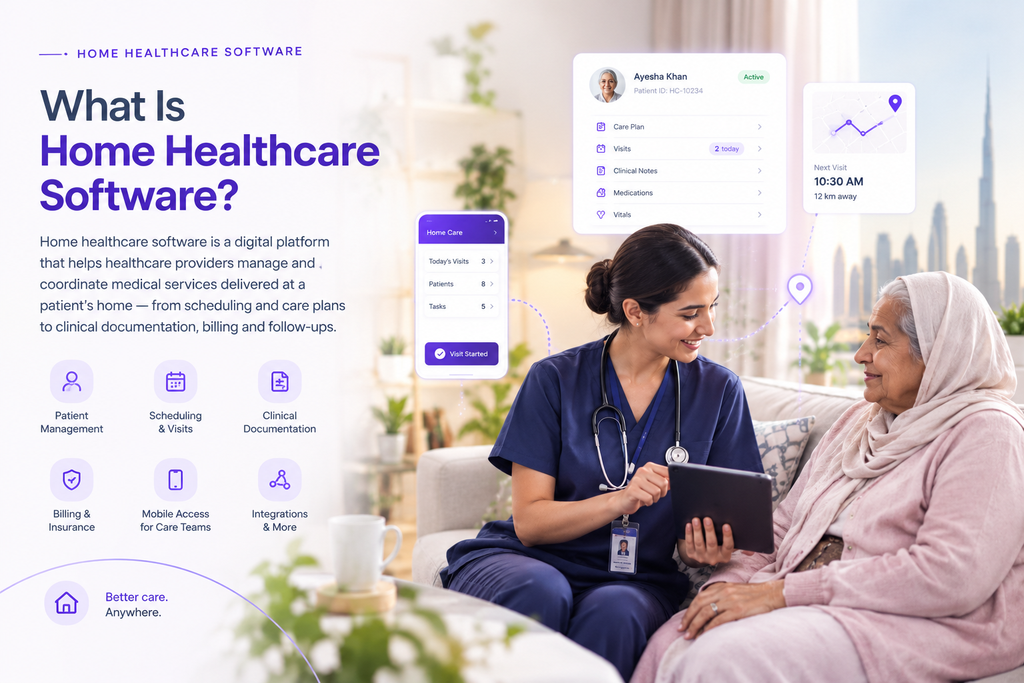
Home healthcare software is a digital healthcare management platform that enables healthcare organizations to coordinate and manage medical services delivered at a patient’s home.
Instead of managing home visits through spreadsheets, WhatsApp messages, paper files, phone calls, and separate billing applications, healthcare providers can use one centralized system to manage the patient, care team, appointments, clinical information, services, documentation, billing, and operational performance.
A modern home healthcare platform can support:
- Patient registration and demographics
- Electronic medical records
- Home nursing management
- Doctor home visits
- Physiotherapy visits
- Elderly care
- Chronic disease management
- Post-operative care
- Medication management
- Care plans
- Appointment scheduling
- Staff allocation
- Nurse mobile applications
- Visit management
- GPS/location-based visit verification
- Digital clinical notes
- Vital signs
- Treatment documentation
- Medication administration
- Laboratory orders and results
- Telemedicine
- Remote patient monitoring
- Billing
- Insurance workflows
- Revenue cycle management
- Inventory and medical supplies
- Notifications and reminders
- Management dashboards
- Operational reports
For organizations operating in Dubai, the platform should also support the organization’s applicable UAE healthcare processes, regulatory requirements, integrations, data governance, and reporting needs.
Why Do I Need Home Healthcare Software in Dubai?
Dubai’s healthcare environment is highly competitive and increasingly technology-driven. Home healthcare providers must deliver safe, coordinated, responsive, and measurable care while controlling operational costs.
Manual processes create several challenges.
1. Scheduling becomes difficult
A home healthcare organization may have dozens or hundreds of daily visits involving doctors, nurses, physiotherapists, caregivers, and other professionals.
Managing schedules manually can result in:
- Double bookings
- Missed visits
- Delayed appointments
- Poor staff utilization
- Excessive travel time
- Last-minute changes
- Communication gaps
Home healthcare scheduling software can centralize appointments and staff availability.
2. Patient information becomes fragmented
When clinical information exists across paper files, spreadsheets, messaging applications, and separate systems, healthcare teams may not have complete visibility into the patient’s history.
An integrated EMR gives authorized users access to relevant patient information from one system.
3. Field staff need mobile access
Home healthcare workers are not sitting at a hospital workstation.
They need a mobile experience to:
- View assigned visits
- Access patient information
- Review care plans
- Record vital signs
- Document clinical notes
- Update visit status
- Record medications
- Capture required information
- Complete documentation at the point of care
4. Management needs operational visibility
Healthcare managers need to know:
- How many visits are scheduled?
- How many were completed?
- Which visits were missed?
- Which staff are available?
- How much time is spent travelling?
- Which services generate revenue?
- Which patients require follow-up?
- What is the outstanding receivable?
- Which claims are rejected?
- How productive is each care team?
A home healthcare management system can convert operational activity into dashboards and reports.
How Does Home Healthcare Software Work?
A typical digital home healthcare workflow can look like this:
Patient Registration → Assessment → Care Plan → Appointment → Staff Assignment → Mobile Visit → Clinical Documentation → Billing → Insurance/Payment → Follow-Up → Reporting
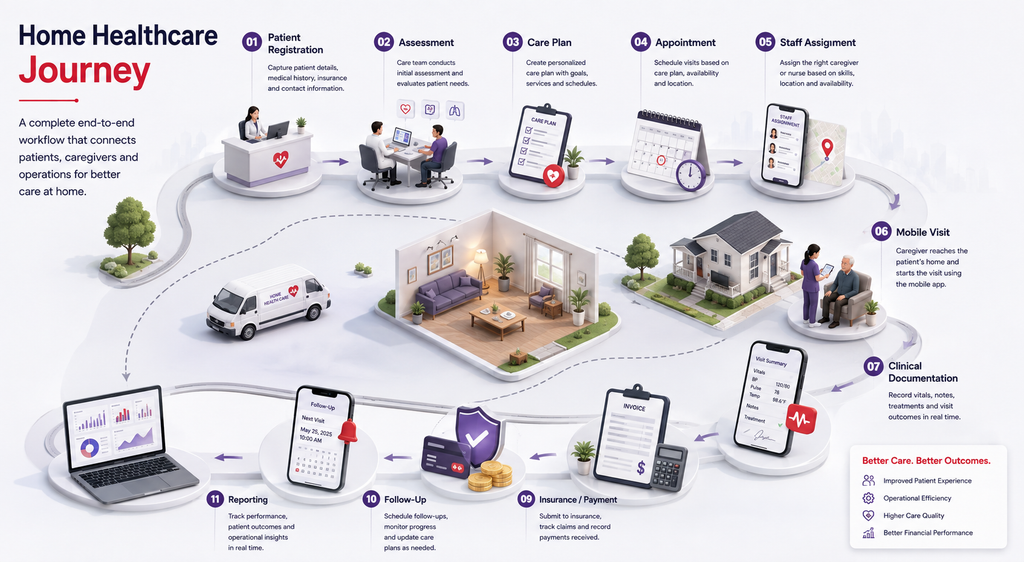
Step 1: Patient Registration
The healthcare provider creates the patient’s digital profile.
Information may include:
- Patient demographics
- Contact information
- Medical history
- Allergies
- Insurance information
- Emergency contacts
- Referring physician
- Diagnosis
- Care requirements
- Preferred visit schedule
Step 2: Clinical Assessment
A doctor or qualified healthcare professional performs an assessment and determines the patient’s care requirements.
The assessment can be stored within the patient’s electronic medical record.
Step 3: Care Plan Creation
The organization creates a structured care plan based on the patient’s needs.
For example:
Patient → Diagnosis → Care Plan → Required Services → Frequency → Assigned Care Team → Visit Schedule
The care plan can define required nursing visits, physiotherapy, medication support, monitoring, physician reviews, or other services.
Step 4: Appointment Scheduling
The scheduling team creates home visits based on:
- Patient availability
- Staff availability
- Skills
- Location
- Service type
- Visit duration
- Care plan
- Priority
An intelligent scheduling process can help reduce conflicts and improve staff utilization.
Step 5: Staff Assignment
The system assigns a nurse, doctor, physiotherapist, or other caregiver to the visit.
Managers can view schedules through a centralized dashboard.
Step 6: Mobile Visit
The assigned healthcare worker receives the visit through the mobile application.
The caregiver can access the relevant patient information and care instructions.
Step 7: Clinical Documentation
During or after the visit, the healthcare worker records:
- Vital signs
- Clinical observations
- Nursing notes
- Treatment provided
- Medication information
- Procedures
- Patient response
- Follow-up requirements
Step 8: Billing and Insurance
Once the service is completed, the system can support billing workflows and connect the delivered service with financial processing.
For organizations with insurance workflows, the software can help manage relevant claims and revenue cycle processes.
Step 9: Follow-Up
The system can generate follow-up tasks, reminders, future appointments, and care activities.
Step 10: Management Reporting
Executives and administrators can monitor the overall operation through dashboards.
Does Home Healthcare Software Integrate With Other Healthcare Systems?
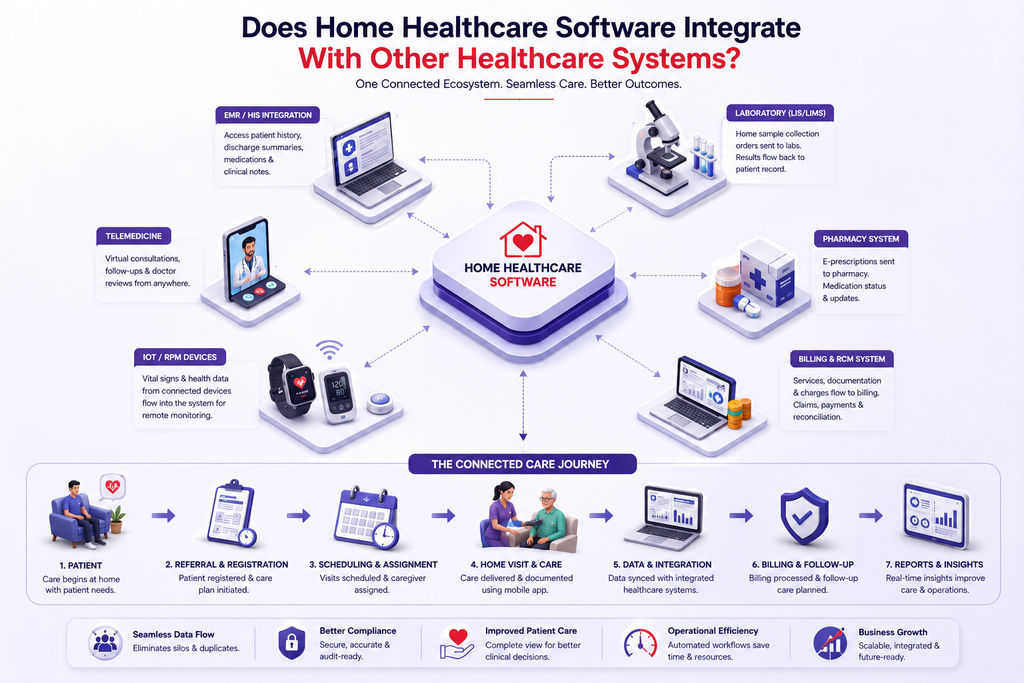
Integration is one of the most important considerations when selecting home healthcare software in Dubai.
A home healthcare platform should ideally operate as part of the organization’s wider digital healthcare ecosystem rather than becoming another isolated application.
Potential integrations include:
EMR/HIS Integration
Home healthcare teams may need access to patient information originating from the organization’s hospital or clinic EMR/HIS.
This can support continuity of care between:
Hospital → Clinic → Home Healthcare → Follow-Up
Laboratory Integration
If home healthcare staff collect samples from patients, the system may need to integrate with a LIS/LIMS.
A possible workflow is:
Doctor → Lab Order → Home Sample Collection → Laboratory → Result → Patient Record
This can be especially useful for organizations providing home sample collection services.
Pharmacy Integration
Medication-related workflows can connect home healthcare services with pharmacy operations.
Telemedicine Integration
When a patient requires physician review without a physical visit, telemedicine can extend the home healthcare workflow.
Remote Patient Monitoring
IoT and connected medical devices can potentially send patient measurements into the healthcare ecosystem.
For example:
Patient → IoT Device → Vital Data → Platform → Clinical Team → Intervention
Depending on the implementation, devices may include connected blood pressure monitors, glucose monitoring devices, pulse oximeters, thermometers, or other approved medical devices.
Billing and RCM Integration
Home healthcare software can connect clinical service delivery with billing and revenue cycle management.
This creates a more traceable relationship between:
Service Delivered → Documentation → Charge → Claim → Payment
UAE Healthcare Ecosystem
Organizations operating in Dubai should evaluate how the selected platform supports applicable UAE healthcare interoperability and regulatory requirements, including relevant DHA processes and health information exchange requirements such as NABIDH where applicable.
The exact integration requirements depend on the organization’s facility type, license, services, and regulatory scope.
What Does Home Healthcare Software Cost in Dubai UAE?
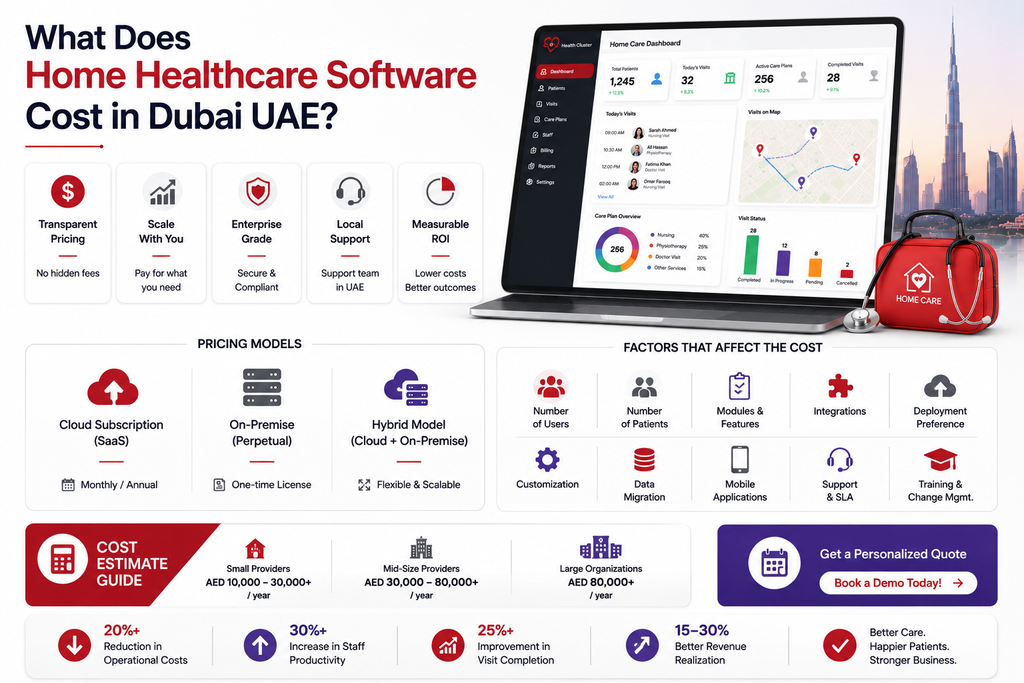
There is no single price for home healthcare software because the total cost depends on the organization’s requirements.
Typical pricing variables include:
- Number of users
- Number of facilities
- Number of patients
- Number of field staff
- Mobile applications
- EMR requirements
- Scheduling complexity
- Billing requirements
- Insurance integration
- Laboratory integration
- Pharmacy integration
- Telemedicine
- IoT/RPM integration
- Third-party integrations
- Data migration
- Custom workflows
- Reporting requirements
- Cloud or on-premise deployment
- Training
- Support and SLA requirements
A small home healthcare provider may require basic patient management, scheduling, mobile visits, and billing.
A large hospital group may require a much broader ecosystem including EMR, RCM, insurance, laboratory, pharmacy, telemedicine, IoT, analytics, and interoperability.
Therefore, healthcare organizations in Dubai should compare total implementation cost and expected operational value, rather than selecting software based only on the initial license price.
What ROI Can I Expect From Home Healthcare Software?
The ROI of home healthcare software comes from improving operational efficiency, reducing administrative work, increasing staff utilization, improving billing accuracy, and enabling providers to handle more patients without proportionally increasing administrative overhead.
Potential ROI areas include:
Reduced Administrative Work
Automation can reduce repetitive activities related to:
- Appointment management
- Staff allocation
- Visit tracking
- Documentation
- Reporting
- Billing preparation
Better Staff Utilization
Better scheduling and visibility can help organizations make more effective use of nurses, doctors, physiotherapists, and caregivers.
Fewer Missed Visits
Automated reminders, mobile notifications, and centralized scheduling can help reduce appointment management failures.
Faster Documentation
Digital point-of-care documentation reduces dependence on paper forms and manual data entry.
Better Revenue Capture
When completed services are properly documented and connected to billing, organizations can improve visibility into billable services.
Improved Patient Experience
Patients can benefit from:
- Faster scheduling
- Appointment reminders
- Better communication
- More coordinated care
- Digital follow-up
- Consistent access to their healthcare information
The actual ROI should be calculated using the organization’s baseline metrics.
A practical ROI model can compare:
Current Administrative Cost + Missed Visit Cost + Revenue Leakage + Manual Documentation Cost
against:
Software Cost + Implementation Cost + Support Cost
This gives management a more realistic business case for digital transformation.
How Do I Implement Home Healthcare Software in Dubai?
A successful implementation should begin with the organization’s operational requirements rather than software configuration alone.
Phase 1: Requirements Discovery
Document:
- Current workflows
- Services
- Staff roles
- Patient journey
- Scheduling model
- Clinical documentation
- Billing process
- Insurance workflow
- Integration requirements
- Regulatory requirements
- Reporting requirements
Phase 2: Workflow Design
Map the complete patient journey.
For example:
Lead/Referral → Registration → Assessment → Care Plan → Scheduling → Staff Assignment → Home Visit → Documentation → Billing → Follow-Up
Phase 3: Configuration
Configure:
- User roles
- Departments
- Services
- Care plans
- Appointment types
- Staff schedules
- Clinical forms
- Billing rules
- Reports
- Notifications
Phase 4: Integration
Implement required integrations with:
- EMR/HIS
- LIS/LIMS
- Pharmacy
- Insurance
- Billing/RCM
- Telemedicine
- IoT/RPM
- Relevant UAE healthcare platforms
Phase 5: Data Migration
Existing patient and operational data may need to be migrated into the new platform.
Phase 6: Training
Train:
- Administrators
- Doctors
- Nurses
- Physiotherapists
- Care coordinators
- Billing teams
- Finance teams
- Management
Phase 7: Pilot
Start with a controlled group of users or services.
Measure:
- Visit completion
- Scheduling accuracy
- Documentation time
- Staff utilization
- Billing cycle time
- User adoption
Phase 8: Full Rollout
After validating the pilot, expand the solution across the organization.
Which Home Healthcare Software Vendor Should I Choose in Dubai?
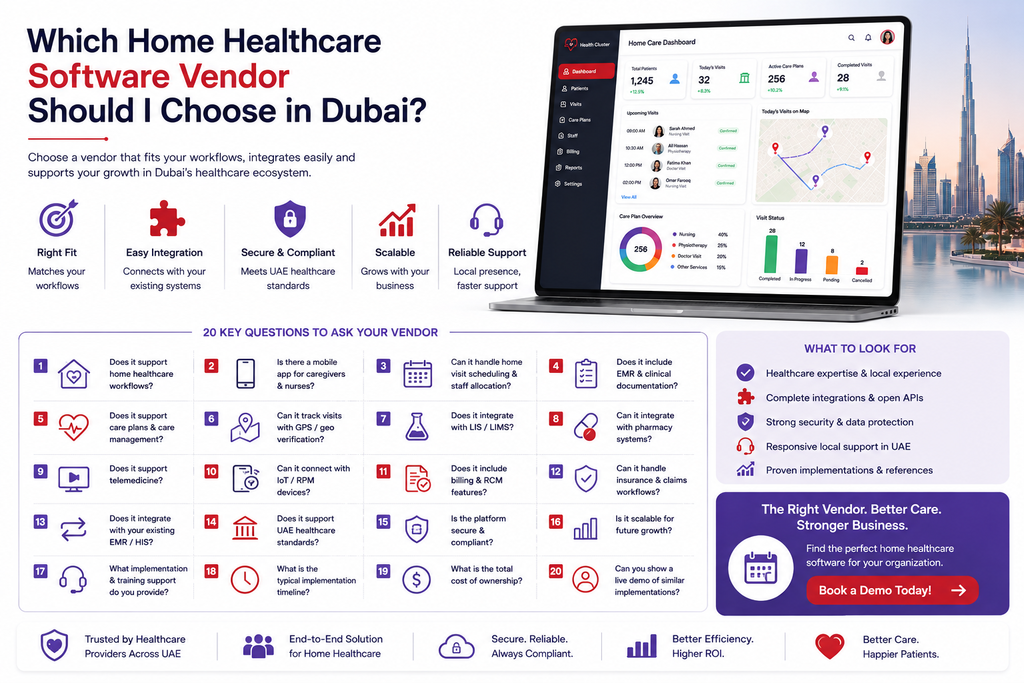
Choosing a vendor should be based on operational fit, healthcare functionality, integration capability, security, scalability, implementation experience, and local requirements.
Before selecting a platform, ask the vendor:
- Does it support home healthcare workflows?
- Does it include EMR functionality?
- Does it provide a nurse/doctor mobile application?
- Can it manage home visit scheduling?
- Can it assign staff based on availability and requirements?
- Does it support care plans?
- Can it capture clinical notes at the point of care?
- Can it integrate with LIS/LIMS?
- Can it integrate with pharmacy systems?
- Does it support billing and RCM?
- Can it support insurance workflows?
- Does it support telemedicine?
- Can it connect with IoT or RPM solutions?
- Does it support UAE healthcare interoperability requirements relevant to the organization?
- Is the platform scalable?
- What security controls are available?
- What implementation and support services are included?
- What is the expected implementation timeline?
- What are the licensing and integration costs?
- Can the vendor provide a live demonstration?
For Dubai healthcare providers, the best vendor is not necessarily the one with the longest feature list. It is the vendor that can demonstrate how its platform supports the organization’s actual patient journey, clinical workflows, operational model, integrations, compliance requirements, and growth strategy.
Home Healthcare Software for Clinics, Hospitals and Laboratories in Dubai
Home healthcare is increasingly becoming connected to the broader healthcare ecosystem.
For Clinics
Clinics can use home healthcare software to extend services beyond their facility.
Examples include:
- Doctor home visits
- Home nursing
- Physiotherapy
- Chronic care
- Post-operative care
- Home sample collection
- Follow-up services
For Hospitals
Hospitals can connect inpatient and outpatient care with home-based services.
A typical workflow can be:
Hospital Discharge → Home Care Referral → Assessment → Care Plan → Home Visit → Clinical Monitoring → Physician Follow-Up
This can support continuity of care after discharge.
For Laboratories
Diagnostic laboratories can use connected home healthcare workflows for home sample collection.
A typical workflow can be:
Patient → Lab Order → Home Collection Appointment → Phlebotomist Assignment → Sample Collection → LIS → Result → Patient/Physician
This can help laboratories expand their service model beyond the physical laboratory.
Why IoT Matters for Home Healthcare in Dubai
IoT can make home healthcare more proactive.
Instead of relying entirely on manually reported patient information, connected devices can capture relevant measurements and transmit them to a healthcare platform where appropriate.
A potential model is:
Patient → Connected Medical Device → IoT Layer → Healthcare Platform → Clinical Dashboard → Alert → Care Team
For example, a remote patient monitoring program could capture selected vital measurements and make them available to authorized healthcare professionals.
This can support care models for patients who require ongoing monitoring.
However, IoT implementation should be designed around clinical requirements, device interoperability, cybersecurity, patient consent, data governance, and applicable UAE regulations.
Home Healthcare Software in Dubai
What is the best home healthcare software in Dubai?
The best platform depends on the provider’s services, patient volume, staff size, clinical workflows, integrations, and regulatory requirements. A healthcare organization should evaluate the software through a workflow-based demonstration rather than relying only on feature lists.
Does home healthcare software support nurse scheduling?
Yes. Modern platforms can support nurse scheduling, staff allocation, appointment management, visit status tracking, and mobile access. Advanced implementations can also consider staff skills, availability, location, and service requirements.
Can home healthcare software integrate with an EMR?
Yes. Depending on the platform and integration architecture, home healthcare software can exchange relevant patient and clinical information with an existing EMR/HIS.
Can laboratories use home healthcare software?
Yes. Laboratories can use home healthcare workflows for services such as home sample collection, phlebotomist scheduling, sample tracking, and integration with LIS/LIMS.
Does home healthcare software support mobile applications?
Modern solutions commonly provide mobile functionality for field staff so nurses, doctors, physiotherapists, and caregivers can access assigned visits and document care at the point of service.
Can home healthcare software support billing?
Yes. Depending on the solution, it can connect completed services and documentation with billing, payment, insurance, and revenue cycle workflows.
Is home healthcare software suitable for hospitals?
Yes. Hospitals can use it to manage post-discharge care, home nursing, home physiotherapy, chronic disease programs, remote monitoring, and other home-based services.
Can home healthcare software support UAE healthcare requirements?
It can support relevant UAE healthcare workflows and integrations, but requirements vary by organization, facility type, service scope, and emirate. Providers should confirm the exact regulatory and interoperability requirements applicable to their operation.
The Future of Home Healthcare in Dubai
The future of home healthcare is moving toward a connected care model.
Instead of treating home healthcare as a separate service, healthcare organizations can connect:
Hospital + Clinic + Home Healthcare + Laboratory + Pharmacy + Telemedicine + Remote Monitoring + RCM
This creates a more unified digital healthcare ecosystem.
Artificial intelligence, mobile healthcare applications, IoT devices, remote patient monitoring, digital documentation, predictive analytics, and automated scheduling can further improve how healthcare organizations deliver services outside traditional facilities.
For Dubai healthcare providers, this creates an opportunity to build scalable home-based care models while improving operational visibility and patient engagement.
Why Health Cluster for Home Healthcare in Dubai UAE?
Health Cluster can provide a broader digital healthcare ecosystem for organizations that need to connect home healthcare with clinical, operational, laboratory, pharmacy, billing, and other healthcare workflows.
Depending on the organization’s requirements, the platform can support areas such as:
- HIS/EMR
- Patient management
- Home healthcare
- Doctor mobile applications
- Nurse/caregiver workflows
- Scheduling
- LIS/LIMS
- Pharmacy
- Billing
- RCM
- Telemedicine
- Remote patient monitoring
- Inventory
- Reporting and dashboards
- Healthcare integrations
This approach allows a clinic, hospital, laboratory, or healthcare group to build home healthcare capabilities without creating another isolated technology environment.
Book a Home Healthcare Software Demo in Dubai
If your clinic, hospital, laboratory, medical center, or healthcare group operates in Dubai and you are planning to digitize home healthcare services, the next step should be a workflow-based software demonstration.
Instead of simply reviewing a feature list, evaluate how the platform handles your actual workflow:
Patient → Referral → Registration → Assessment → Care Plan → Scheduling → Staff Assignment → Home Visit → Mobile Documentation → Laboratory/Pharmacy → Billing → Insurance → Follow-Up → Analytics
A tailored demonstration can help your team evaluate the platform against your operational, clinical, financial, integration, and scalability requirements.
Looking for home healthcare software for Dubai UAE? Book a Health Cluster demo and see how an integrated healthcare platform can help your organization manage patients, staff, home visits, clinical documentation, integrations, billing, and reporting from one connected ecosystem.
