
Healthcare in Bahrain is built around patient safety, quality, and clear regulatory standards. For hospitals, clinics, medical centers, laboratories, dental facilities, and healthcare professionals, understanding the rules is an important part of running a safe healthcare service.
At the center of this system is the National Health Regulatory Authority Bahrain, commonly known as NHRA Bahrain.
NHRA is responsible for regulating healthcare services and professionals in the Kingdom of Bahrain. It plays an important role in licensing, quality, safety, accreditation, and healthcare regulation.
For healthcare providers in Manama and across Bahrain, NHRA compliance is more than having a license. It also involves meeting the required standards and maintaining safe and effective healthcare operations.
Digital healthcare is now an important part of this process. Modern EMR, HIS, LIS, pharmacy software, dental software, RCM, and patient engagement tools can help healthcare organizations manage their daily workflows and maintain better records.
This guide explains what NHRA Bahrain is, what it regulates, how licensing works, and how healthcare technology can support compliance.
What Is NHRA Bahrain?
NHRA Bahrain stands for the National Health Regulatory Authority.
It is the national regulatory body responsible for regulating healthcare professions and health services in Bahrain. Its work covers both healthcare professionals and healthcare facilities.
NHRA’s responsibilities include licensing healthcare professionals and facilities, issuing regulations and decisions, monitoring and evaluating healthcare facilities, and supporting healthcare quality and safety. It also has responsibilities related to healthcare informatics, medical devices, clinical trials, and medicines.
In simple terms, NHRA helps make sure that healthcare providers meet the standards required to deliver safe and acceptable healthcare services in Bahrain.
What does NHRA stand for in Bahrain?
NHRA stands for National Health Regulatory Authority.
The authority is commonly referred to as NHRA Bahrain because it regulates healthcare services within the Kingdom of Bahrain.
What is the role of NHRA in Bahrain?
The role of NHRA includes:
- Healthcare licensing: NHRA grants and renews licenses for healthcare facilities and professionals.
- Regulation: It develops regulations and requirements for healthcare services.
- Quality and safety: It establishes standards to support safe and high-quality care.
- Facility monitoring: Healthcare facilities can be evaluated and assessed against applicable standards.
- Professional regulation: Healthcare professionals must meet applicable registration and licensing requirements.
- Healthcare informatics: NHRA has responsibilities related to the use of healthcare information systems.
NHRA also publishes standards and guidance to help healthcare organizations understand and meet regulatory expectations.
What Does NHRA Regulate in Bahrain?
NHRA regulation covers several areas of the healthcare sector.
This includes healthcare facilities, healthcare professionals, quality and safety, accreditation, medicines, medical devices, and other regulated healthcare services.
The exact requirements depend on the type of facility, service, and professional role.
Healthcare facilities can include:
- Hospitals
- Medical centers
- Clinics
- Dental centers
- Dental clinics
- Laboratories
- Radiology centers
- Physiotherapy facilities
- Rehabilitation centers
- Telemedicine facilities
- Other specialized healthcare facilities
NHRA’s published material shows that Bahrain has different facility classifications and licensing categories. This means a healthcare organization should identify its correct facility type before starting the licensing process.
NHRA Bahrain Licensing Requirements
NHRA Bahrain licensing is a key requirement for healthcare organizations operating in the Kingdom.
The licensing process can vary based on the type of healthcare facility or professional.
For healthcare facilities, the process is designed to establish whether the facility meets the required licensing rules and standards. NHRA guidance states that the purpose of the process is to register and license facilities and ensure they continue to meet the requirements needed to retain their license.
Healthcare providers should therefore consider licensing as an ongoing responsibility.
Getting an NHRA facility license is only one part of compliance. The organization must continue to meet the applicable standards during its operations.
How to get an NHRA license in Bahrain
The exact NHRA licensing process depends on the service and facility type.
In general, healthcare organizations should:
- Identify the correct healthcare facility classification.
- Review the applicable NHRA requirements and standards.
- Prepare the required documents.
- Submit the relevant application.
- Complete the required assessments or inspections.
- Address any identified gaps.
- Obtain the applicable license.
- Maintain compliance after licensing.
Healthcare organizations should always check the latest NHRA guidance before submitting an application because requirements and procedures can change.
NHRA Professional Licensing in Bahrain
NHRA also regulates healthcare professionals working in Bahrain.
This includes professionals such as doctors, dentists, nurses, pharmacists, and other healthcare professionals.
The NHRA Bahrain professional license process requires applicants to meet the applicable education, experience, documentation, and licensing requirements.
For example, NHRA’s current government service information for new health professional licenses lists requirements such as an application, CV, qualification documents, verification reports, professional license documents where applicable, good conduct documentation, identification, photograph, and health fitness certification. Certain applicants may also need to pass a licensing examination.
This means healthcare professionals should understand the requirements for their specific profession before applying.
NHRA license for doctors, nurses, and pharmacists
NHRA professional licensing applies to several healthcare professions.
Depending on the profession and applicant category, the process may include document verification and an examination.
Current examination information identifies medical practitioners, dental practitioners, nurses, and pharmacists among professions that may require Bahrain licensure examinations.
The requirements can differ by profession, experience, nationality, and other factors.
For this reason, applicants should use the latest NHRA requirements for their specific professional category.
NHRA Compliance for Hospitals and Clinics
Getting an NHRA license does not mean that compliance ends.
NHRA compliance for hospitals and clinics is an ongoing process.
Healthcare facilities need to maintain the required standards for quality, safety, risk management, clinical services, staffing, documentation, and other areas that apply to their facility type.
NHRA quality and safety guidance explains that licensing standards provide common requirements for healthcare service providers and are intended to support safe and acceptable-quality healthcare.
For hospitals, NHRA accreditation and licensing standards also cover core elements of care and can support inspection and audit preparation.
What are the NHRA requirements for healthcare facilities?
Requirements can vary based on the facility and service.
However, healthcare organizations should pay close attention to:
- Patient safety: Processes should support safe care and reduce avoidable risks.
- Clinical documentation: Patient information should be complete, accurate, and available to authorized users.
- Staffing: Healthcare professionals must meet applicable licensing requirements.
- Quality management: Facilities should have processes for monitoring and improving care.
- Risk management: Risks should be identified, assessed, and managed.
- Policies and procedures: Staff should have clear processes for key healthcare activities.
- Records: Healthcare records should be properly maintained and protected.
- Facility standards: The physical and operational environment must meet applicable requirements.
The exact requirements should always be checked against the latest NHRA standards for the specific facility.
NHRA Healthcare Standards and Quality
Healthcare regulation is not only about paperwork.
The purpose is to support safer care and better outcomes.
NHRA’s quality, safety, and risk management guidance states that maintaining healthcare quality requires continuous improvement across healthcare organizations.
This makes healthcare quality standards Bahrain an important part of the wider compliance picture.
Hospitals and clinics should build systems that help staff identify issues, document actions, track performance, and improve processes over time.
Digital systems can support this work by creating more structured and accessible records.
How Does Healthcare Software Support NHRA Compliance?
Healthcare software does not replace NHRA compliance.
Instead, it can help healthcare organizations manage the processes that support compliance.
A modern healthcare platform can bring clinical, administrative, financial, laboratory, pharmacy, and patient communication workflows together.
Important systems can include:
EMR Software
An EMR helps healthcare providers maintain electronic medical records.
Doctors and authorized healthcare staff can document consultations, diagnoses, clinical notes, medications, allergies, investigations, and other patient information within a structured digital workflow.
A good EMR can also improve record access and reduce reliance on paper files.
For healthcare providers evaluating EMR software Bahrain, compliance, security, access control, auditability, and data management should be important considerations.
HIS Software
A Hospital Information System (HIS) manages broader hospital and healthcare workflows.
Depending on the solution, this can include registration, appointments, admissions, clinical workflows, billing, pharmacy, laboratory services, reporting, and other operations.
An integrated HIS can reduce the need to enter the same information into multiple systems.
This can improve data consistency and operational visibility.
LIS
A Laboratory Information System (LIS) supports laboratory workflows.
It can manage areas such as test orders, specimen information, results, validation, reporting, and laboratory operations.
When LIS and EMR systems are connected, authorized clinical teams can access laboratory results as part of the patient’s wider digital record.
This creates a more connected healthcare information system.
Pharmacy Software
Pharmacy software can support prescriptions, dispensing, medication records, inventory, and other pharmacy workflows.
When pharmacy management is connected to the EMR or HIS, healthcare teams can work with more consistent patient and medication information.
This can also reduce duplicate data entry.
Dental Software
Dental facilities have specialized clinical workflows.
Dental software Bahrain can support dental patient records, treatment plans, dental examinations, procedures, appointments, billing, and other dental practice workflows.
Connecting dental workflows with a broader healthcare platform can help organizations maintain a more complete view of patient care.
Revenue Cycle Management
Revenue Cycle Management (RCM) supports the financial side of healthcare.
It can cover registration, billing, coding, insurance workflows, claims, payments, and receivables.
An integrated RCM solution can connect financial workflows with clinical services.
This can help reduce manual work and improve billing visibility.
Why EMR and HIS Integration Matters
Healthcare organizations rarely operate with one system.
A hospital may use:
EMR + HIS + LIS + Pharmacy + RCM + Appointment Management + Patient Engagement
When these systems work together, information can move through the healthcare workflow with less manual entry.
For example:
A patient registers → sees a doctor → receives a laboratory order → completes the test → receives a result → receives a prescription → completes payment.
An integrated healthcare system can connect these steps.
This is especially useful for larger hospitals and healthcare groups in Bahrain.
WhatsApp Chatbot for Healthcare in Bahrain
Patient communication is another area where healthcare technology is changing.
A WhatsApp Chatbot Bahrain solution can provide patients with a familiar way to interact with hospitals and clinics.
Depending on the implementation, a WhatsApp healthcare chatbot can support:
- Appointment requests
- Appointment confirmations
- Appointment reminders
- Clinic information
- Doctor and department information
- Patient registration support
- General administrative questions
- Follow-up communication
The chatbot should not replace doctors or make clinical decisions.
Its main role should be to automate suitable communication and administrative workflows.
WhatsApp Chatbot EMR and HIS Integration
The value of a chatbot increases when it can connect with healthcare systems.
A typical architecture can look like:
Patient → WhatsApp → Chatbot → Integration/API → EMR or HIS
The chatbot handles the conversation.
The integration layer connects the conversation to the relevant workflow.
The EMR or HIS remains the core healthcare system.
For example, a patient in Manama may send a WhatsApp message asking for a dermatology appointment.
The chatbot can identify the request and, where the system is configured for it, connect the patient with the appointment workflow.
This approach can reduce manual appointment requests and create a smoother patient journey.
Health Cluster’s Bahrain healthcare technology offering includes EMR, HIS, dental solutions, appointment management, and other digital healthcare capabilities. Its WhatsApp chatbot approach is designed to connect patient communication with healthcare systems such as EMR, HIS, appointment systems, and other platforms through suitable integrations.
Healthcare Data Management and NHRA Compliance
Healthcare organizations manage sensitive patient information every day.
This makes healthcare data management Bahrain an important consideration.
A healthcare system should provide suitable controls for:
- Access control: Users should only access information needed for their role.
- Authentication: Systems should verify authorized users.
- Audit trails: Important system activity should be traceable.
- Data protection: Patient information should be protected during storage and transfer.
- Secure integrations: APIs and system connections should be properly protected.
- Record management: Patient records should remain accurate and accessible to authorized users.
NHRA’s strategic material specifically identifies healthcare informatics among its responsibilities.
For this reason, healthcare organizations should consider technology and compliance together.
NHRA Bahrain and Digital Healthcare
Bahrain’s healthcare sector is moving toward more connected digital services.
The Ministry of Health’s I-SEHA system is part of Bahrain’s National Health Information Program and provides digital healthcare services, including online appointments and patient information services.
This wider digital environment increases the importance of connected healthcare systems.
Hospitals and clinics need technology that can support clinical work while also helping staff manage administrative and operational processes.
This is where modern healthcare management software can provide value.
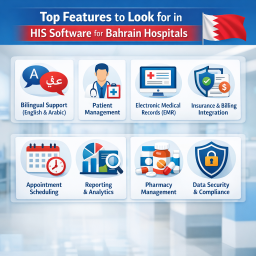
What Should Hospitals Look for in Healthcare Software in Bahrain?
Healthcare providers should not select software based only on the number of features.
The system should fit the organization’s workflows and regulatory environment.
Key areas to evaluate include:
- Integrated EMR and HIS: The clinical record and hospital workflows should work together.
- LIS integration: Laboratory orders and results should connect with clinical workflows.
- Pharmacy management: Prescriptions, dispensing, and inventory should be managed efficiently.
- RCM: Billing, insurance, claims, and financial workflows should be connected.
- Dental workflows: Dental facilities should have tools designed for their specific clinical needs.
- Patient engagement: Appointment and communication tools can improve the patient journey.
- WhatsApp integration: Where appropriate, patient communication can be connected with approved workflows.
- Security: Access control, authentication, audit trails, and data protection should be considered.
- Reporting: Management should have clear operational and performance information.
- Scalability: The system should support future services, users, branches, and integrations.
The right solution depends on the healthcare provider’s size, services, workflows, and technology environment.
How Health Cluster Supports Healthcare Providers in Bahrain
Health Cluster provides a connected digital healthcare platform for hospitals, clinics, medical centers, dental practices, laboratories, and other healthcare organizations.
Its Bahrain offering includes EMR, HIS, dental software, doctor mobile applications, appointment management, billing, and other healthcare technology capabilities.
The wider Health Cluster ecosystem also brings together:
- EMR and EHR: Digital patient records and clinical documentation.
- HIS: Hospital-wide clinical, administrative, and operational workflows.
- LIS: Laboratory orders, results, and laboratory workflows.
- Pharmacy: Prescription, dispensing, and medication management.
- RCM: Billing, claims, payments, and revenue cycle workflows.
- Dental software: Specialized workflows for dental practices.
- WhatsApp chatbot: Patient communication and selected automated workflows.
- Telemedicine: Support for virtual healthcare workflows.
- RPM: Support for remote patient monitoring.
- Doctor mobile app: Mobile access to relevant clinical workflows.
The advantage of an integrated platform is that these systems can work as parts of one healthcare ecosystem instead of isolated applications.
For a healthcare organization in Manama or elsewhere in Bahrain, this can support a more connected approach to digital transformation.
NHRA Bahrain Compliance: A Practical Checklist
Healthcare organizations can use a simple checklist when reviewing their compliance and technology environment:
- Is the facility correctly licensed?
- Are all relevant healthcare professionals properly licensed?
- Are current NHRA standards being followed?
- Are quality and patient safety processes documented?
- Are healthcare records accurate and protected?
- Are access rights controlled?
- Are important activities traceable through audit logs?
- Are clinical and administrative workflows properly documented?
- Are digital systems integrated where appropriate?
- Are staff trained to use the systems and follow required procedures?
- Is the organization prepared for inspection, assessment, or audit?
- Are regulatory requirements reviewed when NHRA guidance changes?
This checklist does not replace professional regulatory advice. Healthcare providers should always confirm current requirements directly with NHRA.
Frequently Asked Questions About NHRA Bahrain
What is NHRA Bahrain?
NHRA Bahrain is the National Health Regulatory Authority. It regulates healthcare professions and health services in the Kingdom of Bahrain. Its responsibilities include licensing, regulation, quality, safety, facility monitoring, and other healthcare regulatory activities.
Who needs an NHRA license in Bahrain?
Healthcare facilities and healthcare professionals that fall under NHRA regulation need the applicable license or registration. The exact requirements depend on the facility type, profession, and service.
How do I get an NHRA license in Bahrain?
The process depends on whether you are applying for a healthcare facility license or a professional license. Applicants should identify the correct category, review the current requirements, prepare documents, submit the application, and complete any required assessment or examination.
What are the NHRA licensing requirements?
NHRA licensing requirements vary by facility and professional category. They can include documents, qualifications, verification, experience, professional registration, facility requirements, inspections, and other applicable conditions. Always check the latest NHRA guidance for the specific application.
How does NHRA regulate hospitals and clinics?
NHRA regulates hospitals and clinics through licensing requirements, standards, assessments, quality and safety requirements, and other regulatory processes. NHRA’s published standards are designed to support safe and acceptable-quality healthcare.
What role does healthcare software play in NHRA compliance?
Healthcare software can support compliance by improving documentation, access control, record management, auditability, reporting, and workflow consistency. However, software alone does not guarantee NHRA compliance.
How can EMR software support healthcare compliance in Bahrain?
An EMR can help healthcare providers maintain structured electronic patient records, clinical documentation, medication information, and other healthcare data. It can also improve access to authorized patient information and support more consistent workflows.
What should hospitals look for in healthcare software in Bahrain?
Hospitals should look for integrated EMR and HIS capabilities, LIS and pharmacy integration, RCM, secure data management, reporting, audit trails, role-based access, patient engagement tools, scalability, and suitable integration capabilities.
Final Thoughts on NHRA Bahrain
NHRA Bahrain plays a central role in regulating healthcare services and professionals in the Kingdom.
For hospitals, clinics, medical centers, laboratories, dental facilities, and healthcare professionals, understanding NHRA Bahrain regulations, licensing requirements, healthcare standards, and compliance expectations is essential.
Compliance should not be treated as a one-time task.
It should become part of daily healthcare operations.
This is where the right digital healthcare technology can help.
An integrated platform can connect EMR, HIS, LIS, pharmacy software, dental software, RCM, appointments, and patient communication in one environment. It can help healthcare teams create better records, reduce duplicate work, improve workflow visibility, and support more consistent operations.
Health Cluster helps healthcare organizations build connected digital healthcare environments across Bahrain and the wider Middle East.
If your hospital, clinic, medical center, laboratory, or dental facility is planning its next digital transformation project, contact Health Cluster for a demo and learn more about EMR, HIS, LIS, pharmacy, dental, RCM, WhatsApp chatbot, and integrated healthcare software solutions for Bahrain.