

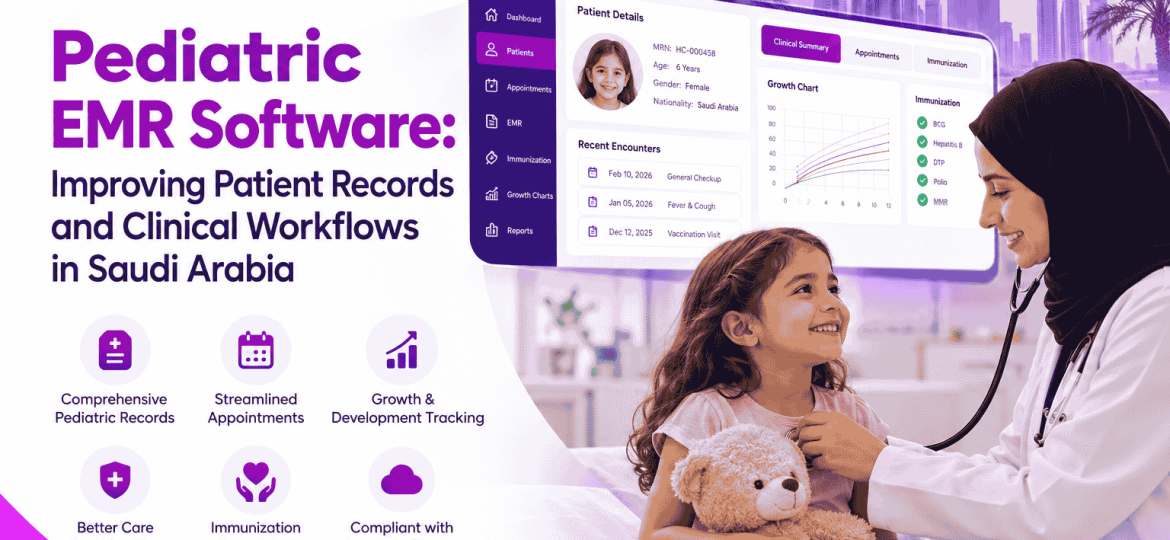
Healthcare providers in Saudi Arabia need reliable digital systems to manage patient information, coordinate clinical teams, and support efficient healthcare delivery. For specialized children’s hospitals and pediatric oncology departments, these requirements are particularly important because patients may need repeated consultations, laboratory investigations, diagnostic imaging, medication management, and long-term follow-up.
Pediatric EMR software in Saudi Arabia helps healthcare organizations maintain structured electronic medical records and connect relevant clinical workflows. For hospitals treating children with complex or chronic conditions, a suitable electronic medical record (EMR) system can help clinicians review patient histories, document treatment decisions, coordinate investigations, and maintain continuity of care.
However, choosing the right software requires more than replacing paper files with digital records. Hospitals must evaluate pediatric documentation, oncology-related workflows, system interoperability, patient data protection, implementation requirements, and integration with existing hospital information systems.
HealthCluster provides healthcare software solutions that bring together electronic medical records, hospital information systems, laboratory and pharmacy workflows, revenue cycle management, and healthcare integrations. Its platform can be evaluated by healthcare organizations looking to improve connected clinical operations in Saudi Arabia.
Challenges in Managing Pediatric Patient Records
Children’s healthcare involves different documentation requirements from adult medicine. Clinicians may need to review age-specific medical histories, allergies, previous medications, growth information, immunization records, diagnostic reports, and family or guardian details.
When information is distributed across paper records, spreadsheets, and disconnected software applications, retrieving a complete patient history can become time-consuming.
A well-designed pediatric electronic medical records system can help address these operational challenges.
Fragmented patient information
Pediatric patients may visit multiple departments throughout their care journey. Doctors, nurses, laboratory teams, pharmacists, and other authorized healthcare professionals may each need access to relevant information.
A centralized electronic patient record can help authorized users review available clinical documentation without repeatedly searching through separate files. The actual level of information sharing depends on system permissions and integration capabilities.
Complex and long-term treatment journeys
Children receiving specialist care may require repeated consultations, investigations, procedures, and follow-up appointments. Pediatric oncology can involve particularly complex care coordination between medical oncology, nursing, laboratory services, radiology, pharmacy, and other specialists.
Oncology software can help organize relevant patient histories, clinical notes, treatment documentation, investigation results, and follow-up information in a structured digital environment.
For specialized children’s centers, the important consideration is whether the EMR supports the organization’s actual clinical workflows rather than only basic registration and appointment scheduling.
Administrative workload and reporting
Manual documentation and duplicate data entry can create additional work for clinical and administrative teams. Disconnected systems can also make it harder to prepare accurate operational reports.
A children’s hospital management system can connect relevant registration, clinical documentation, scheduling, billing, and reporting workflows. The result depends on the implementation, staff adoption, data quality, and the capabilities of the selected software.
Essential Features of a Pediatric EMR System
When evaluating EMR software for specialized hospitals, healthcare organizations should assess both general clinical functionality and the specific workflows required by their pediatric departments.
Longitudinal patient records and growth history
Pediatric patient records should provide a structured view of relevant medical information over time.
Depending on the clinical requirements, a pediatric EMR may include:
- Patient demographics and guardian information.
- Medical history, allergies, diagnoses, and medication records.
- Previous consultations and clinical notes.
- Height, weight, and other relevant growth measurements.
- Immunization history and developmental documentation.
- Laboratory reports, imaging references, and referral information.
- Follow-up plans and appointment history.
For a child receiving ongoing specialist treatment, a longitudinal record helps authorized clinicians review previous assessments and understand the documented course of care.
Growth charts and developmental tracking should be verified during the vendor evaluation because not every general-purpose EMR provides these features natively.
Medication safety and clinical documentation
Medication management requires particular attention in pediatric care. Prescribing decisions can depend on age, weight, clinical condition, allergies, other medications, and the prescribed medicine’s characteristics.
A suitable system should support accurate medication documentation and allow authorized clinicians to review relevant patient information before making treatment decisions.
Hospitals should assess whether the software supports their required prescribing workflows, medication reconciliation, allergy documentation, clinical alerts, and pharmacy integration.
For pediatric oncology departments, the evaluation may also need to cover chemotherapy-related documentation, treatment protocols, dose verification processes, infusion scheduling, and monitoring requirements.
These are specialist capabilities. A hospital should not assume that a general pediatric EMR automatically provides a complete oncology treatment management system.
Clinical software should support qualified healthcare professionals, not replace clinical judgment. Any medication calculations, prescribing safeguards, and oncology workflows must be validated against the hospital’s approved clinical protocols.
Laboratory, pharmacy and diagnostic integration
Pediatric and oncology care often depends on investigations and coordinated diagnostic services.
When laboratory, pharmacy, radiology, and clinical systems operate independently, staff may need to retrieve results from multiple applications or enter information more than once.
An integrated EMR and hospital information system can help connect these workflows, subject to the interfaces and integrations available.
Important evaluation areas include:
- Laboratory orders and results.
- Pharmacy and medication workflows.
- Diagnostic imaging and radiology integration.
- Clinical referrals and consultation documentation.
- Appointment scheduling and follow-up coordination.
- Billing and insurance workflows.
- Operational reports and management dashboards.
For oncology services, hospitals should specifically verify whether the solution can support required treatment documentation and connect to existing laboratory, imaging, pharmacy, and specialist systems.
HealthCluster offers a broader healthcare software platform that includes EMR and HIS capabilities alongside laboratory information systems, pharmacy, revenue cycle management, and healthcare integrations. Hospitals can assess the suitability of these components against their own technical and clinical requirements.
Pediatric Oncology Software for Specialized Children’s Centers
Pediatric oncology introduces additional requirements because cancer treatment may involve several specialists, repeated diagnostic investigations, complex medication regimens, and extended follow-up.
Pediatric oncology software should be evaluated around the complete patient journey, from initial assessment and diagnosis documentation to treatment planning, monitoring, and subsequent consultations.
A hospital assessing oncology software should consider the following workflows:
1. Oncology patient records: Maintain organized histories, diagnoses, consultation notes, investigation results, medication records, and treatment-related documentation.
2. Multidisciplinary coordination: Help authorized members of oncology, nursing, laboratory, radiology, and pharmacy teams access relevant information through appropriate workflows and system integrations.
3. Treatment documentation: Support the recording of treatment plans, administered therapies, clinical observations, and follow-up instructions according to the hospital’s approved protocols.
4. Diagnostic monitoring: Make relevant laboratory results and imaging information accessible within the clinical workflow when supported integrations are available.
5. Follow-up management: Organize subsequent appointments, clinical assessments, and documented monitoring plans for patients receiving ongoing care.
6. Operational visibility: Provide authorized managers with relevant reporting on appointments, service utilization, documentation, and other supported operational measures.
When evaluating oncology software for a specialized children’s center, procurement teams should distinguish between a general EMR with oncology documentation and a dedicated oncology information system with advanced treatment planning or chemotherapy management.
That distinction matters. A vendor should demonstrate the exact capabilities required rather than rely on a broad claim that its platform supports oncology.
HealthCluster’s oncology EMR solution provides a starting point for reviewing its oncology-related healthcare software offering. A technical assessment should determine which workflows are available, which require configuration, and which depend on third-party integrations.
Data Security and Healthcare Interoperability in Saudi Arabia
Patient records contain sensitive health information. Children’s hospitals must consider confidentiality, authorized access, auditability, data availability, and the security of information exchanged between systems.
When evaluating Saudi Arabia healthcare software, organizations should review how the vendor addresses:
- Role-based access and user permissions.
- Authentication and account security.
- Audit logs and monitoring.
- Backup, recovery, and business continuity.
- Data hosting, residency, and access arrangements.
- Secure information exchange with connected systems.
- Implementation responsibilities and ongoing technical support.
The hospital should also assess applicable Saudi legal and regulatory obligations, including the Personal Data Protection Law and relevant health data requirements. Compliance must be established for the actual deployment and use case, not inferred from the software’s marketing description.
EMR interoperability in Saudi Arabia
Interoperability is another important consideration for hospitals operating within a connected healthcare environment.
An EMR may need to exchange information with laboratory systems, pharmacy applications, billing platforms, insurance workflows, and other hospital information systems. Standards such as HL7 and FHIR can support structured healthcare information exchange, depending on the interfaces and implementation.
Saudi Arabia’s National Platform for Health Information Exchange Services, known as NPHIES, is an important part of the Kingdom’s health information and insurance services infrastructure. Hospitals should verify which NPHIES-related workflows apply to their organization and whether the proposed solution supports the required integration.
HealthCluster lists healthcare integration capabilities and Saudi-focused EMR and revenue cycle management workflows. Prospective customers should request technical documentation and confirmation of the specific integrations, certification status, and implementation scope relevant to their facility.
A successful EMR implementation depends on compatibility with the existing hospital environment, clear integration responsibilities, and testing before production deployment.
How to Evaluate an EMR for a Specialized Children’s Center
Selecting EMR software for specialized hospitals requires a structured assessment involving clinical, IT, operational, security, and procurement teams.
Begin by documenting the current workflow. Identify how patient registration, clinical documentation, investigations, prescriptions, referrals, billing, and follow-up are managed today. Record the most significant operational gaps and integration dependencies.
Next, define the required capabilities. Separate essential requirements from optional enhancements and specialist functions that may require dedicated oncology software.
Then evaluate shortlisted vendors against the same criteria.
Clinical suitability: Can the system demonstrate the required pediatric records, clinical documentation, and specialist workflows?
Oncology suitability: Can it support the hospital’s required treatment documentation and integrations, and does it provide any advanced oncology functionality the clinical team needs?
Technical compatibility: Can it connect with existing HIS, laboratory, pharmacy, radiology, and other required systems?
Saudi requirements: Can the vendor document its approach to applicable data protection, interoperability, insurance, and regulatory requirements?
Implementation: What are the timelines, migration approach, training requirements, support arrangements, and responsibilities of each party?
Total cost of ownership: What are the licensing, implementation, integration, infrastructure, training, and ongoing support costs?
Finally, request a demonstration using representative workflows and sample data rather than real patient information. Ask the vendor to show how a clinician would retrieve a patient history, document a consultation, review an investigation, coordinate a follow-up, and complete the required administrative steps.
Questions to Ask Before Selecting an EMR Vendor
Before purchasing EMR software for a specialized children’s center, ask the vendor:
- Does the platform support the clinical documentation and patient record workflows required by our pediatric departments?
- Which pediatric growth, immunization, and developmental features are available?
- What oncology-related workflows are available natively, and which require configuration or additional software?
- Can the solution integrate with our existing laboratory, pharmacy, radiology, and hospital information systems?
- Which HL7, FHIR, NPHIES, or other interfaces are supported, and what are their implementation requirements?
- How are patient data access, audit logs, backups, and recovery managed?
- What documentation is available to demonstrate applicable Saudi regulatory and data protection requirements?
- What are the deployment options, implementation timeline, training plan, and ongoing support arrangements?
- What are the complete implementation and recurring costs?
- Can our clinical and IT teams participate in a tailored demonstration and technical assessment before procurement?
These questions help healthcare organizations compare vendors on practical requirements rather than feature lists alone.
Book a Pediatric EMR Software Demo
Choosing an electronic medical record system is an important operational and clinical decision for any specialized children’s hospital. The right solution should fit the organization’s existing systems, clinical workflows, information security requirements, and long-term digital health strategy.
HealthCluster provides healthcare software capabilities covering EMR, HIS, laboratory and pharmacy workflows, revenue cycle management, and healthcare integrations. Healthcare organizations can review the available capabilities and discuss their requirements with the HealthCluster team.
Whether your priority is improving pediatric patient records, connecting clinical departments, reviewing oncology documentation workflows, or evaluating interoperability with existing hospital systems, a requirements-led demonstration can help determine whether the platform is suitable for your organization.
Modernize Pediatric Care with the Right EMR Solution
Explore how an electronic medical record system can support pediatric clinical documentation, patient history management, and connected healthcare workflows.
Request an EMR Demo to discuss your organization’s clinical and technical requirements.
