

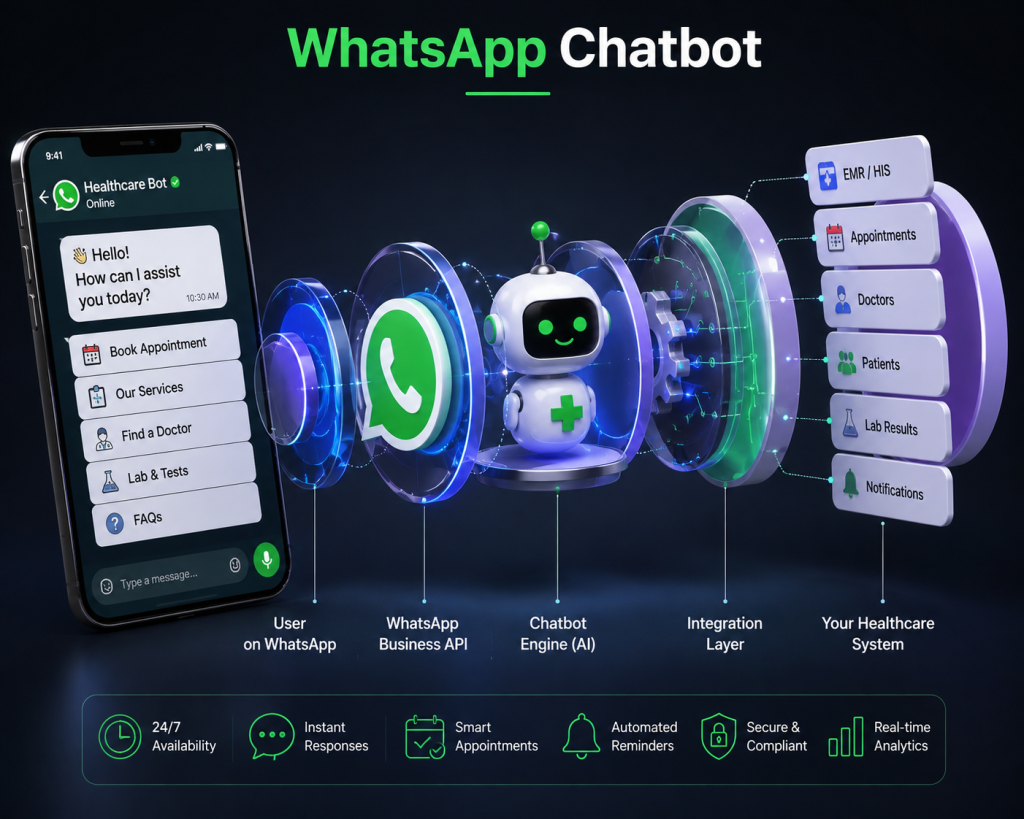
Healthcare providers across the UAE, Saudi Arabia, and GCC are moving toward digital-first patient engagement. Patients increasingly expect fast appointment booking, instant answers, convenient reminders, and simple communication without waiting on a call center.
A WhatsApp chatbot for healthcare providers can help clinics, hospitals, medical centers, diagnostic laboratories, and telemedicine providers automate these interactions through a familiar messaging channel.
Instead of relying entirely on receptionists and call centers, healthcare organizations can use a WhatsApp chatbot to support appointment booking, patient inquiries, reminders, rescheduling, follow-ups, FAQs, and lead conversion.
For healthcare organizations in Dubai, Abu Dhabi, Riyadh, Jeddah, Dammam, Sharjah, Doha, Kuwait City, Muscat, and other GCC markets, the opportunity is to make patient communication faster while keeping workflows connected to the organization’s healthcare systems and privacy requirements.
What Is a WhatsApp Chatbot for Healthcare?
A WhatsApp healthcare chatbot is an automated conversational system that communicates with patients through WhatsApp.
Depending on its configuration and integrations, the chatbot can help patients:
- Find a doctor or specialty
- Check clinic information
- Request or book an appointment
- Select an available date and time
- Receive appointment confirmations
- Reschedule or cancel appointments
- Receive appointment reminders
- Ask frequently asked questions
- Request directions and facility information
- Receive pre-visit instructions
- Connect with a receptionist when human assistance is required
- Receive post-visit follow-up messages
- Provide patient feedback
An advanced chatbot can connect with an EMR, HIS, appointment management system, CRM, or patient engagement platform so that conversations are connected to operational workflows rather than functioning as an isolated messaging tool.
Why Healthcare Providers in the UAE and Saudi Arabia Need WhatsApp Automation
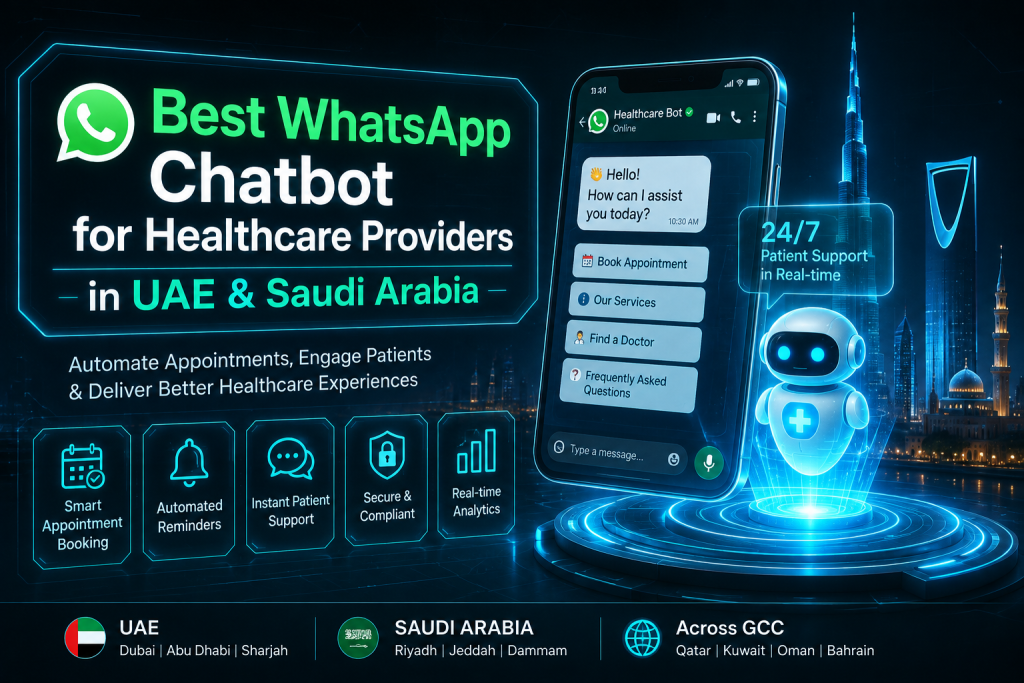
Patient communication can become difficult as healthcare organizations grow.
A clinic may receive hundreds of questions about:
- Doctor availability
- Appointment times
- Consultation fees
- Insurance
- Clinic timings
- Locations
- Specialties
- Laboratory services
- Telemedicine
- Follow-up appointments
When every interaction requires staff intervention, response times increase and administrative workloads grow.
A healthcare WhatsApp chatbot can automate repetitive conversations while allowing staff to focus on interactions that genuinely require human involvement.
Key advantages include:
- 24/7 patient communication
- Faster appointment conversion
- Automated appointment reminders
- Reduced administrative workload
- Improved patient experience
- Arabic and English communication
- Automated follow-ups
- Integration with healthcare systems
- Centralized patient communication
- Conversation and conversion analytics
How a Healthcare WhatsApp Chatbot Works
A typical patient journey can look like this:
Patient → WhatsApp → Chatbot → Patient Details → Specialty → Doctor → Available Slot → Appointment Confirmation → Reminder → Follow-Up
Step 1: Patient Starts a Conversation
The patient opens WhatsApp and starts a conversation with the healthcare provider.
The chatbot can immediately present options such as:
- Book Appointment
- Find a Doctor
- Our Services
- Clinic Locations
- My Appointment
- Contact Support
- Frequently Asked Questions
Step 2: Patient Selects a Service
For example, a patient may select:
Book Appointment → Dermatology → Doctor → Location → Date → Available Time
The chatbot can guide the patient through the process without requiring a phone call.
Step 3: Appointment Availability
When integrated with the healthcare provider’s scheduling system, the chatbot can retrieve relevant appointment availability and help the patient select an appropriate slot.
This can reduce manual scheduling and help minimize booking errors.
Step 4: Appointment Confirmation
After the booking workflow is completed, the patient can receive confirmation containing relevant appointment information such as:
- Doctor
- Specialty
- Facility
- Date
- Time
- Appointment type
- Location
- Preparation instructions
Step 5: Automated Reminders
The chatbot can send scheduled reminders before the appointment.
Patients can potentially be offered options such as:
Confirm | Reschedule | Cancel
This creates a more convenient patient journey and gives the provider an opportunity to manage appointment capacity more efficiently.
Step 6: Post-Visit Engagement
After the appointment, automated workflows can support:
- Patient feedback
- Follow-up reminders
- Future appointment requests
- Satisfaction surveys
- General service information
For clinical advice, diagnosis, treatment recommendations, or other medical decisions, the chatbot should route the patient to an appropriately qualified healthcare professional rather than presenting automated responses as medical advice.
Top Use Cases for WhatsApp Chatbots in Healthcare
1. WhatsApp Appointment Booking
One of the strongest use cases is WhatsApp appointment booking for healthcare.
Patients can search for a specialty, select a doctor, view available appointment options, and receive confirmation through the same conversation.
This can be particularly useful for:
- Multispecialty clinics
- Hospitals
- Dental clinics
- Dermatology clinics
- Physiotherapy centers
- Medical centers
- Diagnostic laboratories
- Telemedicine providers
2. Appointment Rescheduling and Cancellation
Patients frequently need to change appointments.
Instead of calling reception, they can use WhatsApp to request:
Reschedule Appointment
The chatbot can guide them through available options and trigger the appropriate scheduling workflow.
3. Appointment Reminders
Automated reminders can help healthcare providers maintain communication with patients before scheduled visits.
A reminder workflow may include:
Appointment Tomorrow → Reminder → Confirmation → Reschedule Option
This creates a proactive patient communication process rather than relying entirely on manual calls.
4. Patient FAQs
Healthcare providers receive many repetitive questions.
A WhatsApp chatbot can answer approved FAQs about:
- Clinic timings
- Doctor availability
- Locations
- Specialties
- Services
- Insurance information
- Payment methods
- Laboratory services
- Telemedicine
- Parking
- General preparation instructions
5. Doctor and Specialty Discovery
Patients often know the problem they want addressed but do not know which specialist to select.
A chatbot can help them navigate categories such as:
Medical Specialty → Doctor → Location → Appointment
This can simplify patient discovery and improve conversion from inquiry to appointment.
6. Diagnostic and Laboratory Services
Diagnostic centers can use WhatsApp automation for operational communication such as:
- Test appointment requests
- Laboratory location information
- Preparation instructions
- Appointment reminders
- Collection instructions
- Status notifications
- General report availability notifications
Sensitive clinical information should only be handled through workflows designed to meet applicable privacy, security, consent, and access-control requirements.
7. Telemedicine Appointment Booking
Telemedicine providers can use WhatsApp as an entry point for virtual-care scheduling.
A typical workflow could be:
WhatsApp → Select Specialty → Select Doctor → Select Virtual Consultation → Choose Slot → Confirmation
The chatbot can then provide the appropriate instructions for joining the consultation.
WhatsApp Chatbot for Healthcare in the UAE
Healthcare organizations in Dubai, Abu Dhabi, Sharjah, and other UAE markets can use conversational automation to simplify patient communication and appointment workflows.
However, healthcare chatbot implementation should not be treated simply as a marketing automation project.
Healthcare organizations need to consider:
- Patient privacy
- Data protection
- Access controls
- Consent
- Secure integrations
- Auditability
- Data retention
- Interoperability
- Applicable UAE healthcare regulations
UAE digital-health policy emphasizes secure handling of patient and personal data, confidentiality, cybersecurity, and interoperable digital-health infrastructure.
Therefore, a healthcare WhatsApp solution should be designed as part of the provider’s broader digital health and information-security architecture.
WhatsApp Chatbot for Healthcare in Saudi Arabia
For healthcare providers in Riyadh, Jeddah, Dammam, Al Khobar, Medina, and other Saudi cities, WhatsApp automation can support appointment management, patient communication, FAQs, reminders, and digital engagement.
Saudi healthcare organizations must also consider the country’s personal-data requirements.
Saudi Arabia’s Personal Data Protection Law defines health data as personal data related to an individual’s health condition or healthcare services. The framework also establishes additional requirements for protecting health data and limiting access and processing appropriately.
This means healthcare providers should evaluate chatbot architecture, integrations, data flows, access permissions, processing purposes, and third-party processors before deploying patient-facing automation.
WhatsApp Healthcare Automation for KSA Hospitals
A hospital chatbot can support multiple departments and patient journeys.
For example:
Patient → WhatsApp → Outpatient Appointment → Specialty → Doctor → Slot → Confirmation
Other workflows may include:
- OPD appointment requests
- Follow-up appointment reminders
- Laboratory appointment requests
- Teleconsultation scheduling
- Hospital location information
- Doctor information
- General patient FAQs
- Patient support escalation
For more complex workflows, the chatbot can hand the conversation to a receptionist, call-center agent, or appropriate healthcare staff member.
WhatsApp Chatbot Features Healthcare Providers Should Look For
Not every WhatsApp chatbot is suitable for healthcare.
When evaluating a solution, healthcare organizations should consider the following capabilities.
1. WhatsApp Business Integration
The platform should support an appropriate WhatsApp Business integration and approved messaging workflows.
2. EMR/HIS Integration
The chatbot should be capable of connecting with relevant healthcare systems rather than operating as a completely disconnected tool.
3. Real-Time Appointment Integration
Appointment workflows should be synchronized with the provider’s scheduling environment to reduce duplicate bookings and outdated availability.
4. Arabic and English Support
Bilingual communication is particularly valuable for healthcare organizations serving diverse GCC patient populations.
5. Human Handover
Patients should be able to reach a human representative when the automated workflow cannot resolve their request.
6. Role-Based Access
Healthcare organizations should control which users can access patient-related information.
7. Auditability
Organizations should be able to understand relevant actions, changes, and system activity.
8. Analytics Dashboard
Important metrics may include:
- Conversations started
- Appointment requests
- Completed bookings
- Booking conversion rate
- Rescheduling requests
- Cancellation requests
- Human handovers
- Response times
- Patient engagement
9. Secure API Architecture
Healthcare integrations should use appropriate authentication, authorization, encryption, monitoring, and data-minimization practices.
10. Scalable Multi-Branch Support
Healthcare groups with multiple clinics should be able to manage locations, specialties, doctors, and appointment workflows centrally.
AI WhatsApp Chatbot vs Traditional WhatsApp Automation
There is an important difference between basic automation and an AI-powered healthcare chatbot.
| Capability | Basic WhatsApp Automation | AI Healthcare Chatbot |
|---|---|---|
| Appointment booking | Yes | Yes |
| Fixed FAQs | Yes | Yes |
| Menu navigation | Yes | Yes |
| Natural-language questions | Limited | Advanced |
| Contextual conversations | Limited | Advanced |
| Arabic/English conversations | Depends on configuration | Can support both |
| Human handover | Yes | Yes |
| EMR/HIS integration | Depends on platform | Depends on platform |
| Analytics | Basic to advanced | Advanced |
| Complex patient journeys | Limited | More flexible |
AI can make conversations more natural, but healthcare organizations should maintain clear boundaries around clinical advice, sensitive information, patient identity, and automated decision-making.
The goal should not be to replace healthcare professionals.
The goal is to automate repetitive communication while keeping clinical decisions with qualified professionals.
WhatsApp Chatbot and EMR/HIS Integration
The biggest opportunity comes when WhatsApp is connected to the healthcare provider’s core systems.
Instead of:
WhatsApp → Staff → Manual System Entry
the workflow can become:
WhatsApp → Chatbot → Healthcare Platform → Appointment → Confirmation
An integrated architecture can potentially connect conversational workflows with:
- EMR
- HIS
- Appointment scheduling
- CRM
- Patient portal
- Telemedicine
- LIS
- Billing
- Doctor directory
- Multi-branch management
This reduces repetitive data entry and creates a more connected patient journey.
How WhatsApp Chatbots Improve Patient Conversion
A healthcare lead can easily be lost when there is friction between inquiry and appointment.
For example:
Patient Inquiry → Waiting for Call → No Response → Lost Appointment
A conversational workflow can reduce some of that friction:
Patient Inquiry → Instant Response → Select Service → Select Doctor → Select Slot → Appointment
Healthcare organizations can then measure the complete funnel.
Important conversion metrics include:
Inquiry → Appointment Request → Completed Booking → Attended Appointment
This gives healthcare marketers and administrators greater visibility into how patient inquiries translate into actual appointments.
How to Implement a WhatsApp Healthcare Chatbot
Step 1: Define Patient Journeys
Start by identifying the most common patient interactions.
For example:
- Appointment booking
- Appointment rescheduling
- Doctor search
- Clinic information
- FAQs
- Follow-up
- Telemedicine
Step 2: Identify Integration Requirements
Determine which systems the chatbot needs to communicate with.
This may include:
- EMR
- HIS
- Scheduling
- CRM
- Patient portal
- Telemedicine
- LIS
Step 3: Define Privacy and Security Requirements
Before collecting patient information, healthcare organizations should determine:
- What data is required?
- Why is it being collected?
- Where is it stored?
- Who can access it?
- How long is it retained?
- Which systems receive it?
- Which third parties process it?
For Saudi Arabia, healthcare providers should consider the PDPL and its implementing framework when designing health-data processing workflows.
Step 4: Build the Conversation Flow
Create clear pathways such as:
Book Appointment
→ Select Specialty
→ Select Doctor
→ Select Location
→ Select Date
→ Select Time
→ Confirm
Step 5: Add Human Escalation
Not every patient request should be automated.
Include clear escalation options such as:
Talk to Receptionist
or
Contact Support
Step 6: Test Before Launch
Test:
- Arabic conversations
- English conversations
- Appointment availability
- Duplicate booking scenarios
- Cancellation
- Rescheduling
- Human handover
- Invalid inputs
- API failures
- Authentication
- Privacy controls
Step 7: Monitor Performance
After launch, monitor the patient journey and optimize areas where users abandon conversations.
How Much Does a Healthcare WhatsApp Chatbot Cost?
The cost of a healthcare WhatsApp chatbot depends on the complexity of the implementation.
A basic chatbot may primarily handle:
- FAQs
- Clinic information
- Simple lead capture
An advanced healthcare solution may require:
- WhatsApp Business integration
- EMR/HIS integration
- Appointment scheduling
- Patient identification
- Arabic and English support
- AI capabilities
- Multi-location support
- Analytics
- Human handover
- Security controls
- Custom APIs
Therefore, healthcare organizations should evaluate total implementation requirements rather than choosing a chatbot based only on monthly subscription price.
WhatsApp Chatbot vs Call Center for Healthcare
| Factor | Traditional Call Center | WhatsApp Chatbot |
| Availability | Business hours or extended hours | Can support 24/7 automation |
| Appointment booking | Staff-dependent | Automated workflow |
| Repetitive FAQs | Manual | Automated |
| Scalability | Requires additional staff | Can handle more concurrent conversations |
| Patient convenience | Phone call required | Messaging-based |
| Analytics | Call-center dependent | Digital conversation analytics |
| Human interaction | High | Available when required |
| Integration | Depends on system | Can integrate through APIs |
The strongest strategy is not necessarily to replace call centers.
A better model is often:
Automation for repetitive tasks + Human support for complex requests.
Common Mistakes When Implementing Healthcare WhatsApp Bots
Mistake 1: Treating the chatbot as a standalone marketing tool
Healthcare chatbots deliver greater operational value when connected to real healthcare workflows.
Mistake 2: Collecting unnecessary patient information
Organizations should collect only the information necessary for the defined purpose and applicable requirements.
Saudi PDPL guidance emphasizes limiting personal-data collection to what is necessary for the specified purpose.
Mistake 3: No human escalation
Patients should not become trapped in an automated conversation.
Mistake 4: Using AI for clinical decisions
A chatbot should not present itself as a doctor or independently diagnose patients.
Mistake 5: Ignoring Arabic UX
For GCC healthcare providers, Arabic-language support should be considered at the beginning of the design rather than added as an afterthought.
Mistake 6: Measuring conversations instead of outcomes
The important question is not simply:
How many WhatsApp conversations did we receive?
It is:
How many qualified conversations resulted in completed healthcare actions?
WhatsApp Chatbot KPIs for Healthcare Providers
Healthcare organizations should track both operational and commercial performance.
Patient Engagement
- Conversations started
- Returning users
- Response rate
- Completion rate
- Human handover rate
Appointment Performance
- Appointment requests
- Completed bookings
- Booking conversion rate
- Rescheduling rate
- Cancellation rate
- No-show rate
Operational Performance
- Staff time saved
- Automated interactions
- Average response time
- Manual interventions
- Call-center deflection
Business Performance
- Leads generated
- Appointment conversion
- Cost per converted appointment
- Revenue influenced by digital bookings
- Patient retention
Frequently Asked Questions
What is the best WhatsApp chatbot for healthcare providers in the UAE?
The best healthcare WhatsApp chatbot should support appointment automation, Arabic and English communication, healthcare-system integration, human handover, analytics, security controls, and scalable workflows for clinics and hospitals.
Can WhatsApp chatbots book medical appointments?
Yes. A properly integrated chatbot can guide patients through specialty, doctor, location, date, and available appointment selection, then confirm the booking through WhatsApp.
Can a WhatsApp chatbot integrate with an EMR?
Yes, depending on the chatbot platform and the EMR/HIS APIs available. Integration can connect patient communication with scheduling and other approved healthcare workflows.
Can healthcare chatbots support Arabic?
Yes. Arabic and English conversational workflows can be designed for GCC healthcare providers.
Can hospitals use WhatsApp chatbots?
Yes. Hospitals can use WhatsApp automation for appointment requests, FAQs, reminders, doctor discovery, telemedicine scheduling, patient support, and other non-clinical communication workflows.
Are WhatsApp healthcare chatbots secure?
Security depends on the complete solution architecture, configuration, integrations, access controls, data handling, and applicable regulations. Healthcare organizations should assess privacy and security requirements before processing patient information through any messaging workflow.
Does Saudi Arabia have specific requirements for healthcare data?
Yes. Saudi Arabia’s Personal Data Protection Law and related regulations establish requirements for processing personal data, including additional controls for health data.
Can a chatbot replace healthcare staff?
A chatbot can automate repetitive administrative communication, but it should not be positioned as a replacement for qualified healthcare professionals. Human escalation remains important for complex, clinical, sensitive, or exceptional situations.
Can WhatsApp automation reduce appointment no-shows?
Automated reminders and convenient confirmation or rescheduling workflows can help providers manage appointment communication more effectively. Actual improvement should be measured using the provider’s own pre- and post-implementation data.
Why Health Cluster for Healthcare WhatsApp Automation?
Healthcare organizations need more than a generic chatbot.
The real value comes from connecting patient communication with healthcare operations.
Health Cluster can be positioned as a healthcare technology platform where conversational workflows work alongside broader digital-health capabilities such as:
- EMR
- HIS
- Appointment Management
- Patient Engagement
- Telemedicine
- LIS
- Pharmacy
- Billing
- Inventory
- Multi-branch Management
- Healthcare Analytics
This approach allows healthcare providers to move from simple messaging automation toward a more connected digital patient journey.
Final Takeaway
A WhatsApp chatbot for healthcare providers in the UAE, Saudi Arabia, and GCC can transform how patients interact with clinics, hospitals, diagnostic centers, and telemedicine providers.
From appointment booking and reminders to FAQs, patient engagement, rescheduling, and follow-up, conversational automation can reduce repetitive administrative work while creating a faster digital patient experience.
However, healthcare organizations should look beyond basic chatbot functionality.
The right solution should combine:
WhatsApp + AI + EMR/HIS Integration + Appointment Automation + Arabic/English Support + Human Handover + Analytics + Security
For healthcare providers in Dubai, Abu Dhabi, Riyadh, Jeddah, Doha, Kuwait, Muscat, and across the GCC, the next generation of patient engagement is increasingly conversational.
The organizations that connect that conversation to their underlying healthcare systems can create a more efficient, measurable, and patient-centered digital experience.
Ready to automate your healthcare patient journey?
Explore how Health Cluster can help connect patient engagement, appointment management, EMR/HIS workflows, and digital healthcare operations through a unified healthcare technology platform.

