

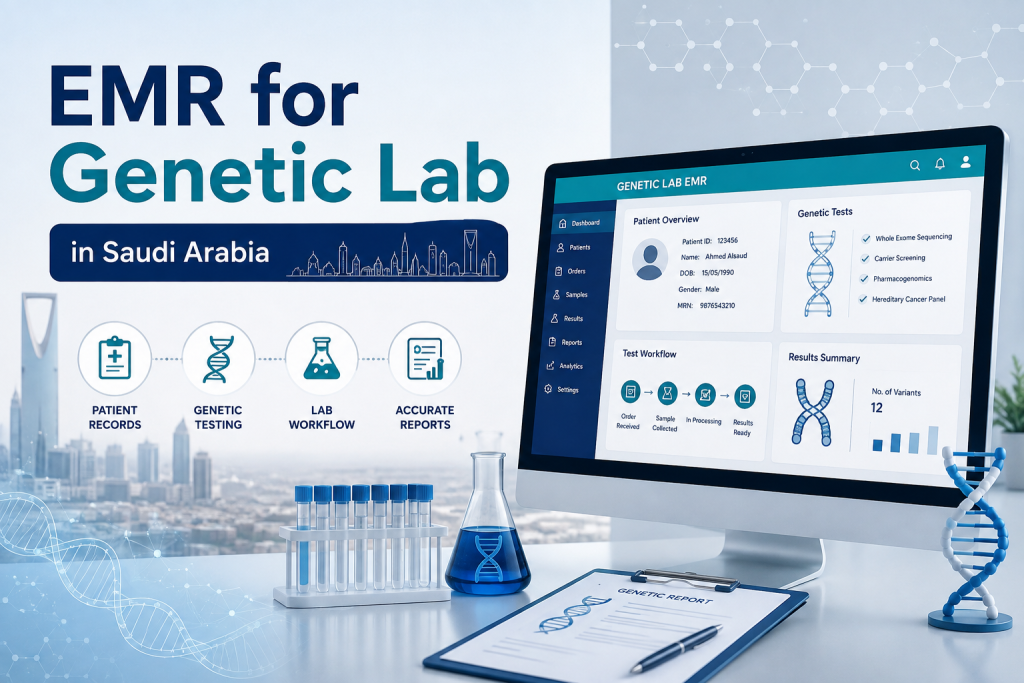
Genetic laboratories in Saudi Arabia handle some of the most sensitive and information-rich healthcare data, from patient demographics and family history to molecular test orders, DNA-based findings, variant interpretations, and genetic reports. Managing this information through disconnected systems can create delays, duplicate data entry, reporting risks, and integration challenges.
An EMR for genetic lab connects the patient’s clinical record with genetic testing workflows, laboratory results, physician documentation, and healthcare interoperability requirements. For laboratories performing molecular diagnostics, genomics, hereditary disease testing, oncology testing, or pharmacogenomics, the right platform can provide a more connected workflow across clinical and laboratory operations.
For Saudi healthcare organizations, the technology decision should also consider interoperability, NPHIES connectivity where applicable, HL7 and FHIR capabilities, data governance, cybersecurity, and the protection of genetic and health information. Saudi Arabia’s Personal Data Protection Law specifically recognizes genetic data and health data as sensitive personal data.
What Is an EMR for a Genetic Lab?
An EMR for genetic lab is an electronic medical record system designed or configured to connect patient clinical information with genetic laboratory services.
In simple terms, it creates a digital link between:
Patient → Physician → Genetic Test Order → Sample → Laboratory Workflow → Genetic Result → Interpretation → Report → Patient Record
Unlike a conventional EMR used mainly for clinical documentation, a genetic laboratory environment may need to manage additional information such as:
- Genetic test requests
- Clinical indications
- Family and medical history
- Specimen information
- Molecular test results
- Variant information
- Interpretation and clinical significance
- Genetic counselling documentation
- Physician comments
- Laboratory reports
- Follow-up recommendations
- Previous genetic test history
This is why organizations evaluating genetic laboratory EMR solutions should look beyond ordinary patient-record functionality.
A modern platform may combine an EMR with a genetic laboratory information system, LIS/LIMS connectivity, molecular diagnostics workflows, and interoperability APIs.
Why Does Genetic Laboratory EMR Matter in Saudi Arabia?
Genetic testing produces information that can remain clinically relevant throughout a patient’s lifetime. A patient’s genetic result may influence future diagnosis, treatment decisions, family screening, reproductive planning, oncology care, or precision medicine.
A disconnected workflow can make it difficult for clinicians to find previous genetic results or for laboratories to receive complete clinical information before testing.
An integrated genetic testing EMR software solution can help organizations:
- Reduce duplicate patient data entry
- Connect laboratory results with the patient’s clinical record
- Improve sample and test traceability
- Provide clinicians with accessible genetic reports
- Maintain historical genetic testing information
- Support structured laboratory workflows
- Improve communication between laboratories and healthcare providers
- Create an auditable record of clinical and laboratory activity
- Support interoperability with healthcare systems
Saudi Arabia’s health information ecosystem places strong emphasis on health information exchange and interoperability. CHI documentation identifies HL7, preferably FHIR R4, as a supported approach for health information exchange and references interoperability with NPHIES.
NPHIES itself includes FHIR training and implementation guidance for system vendors.
Key Features of Genetic Lab EMR Software
A capable genetic lab management software platform should connect clinical, laboratory, administrative, and reporting workflows rather than simply store patient information.
Patient and Clinical Record Management
The EMR should provide a centralized patient record containing:
- Patient demographics
- Medical history
- Family history
- Clinical notes
- Diagnoses
- Allergies
- Medications
- Previous laboratory results
- Genetic testing history
- Referring physician information
- Consent documentation
This gives laboratory and clinical teams the context needed to understand why a genetic test was ordered.
Genetic Test Ordering
A genetic testing laboratory software platform should allow authorized clinicians to request tests electronically.
The workflow can include:
Clinical indication → Test selection → Required information → Consent → Specimen request → Laboratory processing
Structured test ordering can reduce incomplete requests and unnecessary manual communication.
Sample and Specimen Tracking
Genetic laboratories often process different specimen types depending on the testing workflow.
Software should support:
- Specimen registration
- Barcode identification
- Collection information
- Accession numbers
- Sample status
- Storage location
- Processing history
- Rejection reasons
- Chain-of-custody information where required
- Sample-to-patient traceability
Genetic Results and Reporting
The system should provide a controlled environment for laboratory results and final reports.
Depending on the laboratory’s scope, reporting may include:
- Molecular findings
- Variant information
- Test methodology
- Interpretation
- Reference information
- Clinical comments
- Laboratory approval
- Result status
- Report version
- Physician access
Role-Based Access Control
Because genetic information is sensitive, access should be based on the user’s role and responsibilities.
For example:
| User | Typical Access |
|---|---|
| Laboratory Director | Laboratory oversight and result approval |
| Clinical Geneticist | Clinical interpretation and patient record |
| Genetic Counsellor | Relevant genetic and counselling information |
| Laboratory Technologist | Testing and specimen workflow |
| Physician | Orders, clinical information and finalized reports |
| Laboratory Manager | Operations and workflow monitoring |
| IT Administrator | Technical administration with controlled clinical access |
Saudi Arabia’s PDPL specifically identifies genetic and health information as sensitive data and provides additional protections around processing such information.
Types of EMR and Genetic Laboratory Software
There is no single architecture that fits every genetic testing organization.
1. Genetic Laboratory EMR
A genetic laboratory EMR focuses on connecting patient clinical records with genetic laboratory services.
It is suitable for clinical genetics departments, hospitals, and laboratories that need stronger EMR integration.
2. Genetic Laboratory Information System
A genetics laboratory information system focuses more heavily on laboratory operations, specimens, test workflows, results, reporting, and laboratory administration.
It can be integrated with an EMR to provide a complete clinical-to-laboratory workflow.
3. Genetic Lab Management Software
Genetic lab management software combines operational workflows such as test management, sample tracking, reporting, user management, and laboratory analytics.
4. Molecular Diagnostics Software
Molecular diagnostics software is designed for laboratories performing molecular testing and can support workflows around molecular assays, results, specimens, and reporting.
5. Genomics Laboratory Software
Genomics laboratory software is particularly relevant to laboratories handling sequencing and broader genomic workflows.
For advanced organizations, integration between EMR, LIS/LIMS, sequencing platforms, and bioinformatics systems may be required.
EMR Integration Capabilities?
An EMR for genetic lab should not operate as an isolated application.
The ideal architecture connects the clinical record with laboratory systems, diagnostic instruments, external healthcare platforms, and reporting workflows.
Common integration capabilities include:
- EMR-to-LIS integration
- LIS/LIMS integration
- Laboratory analyzer interfaces
- Molecular testing platforms
- NGS workflow integration
- Patient identity synchronization
- Physician and facility synchronization
- Electronic test ordering
- Electronic result delivery
- API integration
- HL7 messaging
- FHIR APIs
- Healthcare information exchange
- Reporting integrations
The objective is to create a continuous information flow rather than forcing staff to manually transfer information between systems.
Electronic Medical Records for Genetic Research
Electronic Medical Records for genetic research can support research organizations by providing structured access to clinically relevant information, subject records, laboratory findings, and longitudinal patient histories, subject to applicable approvals, consent requirements, data governance, and privacy controls.
For research environments, the EMR should support controlled access, audit trails, data minimization, pseudonymization where appropriate, and clear separation between clinical care and research activities.
This is particularly important in Saudi Arabia because genetic information is explicitly recognized as sensitive personal data under the PDPL. The Saudi data protection framework also includes specific considerations for processing sensitive data for scientific, research, or statistical purposes.
What Is NGS Laboratory Software?
NGS laboratory software supports workflows associated with next-generation sequencing.
A typical NGS workflow can involve:
Patient → Test Order → Specimen → DNA/RNA Extraction → Library Preparation → Sequencing → Bioinformatics → Variant Analysis → Interpretation → Clinical Report
NGS software can help coordinate laboratory and clinical information around this process.
Depending on the implementation, organizations may require integration with:
- Sequencing instruments
- Laboratory information systems
- Sample management systems
- Bioinformatics pipelines
- Variant databases
- Clinical interpretation tools
- EMR platforms
- Reporting systems
An EMR does not necessarily replace specialized bioinformatics or sequencing platforms. Instead, a strong architecture connects them.
Genetic Lab EMR Integration
Genetic lab EMR integration allows clinical and laboratory information to move between systems without repeated manual entry.
For example:
EMR → Genetic Test Order → LIS/LIMS → Laboratory Workflow → Result → Genetic Report → EMR
This integration can help reduce transcription errors and improve turnaround visibility.
A strong integration strategy should define:
- Patient identity matching
- Test and order mapping
- Specimen identifiers
- Result structures
- Report formats
- Error handling
- Authentication
- Audit logging
- Security controls
- Data retention requirements
HL7 Genetic Lab Integration
HL7 genetic lab integration enables genetic laboratories to exchange clinical and laboratory information with healthcare applications using standardized healthcare messaging.
HL7 can support workflows such as:
- Patient information exchange
- Laboratory orders
- Specimen information
- Laboratory observations
- Results
- Clinical documentation
For Saudi healthcare organizations, interoperability should be evaluated against the applicable national implementation requirements rather than assuming that generic HL7 connectivity automatically means regulatory compliance.
Saudi healthcare interoperability documentation emphasizes health information exchange and identifies HL7, preferably FHIR R4, for relevant information-system interoperability.
FHIR Genetic Laboratory Integration
FHIR genetic laboratory integration provides an API-oriented approach for exchanging healthcare information.
FHIR can help connect:
EMR ↔ Genetic Laboratory ↔ LIS/LIMS ↔ Healthcare Platform
Depending on the implementation and applicable profiles, structured resources can represent patients, diagnostic orders, observations, specimens, practitioners, organizations, and diagnostic reports.
For Saudi Arabia, FHIR capability can be especially important where systems need to participate in national health information exchange environments. NPHIES provides vendor training covering FHIR artifacts and its implementation guide.
The key question when selecting a platform is not simply, “Does it support FHIR?”
Instead ask:
Which FHIR version, profiles, implementation guides, resources, authentication mechanisms, and workflows does the platform actually support?
HIPAA Compliant Genetic Lab Software
HIPAA compliant genetic lab software is a commonly searched requirement, particularly for laboratories serving international organizations or operating across multiple jurisdictions.
However, Saudi organizations should not treat HIPAA as a substitute for Saudi regulatory requirements.
HIPAA is a U.S. regulatory framework. A genetic laboratory operating in Saudi Arabia should evaluate compliance with applicable Saudi requirements, particularly the Personal Data Protection Law and relevant health-sector cybersecurity, privacy, interoperability, and information-management requirements.
Because genetic and health information are considered sensitive data under Saudi Arabia’s PDPL, software selection should include:
- Role-based access
- Authentication controls
- Audit trails
- Data encryption
- Data access monitoring
- Consent management where applicable
- Secure integrations
- Backup and recovery
- Data retention controls
- Data governance
- Appropriate data-transfer controls
EMR for Genetic Lab: Feature Comparison
| Feature | Basic EMR | Genetic Lab EMR | Specialized Genetic LIS/LIMS |
| Patient records | ✓ | ✓ | Limited/Integration dependent |
| Clinical documentation | ✓ | ✓ | Limited |
| Genetic test ordering | Limited | ✓ | ✓ |
| Sample tracking | Limited | ✓ | ✓ |
| Genetic reporting | Limited | ✓ | ✓ |
| LIS integration | Sometimes | ✓ | Core capability |
| NGS integration | Usually limited | Integration dependent | Often specialized |
| HL7 integration | Varies | ✓ | ✓ |
| FHIR integration | Varies | ✓ | Integration dependent |
| Physician access | ✓ | ✓ | Integration dependent |
| Audit trail | ✓ | ✓ | ✓ |
| Genetic workflow support | Limited | ✓ | ✓ |
| Clinical + laboratory context | Moderate | Strong | Laboratory focused |
Pros and Cons of EMR for Genetic Lab
| Pros | Cons |
| Centralized patient and genetic information | Implementation can require integration work |
| Better clinical-laboratory connectivity | Specialized workflows may need configuration |
| Reduces duplicate data entry | Staff training is required |
| Supports structured reporting | Advanced genomics may need separate systems |
| Improves result accessibility | Integration costs vary |
| Supports auditability and role-based access | Data governance must be carefully designed |
How to Choose the Right EMR for Genetic Lab
Before selecting genetic laboratory software, use this checklist.
1. Define Your Laboratory Workflow
Document the complete journey from test ordering to final reporting.
2. Identify Required Test Types
Determine whether the laboratory performs:
- PCR
- Molecular diagnostics
- Cytogenetics
- Hereditary testing
- Oncology testing
- Pharmacogenomics
- Whole exome sequencing
- Whole genome sequencing
- Targeted sequencing
- Carrier screening
3. Evaluate EMR and LIS Integration
Ask whether the system supports bidirectional or appropriate workflow integration between EMR and LIS/LIMS.
4. Validate HL7 and FHIR Capabilities
Do not accept “HL7/FHIR compatible” as a generic marketing statement. Request actual interface documentation, supported messages/resources, profiles, and implementation examples.
5. Evaluate Saudi Interoperability Requirements
If the laboratory participates in healthcare information exchange, determine which NPHIES and other national integration requirements apply to your organization. NPHIES provides specific vendor onboarding and FHIR implementation guidance.
6. Assess Data Protection
Ask how the vendor handles genetic and health information, access control, audit logs, data residency or transfer requirements, retention, backups, and security.
7. Check Reporting Flexibility
Genetic reports vary significantly by test type. Make sure report templates can accommodate your laboratory’s required clinical and technical information.
8. Test Scalability
A solution should support growth in:
- Patients
- Tests
- Samples
- Users
- Branches
- Instruments
- Reports
- Integrations
Who Should Use an EMR for Genetic Lab?
An EMR for genetic lab is particularly relevant to organizations that need clinical and laboratory information connected in one workflow.
Primary Buyers
- Laboratory Directors
- Genetics Laboratory Directors
- Medical Directors
- Laboratory Managers
- Pathology Directors
- Clinical Geneticists
- Genomics Directors
- Healthcare IT Managers
- Hospital CIOs and IT Directors
- Operations Managers
- Laboratory Quality Managers
- Procurement Managers
Best-Fit Organizations in Saudi Arabia
Genetic Testing Laboratories
Laboratories providing hereditary, carrier, pharmacogenomic, oncology, or other genetic tests can use an integrated EMR and laboratory architecture to connect clinical context with test results.
Molecular Diagnostic Laboratories
Molecular laboratories can benefit from electronic orders, specimen tracking, result management, and EMR connectivity.
Genomics Laboratories
Genomics organizations may require connectivity between EMR, LIS/LIMS, sequencing platforms, bioinformatics, and reporting systems.
Hospitals With Genetics Departments
Hospitals can connect genetics consultations, patient records, laboratory testing, and genetic reports.
Precision Medicine Centers
Precision medicine programs require structured clinical and molecular information to support multidisciplinary workflows.
IVF and Fertility Centers
Organizations offering reproductive genetic testing can connect patient records, test orders, laboratory results, and clinical documentation.
Oncology Centers
Molecular and genomic testing can become part of the broader oncology patient record when appropriate integration is available.
Why Choose Health Cluster for Genetic Laboratory EMR?
Health Cluster can be positioned as a connected healthcare technology platform rather than a standalone genetic laboratory application.
For a Saudi genetic laboratory, the value proposition should center on EMR + laboratory integration + interoperability.
Health Cluster can support an integrated environment involving:
- Electronic Medical Records
- Hospital Information System
- Laboratory Information System
- Pharmacy
- Billing and revenue cycle workflows
- Patient management
- Telemedicine
- Reporting and analytics
- API-based integration
- HL7/FHIR-oriented interoperability
The strongest architecture for a genetic laboratory is not necessarily to force every genomic workflow into one application. Instead, specialized laboratory and genomic technologies can remain in their appropriate systems while the EMR acts as the clinical record and integration layer.
This approach can allow:
Patient Record → Genetic Order → Laboratory System → Molecular/Genomic Workflow → Result → Report → EMR
For Saudi deployments, the solution should also be evaluated against the organization’s applicable NPHIES, interoperability, cybersecurity, privacy, and data-governance requirements. CHI materials emphasize information-system support for health information exchange and FHIR R4 preference in the relevant interoperability context.
Common Mistakes to Avoid When Buying Genetic Laboratory Software
Choosing a Generic EMR Without Laboratory Integration
A standard EMR may manage clinical notes well but lack specimen, accession, laboratory workflow, or genetic reporting capabilities.
Treating LIS and EMR as the Same System
They serve different purposes. A strong implementation may require both systems connected through integration.
Assuming HL7 Means Full Interoperability
HL7 support can mean different things. Always validate the exact messages, interfaces, versions, and workflows supported.
Ignoring FHIR
API-based interoperability is increasingly important in modern healthcare environments. Saudi interoperability requirements and NPHIES materials specifically reference FHIR.
Overlooking Genetic Data Privacy
Genetic information deserves particular attention because Saudi Arabia’s PDPL explicitly classifies genetic data as sensitive personal data.
Selecting Software Without a Reporting Strategy
Genetic testing reports can be complex. Make sure the platform can support the laboratory’s reporting requirements.
Forgetting Scalability
A solution that works for a small laboratory may not support a growing genomics operation with multiple branches, instruments, test types, and integrations.
Frequently Asked Questions About EMR for Genetic Lab
What is an EMR for genetic lab?
An EMR for genetic lab connects patient clinical records with genetic test ordering, laboratory workflows, results, interpretations, and reports. It can integrate with LIS/LIMS and specialized molecular or genomic systems.
What is genetic laboratory software?
Genetic laboratory software is technology used to manage workflows associated with genetic testing, including test orders, specimens, laboratory processing, results, reporting, and clinical integration.
What is the difference between genetic lab EMR and genetic LIS?
A genetic lab EMR focuses on the patient’s clinical record and its connection to genetic care, while a genetic LIS/LIMS focuses primarily on laboratory operations, specimens, testing workflows, results, and laboratory reporting. Many organizations need both systems integrated.
Can genetic laboratory software integrate with an EMR?
Yes. Genetic laboratory software can integrate with an EMR using APIs, HL7, FHIR, or other supported interoperability methods. The exact interface depends on the systems and applicable implementation requirements.
Does a genetic laboratory EMR support NGS?
It can support NGS-related workflows through integration with sequencing, laboratory, bioinformatics, and reporting systems. The EMR itself does not necessarily replace specialized NGS or bioinformatics software.
Is FHIR important for genetic laboratory integration in Saudi Arabia?
FHIR can be important for modern healthcare interoperability. Saudi healthcare interoperability documentation identifies HL7, preferably FHIR R4, for relevant health information exchange, while NPHIES provides vendor guidance covering FHIR artifacts and implementation.
Is genetic data protected under Saudi Arabia’s PDPL?
Yes. Saudi Arabia’s PDPL defines genetic data and health data, and genetic data is treated as sensitive personal data requiring appropriate protection.
Conclusion: Build a Connected Genetic Laboratory Workflow
The right EMR for genetic lab should do more than digitize patient records. It should connect clinical information, genetic testing, specimens, laboratory systems, results, reporting, and healthcare interoperability into a controlled digital workflow.
For Saudi Arabia, laboratories should evaluate genetic laboratory EMR, genetic testing EMR software, genetic lab management software, genetic laboratory software, genetics laboratory information system, molecular diagnostics software, and genomics laboratory software based on actual workflow requirements rather than features alone.
The most important questions are:
Can it integrate with our LIS/LIMS? Can it support HL7 and FHIR? Can it connect genetic results to the patient’s clinical record? Can it provide appropriate security and auditability? Can it scale with our laboratory? Can it support our applicable Saudi interoperability and data-protection requirements?
For organizations planning a modern genetic testing environment, the next step is to map the laboratory workflow, identify required integrations, and evaluate the EMR and laboratory architecture against operational, clinical, interoperability, and data-governance requirements.
