

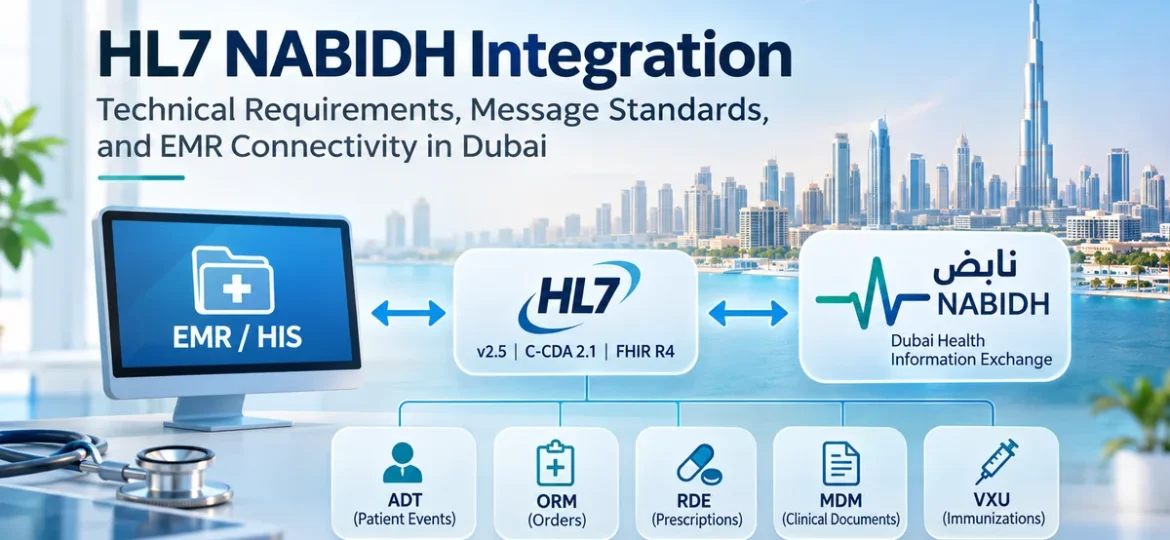
Healthcare facilities in Dubai need their Electronic Medical Record (EMR) systems to exchange patient information accurately and securely with relevant healthcare platforms. One of the key technologies supporting this exchange is Health Level Seven (HL7), a set of international standards for transferring healthcare information between different systems.
For hospitals, clinics, laboratories, and healthcare technology providers connecting their EMR systems to NABIDH, understanding HL7 NABIDH integration is essential. It helps healthcare IT teams understand how patient registrations, clinical encounters, diagnoses, prescriptions, laboratory information, and medical documents can be exchanged in structured formats.
However, HL7 integration is not simply about sending messages from one system to another. Information must follow the required message structures, contain correct patient identifiers, use appropriate clinical codes, and pass applicable validation processes.
To understand the broader NABIDH integration in Dubai, healthcare facilities should also consider how the platform supports information exchange across participating healthcare organizations.
This guide explains how HL7 supports NABIDH connectivity, which message types are relevant, what technical components healthcare facilities need, and how to evaluate an EMR vendor before implementation.
1. What Is HL7 NABIDH Integration?
HL7 NABIDH integration is the process of connecting a healthcare facility’s Electronic Medical Record (EMR) system with Dubai’s NABIDH Health Information Exchange (HIE) using the applicable HL7 messaging specifications.
NABIDH enables participating healthcare providers to exchange patient medical information through a connected healthcare information environment.
HL7 provides standardized message structures that allow different healthcare applications to communicate, even when they use different software platforms or internal databases.
For example, a clinic may use one EMR for patient registration, another application for laboratory operations, and a separate system for radiology. Without standardized data exchange, sharing information between these applications can require manual entry or custom interfaces.
With an appropriately implemented HL7 interface, these systems can exchange structured healthcare information.
The distinction is important:
- HL7: Provides healthcare messaging and interoperability standards.
- NABIDH: Provides Dubai’s Health Information Exchange platform.
- HL7 NABIDH Integration: Connects healthcare systems through the applicable technical interfaces and specifications.
Understanding the role of NABIDH in Dubai’s healthcare ecosystem also helps healthcare providers recognize why standardized information exchange is important for connected digital healthcare services.
2. Which HL7 Standards Are Used for NABIDH Integration?
Healthcare facilities should distinguish between the standards referenced in DHA’s broader interoperability framework and the specific message formats documented for NABIDH connectivity.
DHA’s Standards for Interoperability and Data Exchange, Version 2 (DHA/HISHD/ST-02), issued on 2 April 2025 and effective from 2 July 2025, identifies HL7 v2 as the recommended standard for accessing and submitting healthcare data. It also identifies FHIR and IHE standards within its broader interoperability framework.
The published NABIDH integration implementation guide specifies the following formats.
2.1 HL7 Version 2.5
HL7 v2.5 supports structured healthcare messaging between a healthcare facility’s EMR system and NABIDH.
Messages contain defined segments and fields that communicate patient, encounter, order, and clinical information.
For example, an ADT message can communicate patient registration or admission-related information, while an ORM message can communicate order-related events.
2.2 Clinical Document Architecture (C-CDA) 2.1
Clinical Document Architecture (C-CDA) provides a structured document format for exchanging clinical information.
It is useful for sharing clinical documents such as:
- Patient discharge summaries
- Clinical notes
- Medical reports
- Other patient-related healthcare records
C-CDA helps preserve document structure and relevant clinical context during information exchange.
2.3 HL7 FHIR R4
Fast Healthcare Interoperability Resources (FHIR) uses standardized healthcare resources and modern API-based approaches to interoperability.
FHIR resources include:
- Patient
- Encounter
- Observation
- Condition
- Medication
These resources support the structured representation of healthcare information.
FHIR is identified in DHA’s broader interoperability standards. However, healthcare facilities should confirm which FHIR interfaces and implementation profiles apply to their specific NABIDH integration rather than assuming that every FHIR resource is accepted directly.
3. What Are the Common HL7 Message Types Used in NABIDH Integration?
Different HL7 messages serve different purposes. Selecting the correct message type depends on the information being exchanged and the relevant NABIDH interface specification.
The published NABIDH implementation guide describes several HL7 v2.5 message categories.
| HL7 Message Type | Purpose | Example |
|---|---|---|
| ADT | Admission, discharge, transfer, and patient registration events | Registering a patient |
| ORM | Order-related notifications | Creating or cancelling a clinical order |
| RDE | Pharmacy or treatment order information | Sending prescription details |
| MDM | Medical document notifications | Discharge summary or procedure note |
| VXU | Immunization information | Submitting vaccination records |
Each message follows a defined structure.
For example, an ADT message may contain patient identification, demographic details, visit information, and event details.
An ORM message contains order-related information that must be mapped to the appropriate clinical and operational fields.
The message type alone does not determine successful integration. Required segments, field-level rules, event triggers, identifiers, and coding requirements must also be followed.
4. How Does HL7 Data Exchange Work Between an EMR and NABIDH?
A typical HL7 NABIDH integration workflow involves several technical stages.
Step 1: Clinical Event Generation
The EMR generates an event when a relevant activity occurs, such as patient registration, an encounter update, or a clinical order being placed.
Step 2: HL7 Message Generation
The integration component converts the relevant EMR information into the required HL7 message structure.
Step 3: Data Mapping and Validation
The message is checked for required fields, patient identifiers, timestamps, clinical codes, and formatting rules.
Step 4: Secure Message Transmission
The validated message is transmitted through the communication mechanism specified in the applicable NABIDH interface documentation.
Step 5: Message Acknowledgement and Error Handling
The integration system processes the response, records the transaction status, and identifies rejected or failed messages for investigation.
Step 6: Monitoring and Reconciliation
The technical team monitors message processing, investigates failures, and confirms that the expected information has been exchanged.
This process should be traceable. Every transaction should have sufficient logging to identify its source, processing status, and any errors encountered.
5. What Technical Components Are Required for HL7 NABIDH Integration?
Before implementation, healthcare facilities should assess the following technical components.
EMR Interface Capability
The EMR must be able to generate and process the required healthcare messages based on the applicable integration scope.
HL7 Integration Engine
An interface engine or equivalent integration component can handle message transformation, routing, validation, and error management.
Patient Identification
Patient identifiers must be mapped correctly to support accurate medical record matching.
Clinical Data Mapping
Diagnoses, medications, laboratory results, procedures, and other clinical information must follow the required data structures and terminology.
Communication and Security
Message transmission, authentication, access controls, and data protection must follow applicable technical and regulatory requirements.
Acknowledgement Handling
The integration should capture message responses and distinguish successful processing from rejected or failed transactions.
Monitoring and Logging
Healthcare IT teams need visibility into message volumes, failures, retries, and unresolved integration issues.
These components should be evaluated together. An EMR that supports HL7 messaging does not automatically satisfy every NABIDH integration requirement.
6. What Are the Common HL7 Integration Errors and How Can Facilities Prevent Them?
Many integration problems originate from differences between the data stored in the EMR and the information expected by the receiving platform.
Some common HL7 integration errors include:
| Integration Error | Potential Impact | Prevention |
|---|---|---|
| Incorrect patient identifiers | Patient matching problems | Validate MRNs and required identifiers |
| Missing mandatory fields | Message validation failures | Review mandatory segments and fields |
| Incorrect date and time formats | Clinical event sequencing issues | Validate timestamps and time zones |
| Invalid clinical codes | Inconsistent clinical information | Review terminology and coding mappings |
| Duplicate messages | Duplicate healthcare events | Implement duplicate detection and reconciliation |
| Unresolved acknowledgements | Unnoticed failed transactions | Monitor acknowledgements and message status |
The best way to prevent these problems is to establish a field-level mapping document, validate sample messages, and conduct end-to-end testing before production deployment.
Healthcare facilities should also maintain an error-handling process to investigate rejected messages and correct data mapping issues.
7. How to Choose an EMR Vendor for NABIDH HL7 Integration
Healthcare facilities should evaluate the vendor’s actual integration capabilities rather than relying only on general statements about HL7 support.
Before selecting an EMR, ask these questions:
- Does the system support the applicable NABIDH HL7 v2.5 message specifications?
- Can it generate the required ADT, ORM, RDE, MDM, and VXU messages within the facility’s integration scope?
- How does it handle patient identification and clinical data mapping?
- Does it support C-CDA document exchange where required?
- How are acknowledgements, rejected messages, and retransmissions managed?
- Can the vendor support integration testing, technical documentation, and ongoing maintenance?
- How does the system address applicable DHA authentication and SSO requirements?
Healthcare facilities should also request a demonstration of the integration workflow and clarify the status of technical testing, NABIDH onboarding, and any formal acceptance.
When evaluating available solutions, explore the NABIDH-integrated EMR platform from Health Cluster to understand its EMR capabilities and approach to healthcare interoperability.
Facilities should also consider their broader operational requirements when selecting healthcare technology. Explore HIS software options in the UAE to understand the different capabilities required for hospital and clinic management.
8. Frequently Asked Questions About HL7 NABIDH Integration
What is HL7 NABIDH integration?
HL7 NABIDH integration connects a healthcare facility’s EMR system with Dubai’s NABIDH Health Information Exchange using applicable HL7 messaging specifications. It supports the structured exchange of patient registration, clinical encounters, orders, and other healthcare information.
Which HL7 version is used for NABIDH integration?
The published NABIDH integration implementation guide specifies HL7 Version 2.5 message structures. Healthcare facilities should follow the applicable interface specifications to determine the required messages and data elements.
What is the difference between HL7 and NABIDH?
HL7 is a set of healthcare interoperability and messaging standards, while NABIDH is Dubai’s Health Information Exchange platform. HL7 provides standardized structures for exchanging information through applicable NABIDH interfaces.
Does NABIDH use HL7 FHIR?
DHA’s broader interoperability framework identifies HL7 FHIR R4 as a supported interoperability standard for healthcare information systems. However, facilities should confirm the specific FHIR interfaces and implementation profiles applicable to their NABIDH integration.
What HL7 message types are used in NABIDH integration?
The published NABIDH implementation guide describes ADT, ORM, RDE, MDM, and VXU message categories. Their applicability depends on the facility’s integration scope and the relevant interface specifications.
What is C-CDA in NABIDH integration?
C-CDA (Clinical Document Architecture) is a structured document format used for exchanging clinical information. The published NABIDH implementation guide specifies C-CDA version 2.1 for applicable clinical document exchange.
What causes HL7 integration failures?
Common causes include incorrect patient identifiers, missing mandatory fields, invalid clinical codes, incorrect date and time formats, duplicate messages, and unresolved acknowledgements.
How can healthcare facilities prepare for HL7 NABIDH integration?
Facilities should assess their existing EMR interfaces, review patient identification and clinical data mapping, prepare the required HL7 messages, configure security mechanisms, validate sample transactions, and complete applicable end-to-end testing.
9. Implement HL7 NABIDH Integration with Health Cluster
A successful integration project requires more than an HL7 connection. It requires an EMR system that can manage clinical workflows, structure healthcare information, and support the technical requirements of the intended exchange.
Health Cluster provides an integrated Electronic Medical Record (EMR) and Hospital Information System (HIS) platform for hospitals, clinics, and other healthcare organizations.
Its platform brings together essential healthcare operations, including:
- Patient registration and appointments
- Electronic Medical Records (EMR)
- Physician documentation and clinical workflows
- Billing and Revenue Cycle Management
- Pharmacy management
- Laboratory management
- Radiology and diagnostic workflows
For Dubai healthcare facilities planning HL7 NABIDH integration, Health Cluster can discuss the existing EMR environment, required data exchange workflows, and the technical approach for integration.
Planning to Connect Your EMR with NABIDH?
Looking to understand how HL7 NABIDH integration can support your healthcare facility?
Contact Health Cluster to discuss your HL7 integration requirements, review your existing EMR environment, and explore the available implementation approach.
Book an EMR integration demo to discuss your healthcare technology requirements with our team.


