

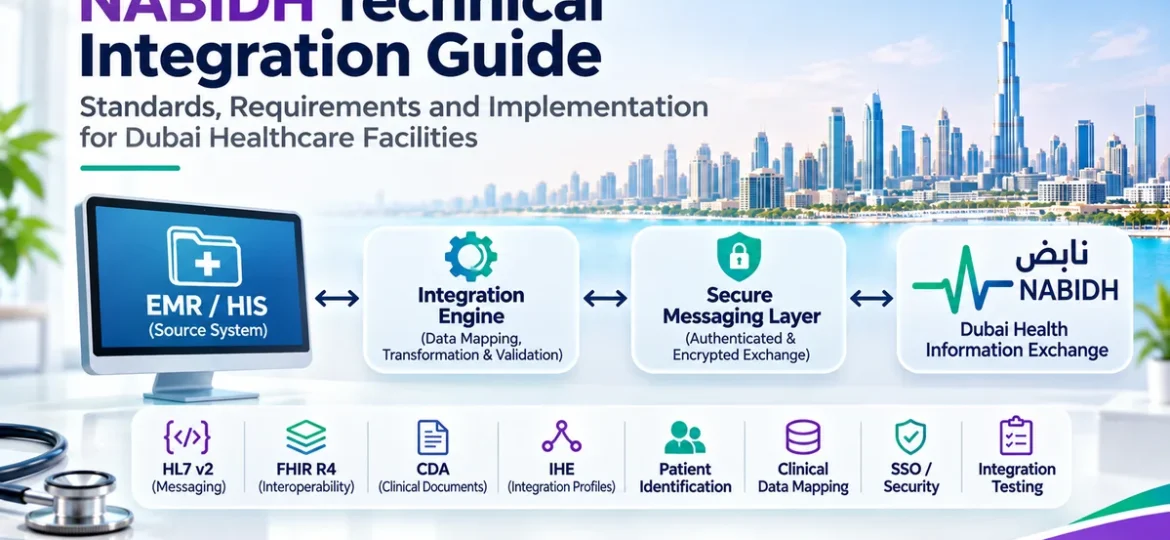
Connecting an Electronic Medical Record (EMR) system to NABIDH requires more than establishing a technical connection. Healthcare facilities must ensure that patient information is structured correctly, clinical data follows recognized interoperability standards, and healthcare systems can exchange information securely and reliably.
For hospitals, clinics, laboratories, and EMR providers in Dubai, understanding the NABIDH technical requirements is an important step before starting an integration project.
NABIDH, Dubai’s Health Information Exchange (HIE) platform, enables participating healthcare providers to exchange patient medical information through a unified digital healthcare environment. It is designed to collect, aggregate, normalize, and present clinical information from participating healthcare organizations.
Healthcare providers planning an implementation should first understand the broader NABIDH integration process in Dubai, including its purpose, requirements, and role in connecting healthcare systems.
Successful NABIDH integration depends on several technical components, including interoperability standards, message structures, patient identification, clinical terminology, authentication, and data validation.
This guide explains the NABIDH integration architecture, technical standards, HL7 messaging, clinical data mapping, security requirements, testing procedures, and EMR vendor selection considerations.
1. Understanding the NABIDH Integration Architecture
NABIDH integration connects a healthcare facility’s EMR system with the central Health Information Exchange (HIE).
The EMR acts as the source system, generating patient registration and clinical information. An integration layer processes the information into the required message formats and transmits it to the receiving platform.
Understanding the role of NABIDH in Dubai’s healthcare ecosystem helps healthcare organizations recognize why standardized information exchange is important for connected healthcare services.
Key Components of NABIDH Integration Architecture
A typical NABIDH integration architecture involves five main components.
1. EMR System
The Electronic Medical Record system stores and manages patient demographics, encounters, diagnoses, prescriptions, laboratory results, and other clinical information.
2. Integration Engine
The integration engine transforms and validates healthcare data according to the applicable technical specifications.
3. Messaging Interface
The messaging interface handles the exchange of structured healthcare messages between the EMR and the designated integration platform.
4. Secure Communication Layer
The secure communication layer supports protected data transmission and the required authentication mechanisms.
5. NABIDH Platform
The NABIDH platform receives and processes information from connected healthcare facilities.
The integration architecture should also support message tracking, error handling, acknowledgements, and controlled retransmission.
A reliable architecture is essential because a successful network connection does not necessarily mean that the receiving platform has accepted and processed the clinical information.
2. What Are the NABIDH Technical Requirements and Interoperability Standards?
One of the most important aspects of NABIDH integration is compliance with the applicable Dubai Health Authority (DHA) interoperability and data exchange standards.
DHA’s Standards for Interoperability and Data Exchange, document DHA/HISHD/ST-02, Issue 2, dated 2 April 2025 and effective 2 July 2025, identifies standards that healthcare information systems should support.
These include HL7 Version 2, HL7 FHIR R4, HL7 CDA R2, and IHE integration profiles.
HL7 Version 2 (HL7 v2)
HL7 v2 is the recommended standard for accessing and submitting healthcare data under the DHA interoperability standard.
It supports structured messaging between healthcare applications. Depending on the integration scope, messages can communicate:
- Patient admission information
- Clinical observations
- Healthcare service orders
- Patient registration events
- Other healthcare events
HL7 FHIR R4
Fast Healthcare Interoperability Resources (FHIR) provides a resource-based approach to exchanging healthcare information through modern interoperability interfaces.
FHIR resources can represent information such as:
- Patients
- Encounters
- Observations
- Medications
- Diagnostic reports
DHA’s Issue 2 standard identifies FHIR as an interoperability standard that healthcare information systems should support.
However, facilities should confirm the specific NABIDH interfaces and implementation profiles applicable to their integration rather than assuming that every FHIR resource is directly accepted by the platform.
HL7 CDA R2
Clinical Document Architecture (CDA) provides a structured format for exchanging clinical documents while retaining relevant clinical context.
It can be used for documents such as:
- Discharge summaries
- Clinical reports
- Structured medical documentation
- Other patient-related clinical records
IHE Integration Profiles
Integrating the Healthcare Enterprise (IHE) defines profiles that help different healthcare systems implement standardized interoperability workflows.
Relevant profiles identified in DHA’s interoperability framework include patient identification and cross-enterprise document-sharing capabilities.
Important consideration: Selecting an interoperability standard alone does not establish NABIDH compliance. The implementation must follow the applicable message specifications, data elements, terminology requirements, and technical profiles.
3. How Does HL7 Messaging Work in NABIDH Integration?
HL7 messaging is a central technical component of healthcare interoperability.
The NABIDH integration implementation documentation describes the use of HL7 messages and Clinical Document Architecture (C-CDA) documents for transmitting patient clinical information.
The published interface documentation specifies HL7 v2.5 and C-CDA v2.1 message structures.
Common HL7 Message Types
Some of the message types described include:
| HL7 Message | Purpose |
|---|---|
| ADT | Patient admission, discharge, transfer, and registration-related events |
| ORM | Clinical and service order notifications |
| RDE | Pharmacy or treatment order information |
| MDM | Clinical document notifications |
| VXU | Immunization information |
The actual message types and trigger events required depend on the applicable NABIDH interface specifications and facility integration scope.
For example, when a patient is registered, the EMR may generate an appropriate patient-related message.
When a clinical order is created or updated, the integration engine must process the corresponding event and transmit the information using the specified structure.
Each message needs appropriate identifiers, timestamps, event information, and clinical content.
Incorrect field mapping, missing identifiers, or invalid message structures can result in rejected or incomplete records.
For a more detailed explanation of HL7 messaging and EMR connectivity, read our guide to HL7 NABIDH integration and technical requirements.
4. Patient Identification and Clinical Data Mapping Requirements
Patient identification is one of the most critical parts of any Health Information Exchange project.
If the same patient is registered differently across healthcare systems, matching medical records becomes difficult.
During NABIDH implementation, healthcare facilities should review their patient identification processes and ensure that the required identifiers are correctly maintained.
Important Patient and Clinical Data Elements
These may include:
- Patient identification numbers and applicable national identifiers
- Patient name and demographic information
- Date of birth and gender
- Encounter and visit identifiers
- Healthcare facility and practitioner identifiers
- Clinical diagnoses and procedures
- Medication and prescription information
- Laboratory and diagnostic results
Clinical Terminology and Coding Standards
Data mapping must also consider clinical terminology and coding standards.
DHA’s interoperability framework references standardized clinical terminologies and coding systems, including:
ICD-10-CM: Used for standardized diagnosis classification and coding.
SNOMED CT: Supports standardized clinical terminology and representation of clinical concepts.
LOINC: Supports standardized identification of laboratory tests, observations, and clinical measurements.
These are referenced alongside other applicable code sets.
For example, a diagnosis stored as free text in an EMR may require standardized coding before it can be exchanged in the expected format.
Similarly, laboratory observations need appropriate coding, units, reference ranges, and result information.
A proper data mapping exercise should identify:
- Source EMR field.
- Target data element.
- Required terminology or coding standard.
- Transformation rules.
- Validation criteria.
This process helps healthcare organizations improve data consistency and reduce errors during information exchange.
5. NABIDH Security, Authentication, and Single Sign-On Requirements
Healthcare information contains sensitive patient data. Therefore, security must be considered throughout the integration architecture.
Facilities should assess the following areas.
Authentication and Authorization
Access should be restricted to appropriately authenticated and authorized users and systems.
Single Sign-On (SSO)
DHA’s Circular CIR-2025-00000101, issued on 26 May 2025, addresses the implementation of EMR systems compliant with NABIDH integration requirements and SSO authentication.
Healthcare facilities should review the applicable DHA/NABIDH identity and access management specifications before implementing the required authentication workflow.
Data Confidentiality
Patient information must be protected during transmission and processing through appropriate security controls.
Audit Trails
Systems should maintain traceable records of relevant access and activities.
Role-Based Access
Users should only access information according to their assigned responsibilities and permissions.
SSO implementation should follow the applicable DHA/NABIDH specifications. A generic login integration should not be assumed to satisfy the required authentication workflow.
6. How to Test and Validate NABIDH Integration
Testing is essential before an integration is moved into production.
A system may generate technically valid messages but still exchange incomplete or incorrectly mapped clinical information.
A structured testing process should cover several areas.
| Testing Area | What to Validate |
|---|---|
| Connectivity Testing | Verify communication with the designated interface |
| Message Validation | Check message structures, mandatory fields, identifiers, and formatting |
| Patient Matching | Verify demographic information and patient identifiers |
| Clinical Data Validation | Test diagnoses, prescriptions, orders, observations, and clinical documents |
| Error Handling | Confirm rejected messages are logged and can be investigated |
| End-to-End Testing | Verify successful transmission and processing |
| Operational Monitoring | Monitor message failures, processing status, and integration performance |
Testing should use the applicable technical specifications and the validation process provided by DHA/NABIDH.
Healthcare facilities should retain test evidence, issue logs, and resolution records to support implementation reviews.
If your facility is preparing for implementation, our NABIDH onboarding process guide explains the stages involved in readiness assessment, DHA coordination, EMR configuration, testing, and go-live preparation.
7. Common NABIDH Integration Challenges and Solutions
Even when an EMR supports interoperability, implementation can encounter practical difficulties.
Some common NABIDH integration challenges include:
| Challenge | Potential Impact |
|---|---|
| Incomplete patient demographic information | Patient matching problems |
| Incorrect Emirates ID or patient identifier mapping | Inaccurate patient identification |
| Missing practitioner or facility identification details | Incomplete healthcare records |
| Inconsistent diagnosis and procedure coding | Clinical data mapping errors |
| Incorrect date, time, and encounter mapping | Incorrect clinical event sequencing |
| Unsupported or incorrectly structured HL7 messages | Message rejection |
| Duplicate clinical events | Duplicate patient information |
| Missing message acknowledgements | Unresolved integration failures |
| Incomplete SSO configuration | Authentication problems |
These issues should be identified during the initial technical assessment rather than after production deployment.
An experienced integration team can help review the existing EMR architecture, identify data quality gaps, and establish a structured implementation and testing plan.
8. How to Choose an EMR Vendor for NABIDH Integration
Healthcare facilities should evaluate more than whether an EMR vendor claims to support NABIDH.
Before selecting a solution, ask the vendor:
- Does the EMR support the applicable HL7 messaging specifications?
- Can it support the relevant FHIR and IHE interoperability requirements?
- How are patient demographics and clinical terminology mapped?
- Does the integration support message acknowledgements and error management?
- Can the system support the required SSO authentication workflow?
- What testing and technical documentation will be provided?
- Who will manage integration maintenance and future updates?
Also request evidence of actual integration experience and clarify whether the vendor has completed technical testing, onboarding, and any required formal acceptance.
Technical capability, successful testing, and formal platform connectivity are separate milestones and should be evaluated accordingly.
Healthcare providers evaluating available solutions can explore the NABIDH EMR platform from Health Cluster to learn about its healthcare management and EMR capabilities.
9. Plan Your NABIDH Integration with Health Cluster
Implementing NABIDH integration requires coordination between healthcare operations, EMR configuration, technical development, and data governance.
Health Cluster provides an integrated EMR and HIS platform for healthcare facilities, bringing together:
- Patient registration
- Appointment management
- Clinical documentation
- Billing
- Pharmacy
- Laboratory
- Radiology
- Other healthcare workflows
For facilities in Dubai, Health Cluster can support discussions around NABIDH integration requirements, interoperability, clinical data exchange, and the technical implementation approach.
The objective is to help healthcare organizations establish a connected digital environment while maintaining the clinical and operational workflows required by their facilities.
Planning a NABIDH Integration Project?
Contact Health Cluster to discuss your existing EMR infrastructure, technical requirements, and implementation objectives.
Book a demo with Health Cluster or request a technical assessment to understand how the platform can support your healthcare facility’s integration plans.


