
Healthcare organizations manage a large amount of information every day. Patient records, appointments, diagnoses, laboratory results, prescriptions, radiology reports, insurance claims, invoices, and clinical notes all need to move between teams.
Managing this information through separate systems can create delays, errors, and data gaps.
A Health Information System (HIS) brings these processes together. It helps hospitals, clinics, medical centers, and healthcare networks collect, store, manage, and share health information through a connected digital platform.
For healthcare providers in the UAE and KSA, a modern HIS also needs to support local healthcare regulations, interoperability, insurance workflows, and digital health networks.
This guide explains what a Health Information System is, how it works, its key features, its benefits, and what healthcare providers should consider when choosing HIS software in Saudi Arabia and the UAE.
What Is a Health Information System?
A Health Information System is a digital system used to manage healthcare information and workflows.
It connects clinical, administrative, financial, and operational processes within a healthcare organization. Depending on the size and needs of the organization, an HIS can include Electronic Medical Records (EMR), Electronic Health Records (EHR), patient registration, appointments, billing, pharmacy, laboratory, radiology, insurance, reporting, and other healthcare services.
A Health Information System is also commonly described as:
- Healthcare Information System: A system that manages healthcare data and processes.
- Hospital Information System: An HIS designed to manage hospital-wide operations.
- HIS Software: The software platform used to digitize healthcare workflows.
- Healthcare Management System: Software that connects clinical and administrative operations.
- Clinical Information System: Technology focused on clinical information and patient care.
The exact name can vary, but the goal is similar: connect people, processes, and healthcare data so providers can deliver safer and more efficient care.
Health Cluster provides a cloud-based EMR and Hospital Information System designed for hospitals, medical centers, polyclinics, specialty practices, laboratories, and other healthcare providers in the UAE, KSA, and the wider GCC region.
How Does a Health Information System Work?
A modern HIS acts as a central digital platform for a healthcare organization.
A typical patient journey may look like this:
Registration → Appointment → Consultation → Diagnostics → Treatment → Pharmacy → Billing → Insurance → Follow-up
The information created at each stage can be connected to the patient’s digital record.
For example, when a patient visits a hospital, the registration team can create or update the patient record. The doctor can then access the relevant clinical history. Laboratory and radiology results can be linked to the encounter. Prescriptions can flow to pharmacy workflows, while billing and insurance teams can process the financial side of the visit.
This reduces the need to enter the same information into multiple systems.
A strong HIS also uses role-based access control. This means doctors, nurses, pharmacists, laboratory staff, billing teams, and administrators can access the information they need based on their roles.
What Are the Main Components of a Health Information System?
The exact modules depend on the organization. However, a comprehensive Health Information System Software platform often includes the following:
1. Patient Registration and Management
The system stores core patient information such as demographics, contact details, identification information, insurance information, and visit history.
A centralized patient management system reduces duplicate records and helps staff find patient information faster.
2. Appointment Management
An HIS can manage appointments, schedules, providers, departments, and patient visits.
Healthcare organizations can use appointment management to reduce scheduling conflicts and improve patient flow.
3. Electronic Medical Records
EMR software is one of the most important parts of a modern HIS.
Doctors and clinical teams can document:
- Medical history
- Diagnoses
- Allergies
- Medications
- Clinical notes
- Treatment plans
- Laboratory results
- Radiology reports
- Follow-up information
The result is a more complete digital patient record.
4. Laboratory Information System Integration
A modern HIS should connect with a Laboratory Information System (LIS).
This allows laboratory orders and results to move between the clinical and laboratory workflows. It can reduce manual data entry and help clinicians access results within the patient’s record.
5. Radiology and PACS Integration
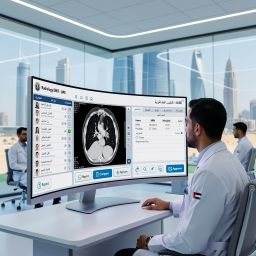
Radiology workflows can be connected through RIS and PACS integration.
This allows healthcare organizations to connect imaging workflows, reports, and patient records.
6. Pharmacy Management
Pharmacy integration connects prescriptions, dispensing, medication records, and inventory workflows.
This creates better visibility between doctors and pharmacy teams.
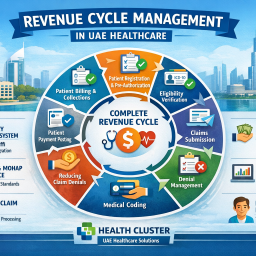
7. Billing and Revenue Cycle Management
Healthcare is not only about clinical workflows. Financial processes are also critical.
Revenue Cycle Management (RCM) connects billing, insurance, claims, payments, and financial reporting.
For providers in Saudi Arabia, the financial workflow may also need to connect with ZATCA e-invoicing requirements.
8. Healthcare Analytics and Reporting
Healthcare organizations generate large amounts of data.
An HIS can turn this information into reports and dashboards covering areas such as:
- Patient volumes
- Revenue
- Appointments
- Claims
- Clinical activity
- Laboratory activity
- Pharmacy performance
- Department performance
This helps healthcare administrators make decisions using current information instead of manual spreadsheets.
What Are the Benefits of a Health Information System?
A well-designed HIS can improve both patient care and business operations.
Better Access to Patient Information
Doctors and authorized staff can access relevant patient information from one connected system.
This can support faster clinical decisions and better continuity of care.
Improved Workflow Efficiency
Automating routine tasks can reduce paperwork and repetitive data entry.
Staff can spend less time moving information between disconnected applications.
Better Coordination Between Departments
An integrated HIS connects departments that may otherwise operate in separate systems.
Doctors, nurses, laboratories, pharmacies, radiology teams, and billing departments can work from connected workflows.
More Accurate Data
Entering information once and reusing it across connected workflows can reduce duplicate data entry.
This is especially important when patient information moves between clinical, financial, and administrative processes.
Better Patient Experience
Digital appointments, connected records, faster access to results, telemedicine, and patient-facing tools can create a smoother patient journey.
Stronger Operational Visibility
Healthcare leaders can use healthcare analytics and dashboards to monitor performance across departments and locations.
This becomes even more important for healthcare groups operating multiple branches.
What Is the Difference Between HIS, EMR, and EHR?
These terms are often used together, but they are not exactly the same.
HIS:
A broader system that can manage clinical, administrative, operational, and financial processes across a healthcare organization.
EMR:
An Electronic Medical Record focuses mainly on a patient’s clinical record within a healthcare provider or organization.
EHR:
An Electronic Health Record is designed to support a broader view of patient health information and sharing across authorized healthcare settings.
In practice, these systems often work together.
A modern EMR and HIS integration allows the clinical record to become part of a larger healthcare workflow.
Why Do Hospitals Need a Health Information System?
Hospitals have complex workflows.
A single patient may interact with registration, outpatient services, emergency care, inpatient departments, nursing, laboratory, radiology, pharmacy, billing, and insurance teams.
Without an integrated system, information can become fragmented.
A hospital information system creates a connected environment where authorized users can access the information required for their work.
For larger hospitals, an HIS may also support:
- Inpatient management
- Outpatient management
- Emergency workflows
- Nursing workflows
- Operating room management
- Bed and ward management
- Pharmacy
- Laboratory
- Radiology
- Billing and RCM
- Inventory
- Reporting and analytics
Health Cluster’s hospital solution is positioned as an enterprise HIS for hospitals and healthcare organizations in the UAE and Saudi Arabia, with integrated EMR, clinical, financial, laboratory, pharmacy, and other healthcare workflows.
Health Information System in KSA and Saudi Arabia
Saudi Arabia is undergoing major healthcare transformation.
Healthcare providers in Riyadh, Jeddah, Dammam, and other cities need systems that support both clinical operations and the Kingdom’s digital healthcare ecosystem.
For providers choosing Health Information System Software in Saudi Arabia, interoperability and local requirements should be considered from the start.
NPHIES Integration
NPHIES, the National Platform for Health Information Exchange Services, is an important part of Saudi Arabia’s healthcare and insurance ecosystem.
Healthcare software used in KSA may need to support relevant NPHIES workflows for clinical and insurance transactions.
For this reason, healthcare providers should ask HIS vendors about:
- NPHIES integration
- Eligibility workflows
- Insurance approvals
- Claims workflows
- Clinical data exchange
- Interoperability standards
Health Cluster positions its platform for the Saudi market with NPHIES integration and healthcare workflows designed for KSA providers.
ZATCA and Healthcare E-Invoicing
Financial workflows are another important consideration for healthcare providers in Saudi Arabia.
ZATCA e-invoicing requirements affect the way eligible businesses issue and manage electronic invoices.
An HIS with integrated billing and e-invoicing can help connect the patient encounter, billing workflow, and invoice process instead of relying on separate systems.
For healthcare organizations in Riyadh and Jeddah, this type of integration can simplify financial operations and improve visibility across the revenue cycle.
HIS and Digital Health in Saudi Arabia
Saudi healthcare is moving toward more connected digital services.
An effective HIS can support this transformation by connecting:
EMR + RCM + LIS + Pharmacy + RIS/PACS + Telemedicine + RPM + Analytics
This gives hospitals and clinics a stronger digital foundation as their services grow.
Health Information System in UAE
The UAE has a highly connected healthcare environment, but requirements can vary by emirate.
Healthcare providers in Dubai, Abu Dhabi, Sharjah, and other Emirates should consider the health information exchange and regulatory environment that applies to their facility.
NABIDH in Dubai
NABIDH is a key part of Dubai’s health information exchange ecosystem.
Healthcare providers in Dubai need to consider NABIDH connectivity when selecting EMR and HIS software.
A suitable system should support secure exchange of relevant patient information while maintaining appropriate access controls and data protection.
Health Cluster states that its platform supports NABIDH requirements and connectivity as part of its UAE healthcare offering.
MALAFFI in Abu Dhabi
MALAFFI is the health information exchange for Abu Dhabi.
It connects healthcare providers and enables authorized access to patient health information.
For hospitals and clinics in Abu Dhabi, MALAFFI integration should therefore be an important consideration when evaluating healthcare software.
Health Cluster’s UAE platform supports MALAFFI connectivity and is designed for healthcare providers operating in Abu Dhabi.
Riayati Across the UAE
Riayati is the UAE’s national unified medical record platform.
The UAE Ministry of Health and Prevention states that Riayati connects healthcare facilities and allows authorized healthcare professionals to access relevant patient information, including diagnoses, laboratory results, radiology reports, medications, and vaccinations.
This highlights why healthcare interoperability is becoming increasingly important.
Healthcare organizations should not look at an HIS as an isolated application. They should consider how it connects to the wider healthcare ecosystem.
Healthcare Interoperability: Why It Matters
Healthcare data is only useful when it can move securely between systems that need it.
This is where healthcare interoperability becomes important.
Modern healthcare providers may need their HIS to communicate with:
- EMR and EHR platforms
- LIS
- RIS and PACS
- Pharmacy systems
- Insurance systems
- Health information exchanges
- Telemedicine platforms
- Remote Patient Monitoring devices
- Patient portals
- Government healthcare platforms
Standards such as HL7 and FHIR can support structured healthcare data exchange between systems.
For a hospital or healthcare network, interoperability can reduce data silos and support a more connected patient journey.
Telemedicine and Remote Patient Monitoring
The role of an HIS is also expanding beyond the physical hospital.
Telemedicine allows healthcare providers to deliver consultations through digital channels. When connected to the HIS and EMR, virtual consultations can become part of the patient’s overall clinical record.
Remote Patient Monitoring (RPM) can extend this model further.
Connected devices can collect health data and send relevant information into clinical workflows for review.
This is useful for chronic disease management, follow-up care, and other services where patients need monitoring outside the facility.
Health Cluster offers telehealth and RPM capabilities as part of its broader digital health platform, alongside EMR, HIS, and other healthcare modules.
What Should Hospitals Look for in HIS Software?
Choosing an HIS is a major technology decision.
Healthcare leaders should look beyond a simple feature list.
Consider these areas:
Interoperability
Can the platform integrate with EMR, LIS, RIS/PACS, pharmacy, insurance systems, and relevant national health networks?
Regulatory Support
Does the vendor understand the requirements that apply to your location?
For KSA, this may include NPHIES and ZATCA. For the UAE, requirements may include NABIDH, MALAFFI, Riayati, and applicable emirate-level standards.
Scalability
The system should be able to grow with your organization.
This is especially important for multi-branch hospitals, clinic groups, and healthcare networks.
Security and Access Control
Patient information is highly sensitive.
Look for strong user access controls, audit trails, secure data handling, and appropriate security practices.
Ease of Use
Healthcare professionals should not need complex workflows to complete basic tasks.
A simple interface can support faster adoption and better user experience.
Cloud and Deployment Options
Cloud-based HIS software can reduce the need for large on-site infrastructure.
However, some organizations may have specific infrastructure, security, or deployment requirements. Health Cluster offers both cloud and on-premise options depending on the package and organization requirements.
Integration With Future Digital Services
Your HIS should not only solve today’s problems.
It should provide a foundation for future services such as telemedicine, RPM, patient portals, analytics, mobile applications, and new healthcare integrations.
Why Health Cluster for Health Information System in KSA and UAE?
Health Cluster is a cloud-based EMR and HIS platform built for healthcare providers in the Middle East.
Its solutions cover different healthcare settings, including polyclinics, medical centers, hospitals, dental practices, laboratories, and telehealth services.
The platform brings multiple healthcare workflows into one connected environment.
These include:
- EMR and EHR: Digital patient records and clinical documentation.
- HIS: Hospital-wide clinical, administrative, and operational workflows.
- LIS: Laboratory workflow and integration.
- Pharmacy: Prescription, dispensing, and inventory workflows.
- RCM: Billing, insurance, and revenue cycle processes.
- Telemedicine: Virtual consultation capabilities connected to digital healthcare workflows.
- RPM: Remote monitoring and connected health services.
- Doctor Mobile App: Mobile access to relevant clinical workflows.
- Patient Portal: Digital patient-facing services.
- Healthcare Analytics: Reports and dashboards for operational visibility.
- Interoperability: Support for healthcare data exchange and integrations.
For organizations operating in KSA and UAE, regional connectivity is also a major consideration. Health Cluster highlights support for NPHIES in Saudi Arabia and NABIDH, MALAFFI, and Riayati across the UAE healthcare ecosystem.
The result is more than a hospital management application.
It is a connected Health Information System designed to bring clinical, operational, financial, and digital healthcare services together.
Frequently Asked Questions About Health Information Systems
What is a Health Information System?
A Health Information System is a digital platform used to collect, store, manage, integrate, and share healthcare information. It can connect clinical, administrative, financial, and operational workflows.
What is HIS in healthcare?
HIS stands for Health Information System or, in many hospital settings, Hospital Information System. It manages healthcare workflows and connects departments, systems, and patient information.
What are the benefits of a Health Information System?
Key benefits include better access to patient information, improved workflow efficiency, reduced manual data entry, better coordination between departments, stronger reporting, and improved operational visibility.
What is the difference between HIS and EMR?
An EMR mainly focuses on a patient’s medical record within a healthcare organization. An HIS has a broader role and can connect EMR with administrative, financial, operational, laboratory, pharmacy, radiology, and other workflows.
What is NPHIES integration?
NPHIES integration allows relevant healthcare and insurance workflows to communicate with Saudi Arabia’s national healthcare and insurance platform according to applicable requirements.
What is NABIDH integration?
NABIDH integration enables healthcare software used in Dubai to connect with the Dubai health information exchange ecosystem and support relevant patient health information exchange requirements.
What is MALAFFI integration?
MALAFFI integration connects healthcare software with Abu Dhabi’s health information exchange ecosystem, supporting the secure exchange of relevant patient health information.
Is HIS software cloud-based?
Yes. Modern HIS platforms can be cloud-based. Some providers also offer on-premise or hybrid deployment options depending on organizational needs.
How much does a Health Information System cost?
HIS software cost depends on factors such as the number of users, facilities, modules, integrations, implementation requirements, hosting model, customization, and support.
A small clinic and a multi-branch hospital network will have very different requirements.
How do I choose the best HIS software?
Start by defining your clinical and operational requirements. Then evaluate interoperability, regulatory support, security, scalability, ease of use, deployment options, integrations, implementation support, and total cost of ownership.
Conclusion: Build a Connected Future With the Right HIS
A Health Information System is more than a digital replacement for paper records.
It is the foundation that connects patient care, clinical workflows, diagnostics, pharmacy, billing, insurance, analytics, telemedicine, and other healthcare services.
For healthcare providers in Saudi Arabia and the UAE, the right HIS must also fit the regional healthcare ecosystem.
That means considering NPHIES and ZATCA in KSA, along with NABIDH, MALAFFI, Riayati, and applicable UAE requirements.
It also means choosing a platform that can connect with EMR, LIS, RIS/PACS, pharmacy systems, RCM, telemedicine, RPM, and other digital health services.
Health Cluster brings these capabilities together in a connected healthcare platform designed for hospitals, clinics, medical centers, and healthcare networks across the region.
Ready to modernize your healthcare operations? Contact Health Cluster or book a demo to see how its Health Information System can help connect your clinical, operational, financial, and digital healthcare workflows.