

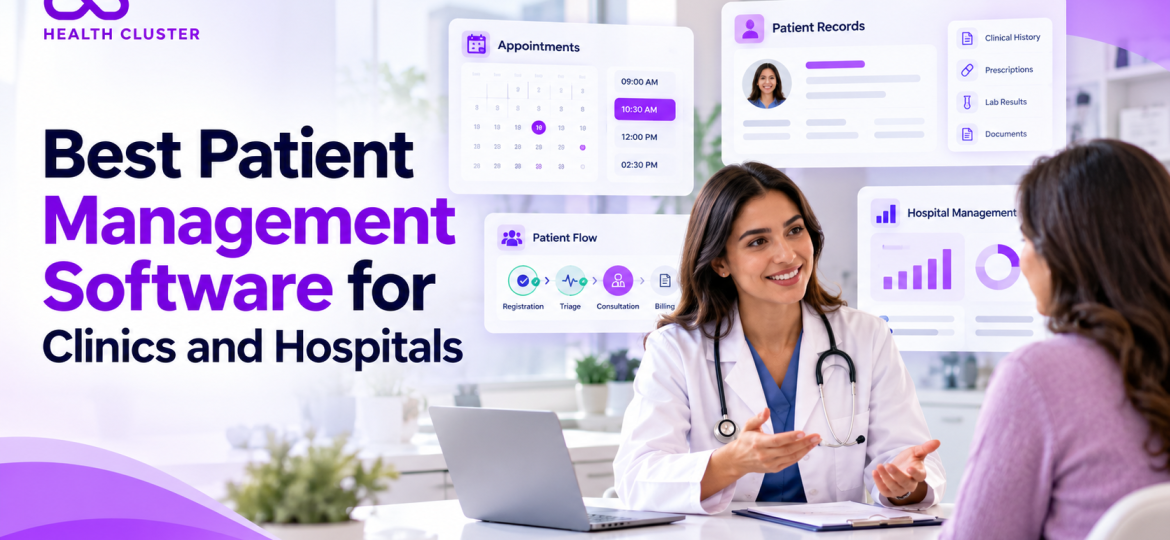
Healthcare is becoming more connected every day. Patients expect faster service, simple booking, easy communication, and better care. Healthcare providers also need to manage appointments, patient records, visits, billing, insurance, and clinical workflows without adding more manual work.
This is where patient management software plays an important role.
A modern patient management system helps clinics and hospitals manage the complete patient journey from registration to consultation, billing, follow-up, and ongoing care. When it is connected with EMR, HIS, RCM, laboratory, pharmacy, telemedicine, and other healthcare systems, it can become the central part of a connected healthcare operation.
For healthcare providers in the UAE and Saudi Arabia, the right solution must also support local healthcare workflows and interoperability requirements.
What Is Patient Management Software?
Dental PMS is a digital healthcare solution that helps providers manage patients, appointments, visits, clinical information, communication, billing, and other administrative tasks from one system.
Instead of managing patient information across spreadsheets, paper files, separate calendars, and disconnected applications, healthcare teams can use a centralized patient management system.
A typical system may cover:
- Patient registration and demographics
- Patient records management
- Appointment scheduling
- Patient visit management
- Practitioner and doctor management
- Waiting lists and queues
- Patient tracking
- Consent forms
- Insurance and prior authorization requests
- Medical billing
- Insurance claims
- Patient communication
- Reports and analytics
The goal is simple: connect the patient journey and reduce unnecessary manual work.
How Does Patient Management Software Work?
A patient management platform usually starts when a patient is registered with a clinic or hospital.
The system creates or retrieves the patient’s profile. The patient can then be booked with the right practitioner based on specialty, availability, and schedule.
During the visit, healthcare staff can access the patient’s information and manage the visit workflow. Depending on the solution, the system can connect the visit with the EMR, billing, insurance, pharmacy, laboratory, or other healthcare services.
After the consultation, the patient can continue through billing, insurance claims, follow-up appointments, prescriptions, or other care pathways.
This creates a connected patient journey.
A simplified workflow looks like this:
Registration → Appointment → Check-In → Waiting List → Patient Visit → Clinical Documentation → Billing → Insurance Claim → Follow-Up
This is one reason integrated patient management software can be more useful than a standalone scheduling tool.
Key Features of Patient Management Software
The best patient management software should support both patient-facing and staff-facing workflows.
1. Patient Registration and Patient Records
Patient registration is the starting point for most healthcare workflows.
A patient management system should allow staff to create and maintain patient profiles while reducing duplicate records. Important demographic and administrative information should be easy to access and update.
Patient records can also connect with an electronic medical record (EMR) or electronic health record (EHR) system.
This gives doctors and healthcare staff a more complete view of the patient.
2. Appointment Scheduling and Calendar Management
A good patient appointment scheduling software should make it easy to manage doctors, practitioners, clinics, specialties, rooms, and appointment slots.
A central calendar can help reception teams see upcoming appointments and available slots.
Healthcare providers can use scheduling tools to:
- Book new appointments
- Reschedule or cancel appointments
- Manage practitioner availability
- View daily and future schedules
- Reduce scheduling conflicts
- Manage follow-up visits
Better scheduling can also improve patient flow and reduce unnecessary waiting.
3. Patient Visit Management
Patient visit management software helps healthcare teams manage what happens after a patient arrives at the facility.
The workflow can include check-in, queue management, practitioner assignment, consultation, clinical documentation, billing, and checkout.
This provides better visibility into the patient’s current visit.
Staff can also use patient visit tracking to understand where a patient is within the care process.
For busy clinics, this can help improve patient flow and support faster service.
4. Patient Tracking and Waiting Lists
Patients may move through several stages during a healthcare visit.
They may register, check in, wait for a doctor, visit another department, complete a laboratory test, visit the pharmacy, and then proceed to billing.
A patient tracking feature gives staff better visibility into this journey.
A waiting list management and queue management system can also help reception teams manage patients when appointments are delayed or when walk-in patients need care.
This can improve operational visibility without requiring staff to rely on manual lists.
5. Practitioner Management
Healthcare organizations need to manage more than patients.
They also need to manage doctors, nurses, therapists, dentists, and other practitioners.
A patient management platform can connect practitioners with their schedules, specialties, appointments, patient visits, and clinical workflows.
This is especially useful for multispecialty clinics and healthcare groups with several providers.
6. Patient Consent Forms
Consent is an important part of many healthcare workflows.
Digital patient consent forms can help healthcare providers collect, store, and manage patient consent as part of the digital patient journey.
Instead of relying only on paper forms, healthcare organizations can include consent within the patient workflow.
This can make information easier to access and reduce manual paperwork.
7. Prior Authorization Requests
Insurance workflows can add significant administrative work for healthcare teams.
A modern patient management solution can connect patient visits and clinical workflows with insurance processes such as eligibility checks, prior authorization requests, billing, and claims.
This helps reduce disconnected workflows between clinical and financial teams.
8. Quick Billing and Insurance Claims
A patient visit often leads to a financial transaction.
Medical billing software, healthcare billing, insurance claims management, and Revenue Cycle Management can therefore play an important role in patient management.
When patient management software connects with RCM, the organization can link services delivered during the visit with billing and insurance workflows.
This can help healthcare teams improve billing visibility and reduce manual data entry.
Health Cluster takes an integrated approach by combining EMR, HIS, RCM, medical billing, insurance billing, reporting, and related healthcare workflows.
Benefits of Patient Management Software
The benefits of patient management software go beyond replacing paper records.
Better Patient Experience
Patients do not want to repeat the same information at every stage of their visit.
A connected patient management system can give staff access to the information they need and support smoother patient journeys.
Faster Clinic Operations
Automated scheduling, digital registration, queue management, and visit tracking can reduce repetitive administrative work.
Staff can spend less time managing spreadsheets and manual records.
Better Patient Flow
When staff can see appointments, queues, waiting lists, and active visits, they have better visibility into patient movement.
This can help identify delays and improve patient flow.
Better Data Access
A centralized system can give authorized users access to relevant patient information.
With proper role-based access control, healthcare organizations can control what different users can view or manage.
Fewer Duplicate Records
Duplicate patient records can create confusion and affect clinical and financial workflows.
Patient search, patient merge, and duplicate-record management features can help organizations maintain cleaner patient data.
Better Revenue Cycle Management
Connecting patient visits with billing, insurance claims, prior authorization, and RCM can create a more complete financial workflow.
This can help organizations track revenue from the point of service through reimbursement.
Better Reporting
Healthcare reporting and analytics can help management understand appointments, patient volumes, practitioner performance, revenue, claims, and other operational metrics.
This supports data-driven decision-making.
Patient Management Software vs EMR
A common question is: What is the difference between patient management software and EMR?
Patient management software focuses heavily on the administrative and operational patient journey.
An EMR focuses more on the patient’s clinical record and medical information.
However, modern healthcare platforms increasingly connect both.
For example, a patient may book an appointment through the patient management workflow. The doctor then opens the patient’s EMR during the visit. The visit creates charges, which move into billing and RCM. If insurance is involved, the claim can continue through the appropriate workflow.
This creates a connected healthcare ecosystem instead of separate systems.
Health Cluster combines patient-facing and operational workflows with EMR, HIS, RCM, telemedicine, LIS, pharmacy, and other healthcare capabilities.
Patient Management Software for Clinics
Clinics have different needs based on their size and specialty.
A small clinic may need patient registration, appointment scheduling, billing, EMR, and basic reporting.
A multispecialty clinic may need practitioner management, patient tracking, insurance claims, laboratory integration, pharmacy integration, and multi-branch management.
A patient management software for clinics should therefore be scalable.
It should support current needs while allowing the organization to add users, departments, specialties, locations, and healthcare modules as it grows.
Dental Patient Management Software
Dental practices have their own workflows.
Dental patient management software should support dental appointments, patient records, practitioner schedules, clinical documentation, treatment workflows, billing, and insurance.
Dental clinics can also benefit from a connected Dental EMR and patient management system.
For Saudi dental clinics, regional healthcare and insurance workflows are also important. Health Cluster provides dental solutions that combine dental clinic management, Dental EMR, appointments, billing, claims, and ZATCA e-invoicing workflows.
Patient Relationship Management Software
Patient management is not only about appointments and records.
Healthcare providers also need to maintain communication with patients.
Patient relationship management software can support communication before, during, and after a visit.
This can include:
- Appointment reminders
- Follow-up communication
- Patient notifications
- Digital patient engagement
- Patient portal access
- WhatsApp-based communication
- Telemedicine communication
A WhatsApp chatbot can also help patients access basic services such as appointment information, reminders, or other approved patient interactions.
The goal is to make communication easier without adding more work for reception teams.
Patient Management Software for UAE Healthcare Providers
Healthcare providers in the UAE need to consider more than basic clinic management.
Organizations operating in Dubai, Abu Dhabi, Sharjah, Ras Al Khaimah, and other Emirates may need healthcare software that fits the wider UAE digital health ecosystem.
Important areas can include:
- NABIDH
- MALAFFI
- Riayati
- DHA requirements
- Healthcare interoperability
- EMR and EHR
- Insurance workflows
- Medical billing
- Patient data security
For Dubai providers, NABIDH-compliant healthcare software and secure health information exchange are important considerations.
For Abu Dhabi providers, MALAFFI is a key part of the healthcare information exchange environment.
Health Cluster provides NABIDH integration and supports healthcare interoperability across relevant UAE workflows.
This makes regional compliance an important factor when selecting patient management software UAE providers can use as part of a wider healthcare platform.
Patient Management Software for KSA Healthcare Providers
Saudi Arabia has also made major progress in digital healthcare.
Healthcare organizations in Riyadh, Jeddah, Dammam, and other cities need systems that can support clinical, administrative, insurance, and financial workflows.
Important considerations include:
- NPHIES
- ZATCA
- E-invoicing
- EMR
- HIS
- Insurance claims
- Prior authorization
- RCM
- Healthcare interoperability
- Data security
A patient management system KSA should therefore be able to work as part of the wider digital healthcare environment.
For example, patient registration and clinical visits can connect with insurance workflows. Claims can then move through the required process, while financial workflows can support billing and e-invoicing.
Health Cluster provides NPHIES-focused EMR capabilities and integrates healthcare workflows across HIS, LIS, pharmacy, insurance, and RCM.
For Saudi providers, this integrated approach can be more useful than using separate patient management, EMR, billing, and insurance systems.
How to Choose the Best Patient Management Software
Choosing the best patient management software depends on the needs of the healthcare organization.
Before selecting a platform, consider these areas:
1. Core patient workflows:
Can the system manage registration, appointments, visits, patient tracking, and follow-ups?
2. EMR and HIS integration:
Can patient management connect with clinical records and hospital workflows?
3. Insurance and RCM:
Can the platform support billing, prior authorization, claims, and revenue cycle management?
4. Interoperability:
Can it connect with laboratories, pharmacies, external healthcare systems, and regional health information exchanges?
5. Security:
Does it provide role-based access, audit trails, and appropriate controls for sensitive healthcare data?
6. Scalability:
Can it support a small clinic today and multiple branches or facilities later?
7. Regional requirements:
For UAE and KSA providers, does the solution support the relevant healthcare and financial ecosystem?
8. Patient engagement:
Does it support patient portals, mobile access, communication, reminders, and digital services?
Why Integrated Patient Management Matters
Healthcare is not a collection of isolated departments.
A patient’s appointment affects reception. The visit affects the EMR. The consultation may affect laboratory and pharmacy workflows. The services delivered affect billing. Insurance affects claims. Management needs reporting across all of these areas.
When systems are disconnected, staff may have to enter the same information multiple times.
That creates more work and more opportunities for errors.
An integrated patient management software platform creates a connected workflow.
Health Cluster follows this model by bringing together EMR, HIS, RCM, telemedicine, LIS, pharmacy, reporting, analytics, and digital health capabilities within its healthcare ecosystem.
Why Choose Health Cluster for Patient Management?
Health Cluster is built as a connected digital healthcare platform for clinics, hospitals, polyclinics, medical centers, and healthcare groups.
Its healthcare ecosystem combines patient and clinical workflows with EMR, HIS, RCM, telemedicine, LIS, pharmacy, patient and doctor applications, analytics, and other digital health capabilities.
The platform also supports cloud-based and on-premises deployment options, allowing healthcare organizations to select an approach that fits their operational requirements.
For healthcare providers in the UAE and KSA, regional interoperability is also an important part of the platform.
Health Cluster supports healthcare workflows involving NABIDH, MALAFFI, Riayati, NPHIES, and ZATCA, helping providers build a more connected digital healthcare environment.
Whether you manage a dental clinic, specialty clinic, polyclinic, medical center, or hospital, the goal is the same: connect people, processes, and technology around the patient.
Frequently Asked Questions
What is patient management software?
Patient management software is a healthcare system used to manage patient registration, appointments, visits, records, communication, billing, insurance, and other patient-related workflows.
What does patient management software do?
It helps healthcare organizations manage the patient journey from registration and appointment scheduling to consultation, billing, claims, and follow-up.
What are the benefits of patient management software?
Key benefits include better patient flow, faster administrative work, centralized information, improved scheduling, better communication, reduced duplicate records, and stronger reporting.
Can patient management software integrate with EMR?
Yes. Modern patient management platforms can integrate with EMR systems so that administrative and clinical workflows can work together.
Can patient management software integrate with LIS and pharmacy systems?
Yes. An integrated healthcare platform can connect patient workflows with laboratory and pharmacy systems to create a more complete patient journey.
Can patient management software support telemedicine?
Yes. Patient management can connect with telemedicine for online appointments, virtual consultations, patient communication, and digital clinical workflows.
Is patient management software cloud-based?
Many modern solutions are cloud-based. However, healthcare organizations may also require on-premises or other deployment models based on their infrastructure, security, and operational requirements.
How secure is patient management software?
Security depends on the platform and its implementation. Healthcare organizations should look for role-based access control, audit trails, secure authentication, data protection, and appropriate compliance measures.
What is the difference between patient management software and hospital management software?
Patient management software focuses strongly on patient-related workflows. Hospital management software, or HIS, covers a wider range of hospital operations, including clinical, financial, administrative, laboratory, pharmacy, and other workflows.
How do I choose the best patient management software?
Look for a platform that supports your patient journey, integrates with EMR and other healthcare systems, supports billing and insurance workflows, provides strong security, scales with your organization, and meets relevant regional requirements.
Final Thoughts
The right patient management software can do more than organize appointments.
It can connect registration, scheduling, patient visits, clinical records, practitioners, billing, insurance, communication, reporting, and follow-up into one connected workflow.
For clinics and hospitals, this can mean less manual work, better visibility, smoother patient flow, and a stronger patient experience.
For healthcare providers in the UAE and KSA, regional interoperability and compliance should also be part of the decision. Solutions should be evaluated based on the requirements of the markets and facilities they serve.
Health Cluster brings these capabilities together through an integrated healthcare platform designed for modern healthcare organizations.
Looking for patient management software for your clinic or hospital? Explore Health Cluster and see how an integrated EMR, HIS, RCM, patient management, and digital healthcare platform can support your organization. Book a demo with Health Cluster today.