

Healthcare facilities operating in Dubai need to understand how their Electronic Medical Record (EMR) systems connect with NABIDH, the Dubai Health Authority’s (DHA) Health Information Exchange (HIE) platform.
The NABIDH onboarding process involves more than submitting an application. Healthcare providers must prepare their facility information, assess EMR compatibility, meet applicable technical and clinical data standards, complete integration testing, and coordinate with DHA before going live.
For hospitals, clinics, laboratories, and other healthcare providers, understanding the NABIDH integration process in Dubai helps teams prepare for implementation and understand the requirements involved in connecting their healthcare systems.
A well-planned onboarding process can help facilities avoid unnecessary delays, improve data quality, and prepare their clinical and technical teams for a successful integration.
This guide explains the NABIDH onboarding requirements, DHA application process, EMR configuration, clinical data mapping, integration testing, and expected implementation timeline.
1. What Is the NABIDH Onboarding Process?
NABIDH onboarding is the process through which a DHA-licensed healthcare facility prepares and connects its EMR system to Dubai’s Health Information Exchange platform.
The purpose is to support the secure exchange of patient health information between participating healthcare providers, helping authorized healthcare professionals access relevant clinical records when needed.
Understanding the role of NABIDH in Dubai’s healthcare ecosystem helps healthcare organizations understand why standardized information exchange is important for connected healthcare services.
Who Is Involved in NABIDH Onboarding?
The onboarding process generally involves three key stakeholders:
Healthcare Facility
The healthcare facility provides licensing information, organizational details, clinical data, operational information, and necessary approvals. Its administrative, clinical, and IT teams coordinate the internal preparation.
EMR Vendor
The EMR vendor handles technical configuration, data mapping, interface development, interoperability requirements, and integration testing according to the applicable specifications.
Dubai Health Authority (DHA)
DHA oversees the applicable onboarding procedures, technical standards, and regulatory requirements for healthcare facilities under its jurisdiction.
Healthcare facilities should review the official NABIDH Policies and Standards before starting implementation.
2. Step-by-Step NABIDH Integration and Onboarding Process
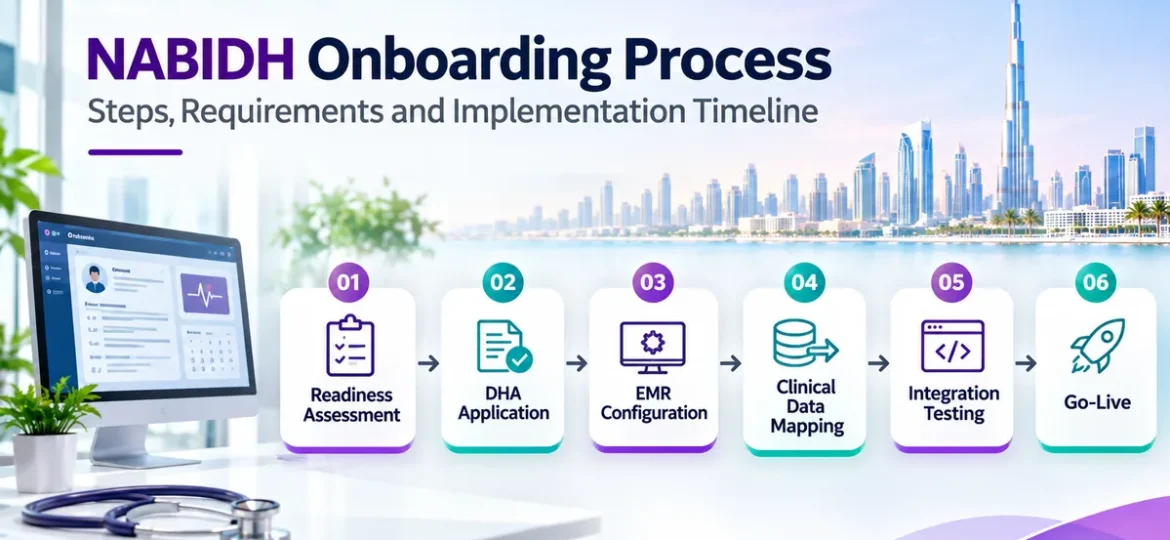
Although implementation requirements can differ between facilities, the NABIDH onboarding process generally involves six stages.
Step 1: Initial NABIDH Readiness Assessment
The first step is to assess whether the healthcare facility and its existing EMR system are ready for NABIDH integration.
A readiness assessment helps identify technical, clinical, operational, and data-related gaps before the formal implementation begins.
The assessment typically covers:
- DHA healthcare facility licensing details.
- Existing EMR capabilities and integration support.
- Patient registration and identification workflows.
- Clinical documentation and coding practices.
- Patient data quality and completeness.
- Technical infrastructure and information security.
- Healthcare professional and facility identifiers.
The EMR vendor should also identify gaps between the existing system and applicable NABIDH requirements.
Facilities evaluating their existing software can explore a NABIDH-compatible EMR solution to understand the importance of EMR capabilities and integration readiness.
Step 2: DHA NABIDH Onboarding Application and Approval
Healthcare facilities must initiate the onboarding process through the applicable DHA procedure.
According to DHA’s Clinical Data Coding and Terminology Standards, licensed facilities intending to integrate with NABIDH should inform the Health Information and Smart Health Department by submitting an application to NABIDH@dha.gov.ae to obtain permission to initiate onboarding.
The facility may need to provide relevant information, including:
- Healthcare facility licensing details.
- Facility and organizational information.
- EMR vendor and system details.
- Relevant technical information.
- Applicable onboarding documentation.
The next steps depend on DHA’s review and the instructions provided to the facility.
Healthcare providers should verify the current application procedure, contact details, and documentation requirements directly with DHA before submitting their application.
Step 3: Technical Assessment and EMR Configuration
Once the onboarding process progresses, the healthcare facility and EMR vendor work together to address the technical requirements.
This stage involves reviewing applicable NABIDH specifications and configuring the EMR system to support the required information exchange.
Key activities include:
- Configuring facility and healthcare professional identifiers.
- Mapping patient demographic information.
- Preparing clinical data structures.
- Configuring supported integration interfaces.
- Reviewing applicable messaging and interoperability standards.
- Implementing authentication and access controls.
- Reviewing system connectivity and security.
The technical approach depends on DHA’s applicable specifications and the facility’s integration scope.
Facilities should also assess their broader healthcare technology requirements, including their hospital information system in the UAE and its ability to support connected clinical and administrative workflows.
Step 4: Clinical Data Mapping and Standardization
Clinical data mapping is an important part of the NABIDH integration process.
Information stored in an EMR must follow the applicable clinical coding and terminology standards so that exchanged records retain their intended meaning.
Typical areas requiring review include:
- Patient demographics and identification.
- Medical history and clinical encounters.
- Diagnoses and clinical conditions.
- Procedures and medications.
- Laboratory results and other clinical information.
- Healthcare provider and facility details.
Missing information, inconsistent codes, duplicate patient records, and incorrect mappings can create problems during testing.
For example, a diagnosis stored as free text may require standardized clinical coding before it can be exchanged in the expected format.
Facilities should document their data mapping rules and address identified data quality issues before moving towards production.
Step 5: NABIDH Integration Testing and Validation
Before production deployment, the integration must undergo technical and clinical validation.
Testing helps identify whether information is structured correctly, transmitted successfully, and interpreted as expected.
The testing process may include:
Interface and Connectivity Testing: Verify that the EMR system can communicate with the designated integration interface.
Patient Identification Validation: Confirm that patient identifiers and demographic information are mapped correctly.
Clinical Data and Terminology Checks: Validate diagnoses, procedures, medications, and other clinical information.
Message Structure Validation: Check message formatting, mandatory fields, and applicable technical specifications.
Authentication and Authorization Testing: Verify that the applicable access and security mechanisms are configured correctly.
Error Handling and Failed-Message Review: Identify rejected transactions and confirm that errors can be investigated and resolved.
Clinical Record Verification: Confirm that the expected information is exchanged and processed through the applicable workflow.
The EMR vendor and healthcare facility should resolve identified issues and complete the applicable validation requirements before proceeding.
Step 6: Production Readiness and NABIDH Go-Live
Once the required technical and onboarding activities are completed, the healthcare facility can proceed according to DHA’s production access and go-live arrangements.
Before going live, the facility should confirm:
- Required integration configurations are complete.
- Clinical data mapping has been validated.
- User access and permissions are configured.
- Operational teams understand their responsibilities.
- Technical support procedures are established.
- Error monitoring and issue resolution processes are available.
After deployment, ongoing monitoring is important to identify failed transactions, data inconsistencies, and connectivity issues.
Healthcare facilities should maintain coordination between their administrative, clinical, and technical teams to support ongoing integration operations.
3. How Long Does NABIDH Integration Take?
There is no single implementation timeline that applies to every healthcare facility.
The NABIDH integration timeline depends on several factors, including:
- Existing EMR readiness.
- Healthcare facility size.
- Technical complexity.
- Clinical data quality.
- Integration scope.
- Testing requirements.
- DHA onboarding and approval arrangements.
The following table provides an illustrative project-planning estimate. These durations are not official DHA service-level commitments.
| Implementation Stage | Indicative Duration |
|---|---|
| Initial readiness assessment | 1–2 weeks |
| Documentation and onboarding coordination | 1–3 weeks |
| Technical configuration and data mapping | 2–4 weeks |
| Integration testing and issue resolution | 2–3 weeks |
| Production preparation and go-live | Depends on DHA arrangements |
Some activities can run in parallel.
Facilities with existing NABIDH-ready EMR systems may require less technical preparation, while complex environments or multiple locations may need additional time.
DHA review, approval, and onboarding scheduling can also affect the overall implementation timeline.
Important: Healthcare providers should treat these figures as internal planning estimates and confirm the actual project schedule with their EMR vendor and DHA.
4. Common Challenges During NABIDH Onboarding
Healthcare providers may encounter several technical and operational challenges during the implementation process.
Understanding these issues early can help reduce delays and improve onboarding preparation.
| Common Challenge | Potential Impact | Recommended Preparation |
|---|---|---|
| Incomplete patient information | Patient matching issues | Review patient demographics and identifiers |
| Clinical coding differences | Inconsistent clinical records | Standardize applicable clinical codes |
| EMR compatibility | Additional technical development | Conduct an early EMR readiness assessment |
| Testing failures | Delayed validation | Test sample messages and data mappings |
| Missing facility information | Configuration issues | Verify facility and practitioner identifiers |
| Operational readiness | Go-live delays | Assign responsibilities and train relevant teams |
| Security configuration gaps | Authentication and access issues | Review applicable security requirements |
Early planning and coordination between the healthcare facility and EMR vendor can help reduce these challenges.
5. Frequently Asked Questions About NABIDH Onboarding
Is NABIDH integration mandatory for healthcare facilities in Dubai?
DHA has issued regulatory communications concerning NABIDH integration requirements for healthcare facilities under its jurisdiction. Applicability and obligations should be confirmed against the latest DHA circulars and the facility’s licensing category.
What documents are required for NABIDH onboarding?
Requirements depend on the facility and DHA’s onboarding instructions. Relevant information may include facility licensing details, organizational information, EMR details, and applicable onboarding documentation.
Can an existing EMR system integrate with NABIDH?
Yes. An existing EMR system can be integrated if it supports the applicable NABIDH technical, clinical, security, and interoperability requirements. Additional configuration or development may be necessary.
Does NABIDH onboarding require technical testing?
Yes. Technical and clinical validation are important to verify connectivity, data structures, patient identification, and information exchange before production deployment.
How can healthcare facilities avoid NABIDH integration delays?
Healthcare facilities should start with an EMR readiness assessment, address data quality issues early, confirm applicable DHA requirements, assign clear responsibilities, and allocate sufficient time for testing and issue resolution.
Who is responsible for NABIDH integration?
The healthcare facility coordinates its licensing, operational, and clinical preparations. The EMR vendor handles the relevant technical configuration and integration activities, while DHA oversees applicable onboarding procedures and requirements.
Can multiple healthcare facilities be onboarded under one organization?
The applicable arrangements depend on DHA’s requirements, facility licensing structure, and organizational setup. Healthcare organizations should confirm the process for each licensed facility with DHA.
6. Prepare Your Healthcare Facility for NABIDH Integration with Health Cluster
A well-planned NABIDH onboarding process requires coordination between healthcare administrators, clinical teams, IT departments, and EMR providers.
Understanding DHA requirements, preparing clinical data, validating technical configurations, and establishing post-deployment monitoring can make the implementation process more manageable.
Health Cluster provides healthcare management and EMR solutions designed to support digital healthcare workflows across hospitals, clinics, and other healthcare organizations.
Healthcare providers planning NABIDH integration can discuss their EMR requirements, technical readiness, and integration approach with the Health Cluster team.
Planning Your NABIDH Onboarding?
Prepare your healthcare facility for a structured integration project.
Book an EMR demo with Health Cluster to discuss your existing healthcare system, integration requirements, and implementation objectives with our team.


