
Introduction
Saudi Arabia’s healthcare system is moving fast toward full digital compliance. For dental clinics, digital transformation is no longer optional. It is a regulatory requirement driven by NPHIES and the Saudi Health Insurance Council. Clinics that delay automation face claim rejections, payment delays, and operational inefficiency.
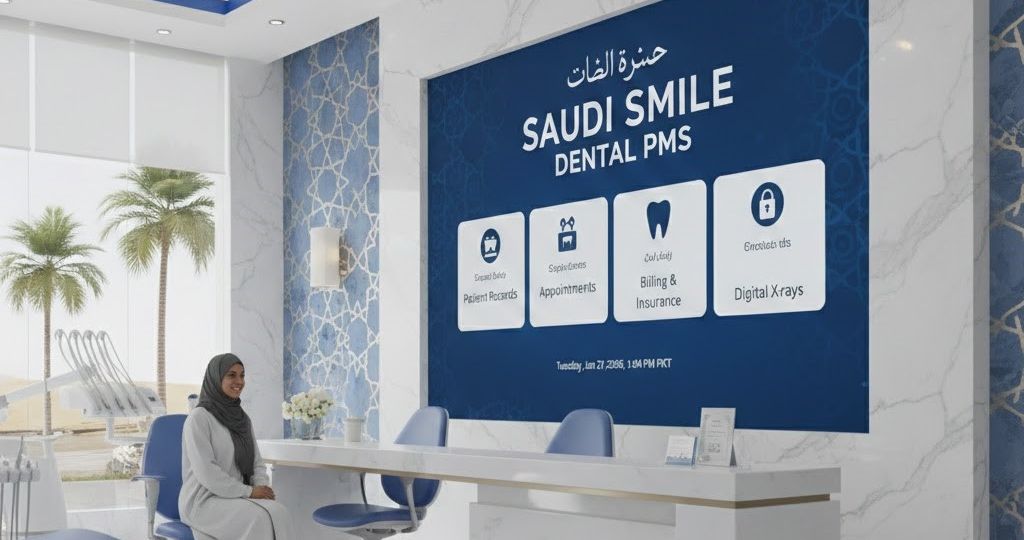
Modern dental software in Saudi Arabia must do three things well. It must manage daily clinical operations. It must integrate smoothly with NPHIES. It must remain scalable as the clinic grows.
This guide explains how dental PMS software works in Saudi Arabia, how NPHIES integration affects clinics, and what features actually matter when choosing a system.
NPHIES Dental Software
NPHIES is the national health information exchange platform in Saudi Arabia. It standardizes how clinics submit insurance claims, verify eligibility, and exchange medical data.
For dental clinics, NPHIES compliance is mandatory. Non-compliant clinics face:
- Claim rejections
- Delayed reimbursements
- Audit risks
- Regulatory penalties
NPHIES dental software ensures that:
- Patient eligibility is verified in real time
- Claims follow standardized coding
- Approvals and rejections are tracked digitally
- Data is transmitted securely to insurers
Without proper NPHIES integration, even a well-run clinic will struggle with cash flow.
NPHIES Dental Medical Integration
NPHIES integration is not a plugin. It is a full workflow connection between your dental PMS and the national platform.
A standard claim flow looks like this:
- Patient registration and eligibility check
- Treatment coding using ICD and CPT standards
- Electronic claim submission to NPHIES
- Automated approval or rejection response
- Payment reconciliation and reporting
Common integration problems include:
- Incorrect coding formats
- Missing mandatory fields
- Poor API handling
- Lack of audit logs
A serious dental PMS must handle these issues natively, not through manual workarounds.
Preparing Your Clinic for NPHIES Integration
Most clinics fail NPHIES onboarding because they treat it as a technical task only. It is an operational change.
Preparation checklist:
- Technical readiness
Stable internet, secure servers, backup systems. - Data readiness
Clean patient records, standardized coding, complete insurance profiles. - Staff training
Front desk, billing, and doctors must understand claim workflows. - Testing phase
Run test claims before going live. - Compliance validation
Confirm approval from NPHIES before production use.
Skipping any of these steps leads to rejected claims and wasted time.
What Is the Best Dental Software?
There is no universal best system. There is only the best system for your clinic size and compliance needs.
Use these criteria:
- Full NPHIES compliance
- Strong practice management features
- Cloud-based with high uptime
- Scalable from single clinic to chains
- Local Saudi support and training
- Regular regulatory updates
Avoid systems that are generic clinic software without Saudi compliance built in.
What Are the Different Types of Dental Software?
Dental clinics usually use a combination of systems:
- Practice Management Software (PMS)
Scheduling, billing, patient management. - Electronic Dental Records (EDR)
Clinical history, treatment plans, progress notes. - Billing and Claims Software
Insurance coding, submissions, reconciliations. - Imaging and Radiology Software
X-rays, CBCT, image storage and viewing. - CRM and Appointment Systems
Reminders, recalls, patient communication.
Modern PMS platforms integrate all of these into one system.
What Software Do Dental Labs Use?
Dental laboratories use specialized lab management systems.
Key functions include:
- Case intake from clinics
- Work order tracking
- Technician workflow management
- Delivery and billing tracking
- Integration with clinic PMS systems
Without integration, labs and clinics waste time on manual coordination.
Features of Dental Software in Saudi Arabia
Core features required in the Saudi market:
- Native NPHIES integration
- ICD and CPT coding support
- Insurance claim management
- Appointment scheduling
- Electronic patient records
- Clinical charting and imaging
- Financial reporting and analytics
- Multi-branch support
- Arabic and English interface
- Role-based access control
- Audit logs and compliance reports
If a system lacks any of these, it is not enterprise-ready.
Templates of Dental Software in Saudi Arabia
Templates improve speed and reduce clinical errors.
Common templates include:
- Treatment plan templates
- Clinical note templates
- Consent form templates
- Prescription templates
- Insurance claim templates
Well-designed templates reduce documentation time and improve compliance quality.
Leading Practices and Healthcare Centers Powered by Cloudpital
Cloudpital supports:
- Single specialty dental clinics
- Multi-branch dental chains
- Hospital dental departments
- Integrated lab networks
These organizations use Cloudpital for:
- Centralized patient records
- Unified billing and claims
- Real-time performance reporting
- Regulatory compliance management
Scale matters. Systems that fail at scale collapse operationally.
Ready-Made Solutions. From Single Clinic to Public Health Programs
A serious dental PMS must scale across three levels:
- Single clinic
Fast setup, low cost, basic compliance. - Multi-branch networks
Central reporting, shared records, standardized workflows. - Public health programs
High volume processing, national reporting, advanced analytics.
Ready-made platforms reduce implementation risk and shorten go-live time.
Conclusion
Dental software in Saudi Arabia is no longer about convenience. It is about survival under regulatory pressure.
Clinics must choose systems that:
- Meet NPHIES requirements
- Improve operational efficiency
- Scale with business growth
- Protect long-term compliance
Anything less is a liability, not a solution.