
Healthcare providers in Abu Dhabi face growing pressure to deliver quality care while managing complex billing, insurance, and compliance requirements. Every patient visit creates financial transactions that must be accurate, timely, and compliant with the Department of Health (DoH) Abu Dhabi regulations.
This is where Malaffi RCM becomes essential.
A modern Malaffi Revenue Cycle Management (RCM) solution connects clinical care with financial operations. It helps hospitals, clinics, day surgery centers, diagnostic centers, and home healthcare providers manage the complete revenue cycle, from patient registration to final payment.
When integrated with a Hospital Information System (HIS) and Electronic Medical Record (EMR), Malaffi RCM improves billing accuracy, speeds up insurance claims, reduces claim denials, and strengthens cash flow. It also supports healthcare interoperability by enabling secure data exchange through the Malaffi Health Information Exchange (HIE).
In this guide, you’ll learn:
- What Malaffi RCM is
- How it works
- Why it matters for healthcare providers in Abu Dhabi
- How Health Cluster helps organizations improve healthcare revenue while staying compliant
What Is Malaffi RCM?
Malaffi RCM refers to Revenue Cycle Management processes and software that are integrated with Malaffi, Abu Dhabi’s Health Information Exchange (HIE).
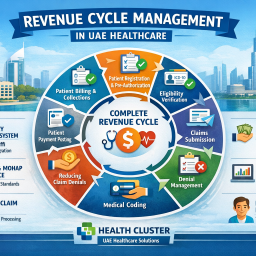
Revenue Cycle Management covers every financial step of a patient’s journey. It begins when a patient books an appointment and ends when the healthcare provider receives full reimbursement.
A typical revenue cycle includes:
- Patient registration
- Insurance eligibility verification
- Clinical documentation
- Medical coding
- Charge capture
- Claim submission
- Insurance payment
- Denial management
- Patient billing
- Revenue reporting
When these processes are connected with Malaffi integration, providers gain access to more accurate patient information and better clinical documentation. This supports cleaner insurance claims and reduces administrative errors.
Understanding Malaffi
Malaffi is the official Health Information Exchange (HIE) for Abu Dhabi.
It securely connects hospitals, clinics, laboratories, pharmacies, and other healthcare providers across the emirate.
Authorized healthcare professionals can access a patient’s unified medical record directly within their EMR. This includes:
- Patient demographics
- Diagnoses
- Allergies
- Laboratory results
- Radiology reports
- Medications
- Procedures
- Clinical documents
- Vital signs
This secure information sharing improves care coordination and reduces duplicate testing while supporting better clinical decisions.
Although Malaffi is primarily a clinical data exchange platform, the quality of clinical information directly impacts medical billing, insurance claims, and revenue cycle management.
What Is Revenue Cycle Management (RCM)?
Revenue Cycle Management is the process healthcare organizations use to manage financial transactions throughout the patient journey.
A strong Healthcare Revenue Cycle ensures providers receive payment quickly while maintaining compliance with payer and regulatory requirements.
The cycle usually follows these steps:
Patient Registration
Accurate patient information is collected during registration.
Incorrect demographics can lead to rejected insurance claims later.
Insurance Verification
Insurance eligibility is verified before treatment.
This reduces payment delays and prevents unnecessary claim rejections.
Clinical Documentation
Doctors document diagnoses, procedures, medications, and treatment plans inside the EMR.
Complete documentation supports accurate coding and claim submission.
Medical Coding
Medical coders assign ICD-10 and CPT codes based on clinical documentation.
Correct coding is essential for insurance reimbursement.
Claim Submission
Electronic claims are submitted to insurance companies using standardized formats.
Automation helps reduce manual work and improves claim accuracy.
Payment Collection
Payments may come from insurance companies or patients.
RCM software tracks outstanding balances and payment status.
Denial Management
Denied claims are reviewed, corrected, and resubmitted.
Modern denial management tools identify recurring issues and help reduce future denials.
How Does Malaffi Support Revenue Cycle Management?
Many people ask: Does Malaffi handle billing?
Not directly.
Malaffi is not a billing platform.
Instead, it provides secure clinical data that strengthens the entire billing process.
When Malaffi integration is combined with a powerful EMR, HIS, and Revenue Cycle Management software, healthcare providers benefit from:
Better Clinical Documentation
Claims depend on accurate documentation.
When physicians have access to complete patient histories through Malaffi, documentation becomes more complete and accurate.
Cleaner Insurance Claims
Missing diagnoses, medications, allergies, or previous procedures often lead to claim rejection.
Malaffi improves information availability, helping providers submit cleaner claims.
Improved Eligibility Verification
Access to accurate patient records supports insurance verification and reduces registration errors.
Faster Claims Processing
Accurate documentation reduces manual corrections.
Insurance companies receive cleaner claims, resulting in quicker reimbursement.
Better Care Coordination
When multiple providers share patient information, unnecessary repeat tests are reduced.
This lowers healthcare costs while improving patient outcomes.
Why Is Malaffi RCM Important for Healthcare Providers in Abu Dhabi?
Healthcare providers in Abu Dhabi operate under strict regulatory requirements.
The Department of Health Abu Dhabi (DoH) requires eligible healthcare facilities to connect with Malaffi to support secure health information exchange. Many facility types, including hospitals, medical clinics, dental clinics, laboratories, home healthcare providers, and telemedicine providers, are required to connect if they meet the applicable criteria.
However, compliance alone is not enough.
Healthcare organizations also need to:
- Improve revenue
- Reduce administrative costs
- Speed up reimbursements
- Maintain billing accuracy
- Deliver better patient experiences
This is why Malaffi Revenue Cycle Management has become a strategic investment.
Organizations with integrated systems experience:
- Better healthcare interoperability
- More accurate insurance claims
- Lower denial rates
- Faster payment cycles
- Improved financial visibility
- Stronger regulatory compliance
Common Challenges Without Malaffi RCM
Healthcare providers using disconnected systems often face several challenges.
High Claim Rejection Rates
Incomplete documentation leads to rejected claims.
Each rejection increases administrative work and delays revenue.
Duplicate Data Entry
Staff may enter the same information into multiple systems.
This wastes time and increases the risk of errors.
Slow Insurance Payments
Manual claim preparation often causes delays.
Small mistakes can postpone reimbursement for weeks.
Revenue Leakage
Missed charges, incorrect coding, and incomplete documentation reduce revenue.
These losses often go unnoticed until financial reports are reviewed.
Compliance Risks
Healthcare regulations continue to evolve.
Organizations using outdated systems face higher risks during audits and inspections.
How Health Cluster Supports Malaffi RCM
Health Cluster provides a fully integrated healthcare platform built specifically for the UAE healthcare market.
Instead of using separate applications for clinical care and billing, Health Cluster combines everything into one connected ecosystem.
The platform includes:
- Cloud-based EMR
- Integrated Hospital Information System (HIS)
- End-to-end Revenue Cycle Management
- Insurance claims management
- Medical billing
- Patient billing
- Eligibility verification
- Claim validation
- Denial management
- Financial reporting
- Malaffi integration
- Healthcare interoperability using HL7 and FHIR standards
Health Cluster also supports secure data exchange, insurance management, electronic pre-authorization, and seamless integration with Malaffi to help healthcare providers improve operational efficiency while meeting UAE regulatory requirements.
With one connected platform, healthcare organizations can reduce manual work, improve claim accuracy, strengthen revenue optimization, and focus more on delivering quality patient care.
How the Malaffi RCM Workflow Improves Healthcare Revenue
A successful Malaffi Revenue Cycle Management process follows every step of the patient journey. Each stage affects the next. If one step contains errors, it can delay payments or increase claim denials.
When your EMR, HIS, and RCM software are fully integrated with Malaffi, information flows smoothly across departments. This reduces manual work and improves financial performance.
1. Patient Registration
The revenue cycle starts when a patient schedules an appointment or walks into a healthcare facility.
Staff collect important information such as:
- Patient demographics
- Emirates ID
- Insurance details
- Contact information
- Referring physician, if applicable
Accurate registration is essential. Even a small spelling mistake or an incorrect insurance number can result in claim rejection.
An integrated Healthcare Information System (HIS) helps validate patient information and reduces registration errors.
2. Insurance Eligibility Verification
Before treatment begins, insurance eligibility should be verified.
Modern Malaffi RCM software can help staff confirm:
- Active insurance coverage
- Policy validity
- Covered services
- Patient co-payment
- Authorization requirements
Eligibility verification prevents unnecessary claim rejections and helps patients understand their financial responsibility before receiving care.
3. Clinical Documentation in the EMR
Doctors document every patient encounter inside the Electronic Medical Record (EMR).
Good documentation includes:
- Symptoms
- Diagnosis
- Medical history
- Examination findings
- Treatment plan
- Prescriptions
- Follow-up instructions
When physicians have access to patient information through Malaffi integration, they can make better clinical decisions while creating more complete documentation.
Accurate documentation forms the foundation of successful medical billing.
Medical Coding and Charge Capture
Once treatment is complete, the documented services must be translated into standardized billing codes.
Professional coders assign:
- ICD-10 diagnosis codes
- CPT procedure codes
- Other payer-required coding standards
Correct coding is critical because insurance companies review these codes before approving payment.
Charge capture also ensures every service provided is billed correctly.
Missing charges lead directly to lost revenue.
Automated RCM systems reduce coding errors by linking documentation with billing workflows.
Electronic Claim Submission
After coding is complete, the claim is prepared and submitted electronically.
Modern Revenue Cycle Management software validates claims before submission by checking for:
- Missing information
- Invalid codes
- Documentation gaps
- Insurance policy issues
- Duplicate claims
This process is often called claim validation.
Submitting cleaner claims increases the chance of first-pass approval and shortens reimbursement time.
Insurance Payment Processing
Once insurers review the claim, payment is processed.
The RCM system tracks:
- Approved claims
- Pending claims
- Rejected claims
- Partial payments
- Outstanding balances
Real-time dashboards help finance teams understand cash flow and identify delays.
Healthcare organizations can respond quickly instead of waiting weeks to discover payment issues.
Denial Management
Even well-prepared claims can sometimes be denied.
Effective claim denial management identifies why claims were rejected and helps teams correct them quickly.
Common reasons include:
- Missing documentation
- Incorrect coding
- Expired insurance
- Duplicate claims
- Authorization issues
- Incomplete patient information
Modern RCM software records denial trends and highlights recurring problems.
Over time, this reduces claim rejection rates and improves overall revenue performance.
Benefits of Malaffi RCM for Healthcare Providers
Healthcare organizations across Abu Dhabi are investing in Malaffi RCM because it improves both clinical and financial outcomes.
Here are some of the biggest benefits.
Faster Insurance Claims
Automation removes many manual tasks.
Claims can be submitted faster with fewer errors, helping providers receive payments sooner.
Better Medical Billing Accuracy
Integrated systems reduce duplicate data entry.
Clinical documentation flows directly into billing, improving coding accuracy and reducing missed charges.
Reduced Claim Denials
One of the biggest goals of Revenue Cycle Management is reducing insurance claim rejections.
With accurate documentation, insurance verification, and automated claim validation, providers can significantly improve first-pass claim acceptance.
Improved Cash Flow
Faster reimbursement means stronger cash flow.
Healthcare organizations can better manage daily operations, staff salaries, equipment purchases, and future investments.
Better Patient Experience
Patients also benefit from efficient revenue cycle management.
They experience:
- Faster registration
- Clear billing information
- Fewer billing disputes
- Better communication
- Shorter waiting times
A smoother financial process improves overall patient satisfaction.
Stronger Regulatory Compliance
Healthcare providers in the UAE must comply with regulatory requirements established by the Department of Health Abu Dhabi (DoH).
Integrated systems help organizations maintain accurate records, secure patient information, and support compliance with healthcare data exchange standards.
Why EMR and HIS Integration Matters
Many healthcare providers still use disconnected software systems.
The EMR stores clinical records.
Another application manages billing.
A separate system handles appointments.
This creates duplicate work and increases the chance of errors.
An integrated Hospital Information System (HIS) connects every department.
Information entered once becomes available throughout the organization.
When combined with Malaffi integration, providers gain additional clinical insight that supports both patient care and financial operations.
An integrated environment allows:
- Patient registration to update billing automatically
- Clinical documentation to support medical coding
- Laboratory and radiology results to become part of the patient record
- Insurance claims to use complete clinical information
- Finance teams to track payments in real time
This connected workflow improves efficiency while reducing administrative burden.
Healthcare Interoperability Through HL7 and FHIR
Modern healthcare depends on systems that can communicate securely.
This is known as healthcare interoperability.
Two widely used standards are:
HL7
HL7 allows healthcare applications to exchange patient information consistently.
It supports communication between:
- HIS
- EMR
- Laboratory Information Systems
- Radiology systems
- Pharmacy systems
- Billing platforms
FHIR
FHIR is a modern interoperability standard designed for secure and flexible healthcare data exchange.
FHIR makes it easier for different healthcare applications to share information while supporting future digital health initiatives.
Together, HL7 and FHIR help create connected healthcare ecosystems that improve care coordination and operational efficiency.
How Malaffi Integration Supports Better Billing
Although Malaffi is not a billing platform, it supports better billing by improving the quality of clinical information available to providers.
This leads to:
- More complete patient histories
- Better diagnosis documentation
- Improved coding accuracy
- Stronger insurance claims
- Lower denial rates
- Better reimbursement outcomes
Better information leads to better financial performance.
That is why many healthcare organizations view Malaffi integration as an important part of their digital transformation strategy.
Best Practices for Successful Malaffi RCM
Technology alone cannot optimize the revenue cycle.
Healthcare providers should also follow proven operational practices.
Train Clinical and Administrative Teams
Everyone involved in the patient journey should understand how documentation affects billing.
Regular training helps reduce avoidable mistakes.
Verify Insurance Before Every Visit
Insurance details can change over time.
Eligibility verification before treatment reduces payment delays and unexpected claim denials.
Improve Clinical Documentation
Complete documentation supports accurate coding and cleaner claims.
Physicians should document diagnoses, procedures, medications, and follow-up plans clearly.
Monitor Revenue Cycle KPIs
Healthcare organizations should regularly track:
- First-pass claim acceptance rate
- Claim denial rate
- Days in accounts receivable
- Average reimbursement time
- Collection rate
- Outstanding balances
These metrics help identify opportunities for continuous improvement.
Use Integrated Healthcare Software
Choosing a platform that combines EMR, HIS, Medical Billing, Insurance Claims Management, and Malaffi integration reduces complexity and improves efficiency across the organization.
Choosing the Best Malaffi RCM Software in UAE
Selecting the right Malaffi RCM software is an important decision for any healthcare provider. The right solution should do more than process claims. It should connect clinical, operational, and financial workflows in one platform.
Whether you operate a hospital, medical center, specialty clinic, diagnostic laboratory, or home healthcare service, your software should help your team work faster while improving patient care.
When evaluating a Revenue Cycle Management software solution, look for these features.
Native Malaffi Integration
The software should support seamless Malaffi integration to enable secure healthcare data exchange.
A connected platform gives clinicians access to complete patient information while supporting better documentation and billing.
Integrated EMR and HIS
Using separate systems often creates duplicate work.
Choose a platform that combines:
- Electronic Medical Record (EMR)
- Hospital Information System (HIS)
- Medical billing
- Appointment scheduling
- Patient registration
- Insurance claims management
- Financial reporting
An integrated solution improves efficiency across every department.
Automated Insurance Claims
A modern RCM solution should automate repetitive tasks.
Look for features such as:
- Eligibility verification
- Claim validation
- Electronic claim submission
- Claim tracking
- Payment reconciliation
- Denial management
Automation reduces manual work and improves claim accuracy.
Real-Time Reporting
Revenue decisions should be based on accurate data.
The software should provide dashboards for:
- Revenue performance
- Outstanding claims
- Collection rates
- Claim denial trends
- Accounts receivable
- Provider productivity
Real-time insights help management make informed decisions.
Scalable Cloud Infrastructure
Healthcare organizations continue to grow.
Cloud-based healthcare software allows providers to add users, locations, and services without major infrastructure changes.
It also improves accessibility, security, and business continuity.
Why Health Cluster for Malaffi RCM?
Health Cluster provides a complete digital healthcare platform designed for the needs of healthcare providers in the UAE.
Instead of relying on multiple disconnected systems, healthcare organizations can manage clinical, operational, and financial processes from one integrated platform.
Our solution supports the complete healthcare revenue cycle while helping providers improve efficiency, reduce claim denials, and maintain regulatory compliance.
End-to-End Revenue Cycle Management
Health Cluster manages every stage of the revenue cycle, including:
- Patient registration
- Insurance eligibility verification
- Appointment management
- Clinical documentation
- Medical coding support
- Charge capture
- Electronic claim submission
- Insurance billing
- Patient billing
- Claim reconciliation
- Denial management
- Financial reporting
This integrated workflow reduces administrative work and helps healthcare providers receive payments faster.
Integrated EMR and HIS
Health Cluster combines a powerful Electronic Medical Record (EMR) with a comprehensive Hospital Information System (HIS).
This allows every department to work with the same patient information.
Clinical documentation, laboratory results, radiology reports, pharmacy records, and billing data remain connected throughout the patient journey.
Healthcare Interoperability
Health Cluster supports modern interoperability standards, including HL7 and FHIR, making it easier to connect with healthcare systems and exchange patient information securely.
The platform also supports Malaffi integration, helping eligible healthcare providers participate in Abu Dhabi’s connected healthcare ecosystem.
Intelligent Medical Billing
Accurate billing starts with accurate clinical documentation.
Health Cluster helps organizations improve billing quality through:
- Automated workflows
- Coding support
- Claim validation
- Revenue analytics
- Payment tracking
- Denial analysis
These features reduce errors and improve reimbursement rates.
Designed for UAE Healthcare
Health Cluster is built for healthcare providers across the UAE.
Our platform supports the operational and compliance needs of:
- Hospitals
- Medical centers
- Specialty clinics
- Dental clinics
- Day surgery centers
- Diagnostic laboratories
- Home healthcare providers
- Rehabilitation centers
By combining Healthcare Information Systems, Medical Billing, Revenue Cycle Management, and Malaffi integration, Health Cluster helps organizations improve both patient care and financial performance.
Frequently Asked Questions About Malaffi RCM
What is Malaffi RCM?
Malaffi RCM refers to Revenue Cycle Management processes that work alongside Malaffi, Abu Dhabi’s Health Information Exchange. While Malaffi focuses on secure health information exchange, an integrated RCM solution helps healthcare providers manage billing, insurance claims, payments, and revenue more efficiently.
How does Malaffi RCM work?
Malaffi shares authorized clinical information between connected healthcare providers. When integrated with an EMR, HIS, and RCM platform, this information supports accurate documentation, medical coding, cleaner insurance claims, and faster reimbursement.
Is Malaffi mandatory for healthcare providers in Abu Dhabi?
The Department of Health Abu Dhabi (DoH) requires eligible healthcare facilities to connect to Malaffi in accordance with its regulations and implementation plans. Providers should review the latest DoH and Malaffi requirements to understand their obligations.
How does Malaffi improve medical billing?
Malaffi improves access to patient health information. Better clinical information supports more accurate documentation, which leads to better coding, stronger insurance claims, fewer denials, and improved revenue collection.
What is the difference between Malaffi and an EMR?
An EMR stores patient records within a healthcare organization.
Malaffi is a Health Information Exchange (HIE) that securely shares authorized patient information across connected healthcare providers in Abu Dhabi.
They work together but serve different purposes.
How does Malaffi integrate with EMR and HIS?
Healthcare software that supports Malaffi integration exchanges clinical information securely using approved interoperability standards.
This allows healthcare professionals to access relevant patient information directly from their existing workflows.
How can healthcare providers reduce insurance claim denials?
Healthcare providers can reduce denials by:
- Verifying insurance eligibility before treatment
- Improving clinical documentation
- Using accurate ICD-10 and CPT coding
- Validating claims before submission
- Monitoring denial trends
- Using integrated Revenue Cycle Management software
Which healthcare software supports Malaffi integration?
Healthcare software that is designed for the UAE market and supports approved interoperability standards can integrate with Malaffi. Health Cluster offers an integrated healthcare platform with EMR, HIS, Revenue Cycle Management, and support for Malaffi integration to help providers streamline clinical and financial workflows.
Conclusion
Healthcare organizations can no longer treat clinical operations and financial management as separate processes.
A connected Malaffi RCM strategy helps providers improve documentation, strengthen medical billing, reduce insurance claim denials, and accelerate reimbursement. It also supports healthcare interoperability, better patient experiences, and compliance with the evolving requirements of the Department of Health Abu Dhabi.
By integrating EMR, HIS, and Revenue Cycle Management into one platform, healthcare providers gain better visibility across the entire patient journey while improving operational efficiency and long-term financial performance.
Health Cluster delivers an end-to-end healthcare solution built for the UAE. From Malaffi integration and healthcare interoperability to medical billing, insurance claims management, and advanced Revenue Cycle Management, our platform empowers healthcare organizations to operate more efficiently and deliver better patient outcomes.
Ready to Improve Your Revenue Cycle?
If you’re looking for a reliable Malaffi RCM solution in the UAE, Health Cluster can help. Our integrated platform combines EMR, HIS, medical billing, insurance claims management, and Malaffi integration into a single, intelligent healthcare ecosystem.
Contact Health Cluster today to schedule a demo and discover how our Malaffi Revenue Cycle Management solution can help your organization reduce claim denials, improve cash flow, strengthen compliance, and deliver exceptional patient care.