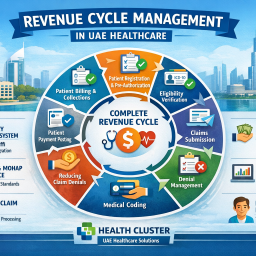

Healthcare providers need more than a system that creates bills. They need a connected way to manage the full path from patient registration to final payment.
This is where RCM software comes in.
Revenue Cycle Management software connects clinical, insurance, billing, claims, payment, and financial workflows. It helps healthcare organizations reduce errors, speed up reimbursements, manage denials, and improve cash flow.
For healthcare providers in the UAE and Saudi Arabia, the need is even greater. Providers must manage complex insurance workflows while meeting local healthcare and e-invoicing requirements.
So, what are the most important RCM software features?
This guide covers 15 essential features to look for in modern healthcare revenue cycle management software.
What Is RCM Software?
RCM software is a healthcare technology solution used to manage the financial side of patient care.
RCM stands for Revenue Cycle Management. The revenue cycle starts when a patient registers or books an appointment. It continues through insurance verification, authorization, service delivery, coding, billing, claims, payment, and collections.
In simple terms, RCM software helps healthcare providers get paid correctly and on time.
A typical healthcare revenue cycle includes:
- Patient registration
- Insurance verification
- Eligibility checking
- Prior authorization
- Charge capture
- Medical coding
- Claim creation
- Claim submission
- Claim tracking
- Denial management
- Payment posting
- Accounts receivable management
- Patient collections
- Financial reporting
Modern healthcare RCM software connects these steps in one workflow. This reduces manual work and gives finance teams better control over revenue.
Why Is RCM Software Important for Healthcare Providers?
Healthcare revenue can be lost at many points.
A patient’s insurance may not be verified. A service may not be coded correctly. A required prior authorization may be missed. A claim may contain an error. A payment may not be posted on time.
Each issue can delay revenue.
A strong revenue cycle management system helps prevent these problems before they become costly.
The main benefits include:
- Faster claim processing
- Fewer billing errors
- Better insurance verification
- Lower claim denial rates
- Faster payment posting
- Better accounts receivable control
- Improved cash flow
- Less revenue leakage
- Better financial visibility
- More efficient healthcare billing
For hospitals, clinics, medical centers, and medical practices, RCM is not only a billing function. It is a key part of financial performance.
15 Essential RCM Software Features
The best RCM software features should support the complete revenue cycle. They should also connect with the clinical and administrative systems used by healthcare teams.
Here are the key features to consider.
1. Patient Registration and Demographic Management
The revenue cycle starts with accurate patient information.
An RCM system should capture patient demographics, contact details, insurance information, payer details, and other billing data.
Accurate registration reduces errors later in the process.
For example, an incorrect patient ID or insurance number can cause a claim rejection. A connected system can use registration data across billing and claims workflows.
This is why patient registration is one of the most important features of healthcare RCM software.
2. Insurance Eligibility Verification
Insurance eligibility verification helps providers confirm whether a patient has active coverage before services are delivered.
This feature can check important information such as:
- Insurance status
- Payer details
- Coverage dates
- Patient benefits
- Coverage limits
- Co-payment requirements
- Deductibles
Early verification can prevent avoidable billing problems.
For providers, this means fewer surprises after treatment and better control over the revenue cycle.
In Saudi Arabia, eligibility workflows are also an important part of NPHIES-enabled healthcare operations. Health Cluster’s RCM platform supports NPHIES-related workflows such as eligibility verification, authorization, claims, and payment processes.
3. Prior Authorization Management
Some services require approval before treatment.
Missing an approval can result in a rejected or unpaid claim.
Prior authorization management helps teams request, track, and manage approvals.
A modern RCM system should allow users to see authorization status and connect approvals with the relevant patient and service.
This helps reduce missed approvals and supports smoother insurance billing.
4. Charge Capture
Every billable service needs to be captured correctly.
Charge capture software helps record services, procedures, consultations, tests, medications, and other billable activities.
When RCM is connected to an EMR or HIS, charges can flow from clinical workflows into billing.
This reduces manual data entry.
It also helps prevent missed charges, which can contribute to revenue leakage.
5. Medical Coding
Medical coding converts clinical services into standardized codes used for billing and claims.
An RCM solution should support the coding workflows required by the target market and payer environment.
Common coding processes may include ICD and CPT-based workflows.
Accurate medical coding is important because coding errors can result in:
- Claim rejection
- Claim denial
- Payment delays
- Incorrect reimbursement
- Compliance issues
Integrating coding with clinical documentation and billing can help improve accuracy.
6. Automated Claim Creation and Submission
Claim processing is a major part of the healthcare revenue cycle.
Modern claims management software should help create claims from patient and clinical data. It should also support electronic claims submission.
Automation can reduce manual work and help teams process claims faster.
A good system should provide visibility into claim status, including submitted, accepted, rejected, denied, and paid claims.
For healthcare providers, this means fewer disconnected processes and better claim tracking.
7. Claim Scrubbing and Validation
Sending an incorrect claim creates more work.
Claim scrubbing helps identify errors before a claim is submitted.
Validation can check information such as:
- Patient details
- Insurance information
- Provider information
- Coding
- Charges
- Required fields
- Payer rules
The goal is simple: catch problems early.
Better claim validation can support a higher clean claim rate and reduce avoidable claim rejections.
8. Claims Tracking and Adjudication
Submitting a claim is not the end of the process.
Healthcare teams need to know what happens after submission.
Claims tracking provides visibility into claim status and payer responses.
An RCM system should help teams identify:
- Claims waiting for processing
- Accepted claims
- Rejected claims
- Denied claims
- Paid claims
- Claims requiring action
This helps revenue teams focus on claims that need attention instead of checking multiple systems manually.
9. Denial Management
Denial management is one of the most important RCM software capabilities.
A denied claim means the provider has not received the expected payment.
Common causes can include incorrect coding, missing information, eligibility issues, authorization problems, or payer-specific requirements.
A strong denial management workflow should help teams:
- Identify the denial.
- Understand the reason.
- Correct the issue.
- Resubmit the claim.
- Track the outcome.
The system should also help identify repeated denial patterns.
This is important because good RCM is not only about fixing denials. It is about preventing the same denials from happening again.
10. Payment Posting and Reconciliation
Once payments arrive, they need to be recorded correctly.
Automated payment posting helps match payments with claims, invoices, and patient accounts.
The system should support both insurance and patient payments.
Payment reconciliation helps finance teams compare expected payments with received payments.
This gives providers better control over:
- Paid claims
- Outstanding balances
- Underpayments
- Patient balances
- Insurance balances
- Payment discrepancies
Accurate payment posting also improves financial reporting.
11. Accounts Receivable Management
Accounts receivable, or AR, represents money that is still owed to the healthcare provider.
Poor AR management can create cash flow problems.
A healthcare RCM system should help teams track outstanding balances and identify accounts that need action.
Useful capabilities include:
- Aging reports
- Outstanding balance tracking
- Payer-wise AR
- Patient-wise AR
- Follow-up management
- Collection tracking
- Aging analysis
Good accounts receivable management in healthcare helps providers reduce the time between service delivery and payment.
12. Patient Billing and Payment Collection
Not all healthcare revenue comes from insurance.
Patients may have co-payments, deductibles, self-pay balances, or other charges.
Patient billing features should provide clear invoices and payment information.
Modern RCM platforms can also support digital payment workflows and patient communication.
For example, a connected healthcare platform can link patient billing with appointments, services, invoices, and payments.
This creates a smoother experience for both patients and finance teams.
13. RCM KPI Dashboard and Analytics
You cannot improve what you cannot measure.
An RCM KPI dashboard gives management a clear view of financial performance.
Important RCM KPIs can include:
- Claim denial rate
- Claim rejection rate
- Clean claim rate
- Collection rate
- Days in accounts receivable
- Outstanding AR
- Payment turnaround time
- Revenue collected
- Revenue leakage
- Payer performance
- Unpaid claims
- Aging balances
Revenue cycle analytics can help management identify trends and problem areas.
For example, if denials increase for one payer, the team can investigate the reason. If AR days increase, management can review collection and payment workflows.
This turns RCM reporting into a decision-making tool.
14. Healthcare Billing Automation
Manual billing creates more opportunities for errors.
Healthcare billing automation can connect services, charges, claims, invoices, payments, and financial records.
Automation can reduce repetitive tasks and allow staff to focus on exceptions.
A modern medical billing software solution should automate as much of the revenue cycle as practical without removing the controls needed by finance and clinical teams.
The result can be faster workflows and better financial visibility.
15. Integration, Interoperability, and Regional Compliance
One of the most important RCM software capabilities is integration.
RCM should not work as an isolated billing system.
It should connect with the EMR, HIS, accounting system, insurance workflows, and other healthcare applications.
For healthcare providers in the UAE and KSA, regional interoperability is also important.
Health Cluster supports a connected healthcare ecosystem that combines EMR, HIS, RCM, billing, insurance, reporting, and other healthcare capabilities. Its platform also supports workflows involving NABIDH, MALAFFI, Riayati, NPHIES, and ZATCA.
UAE Healthcare RCM
Healthcare providers in Dubai, Abu Dhabi, Sharjah, and Ras Al Khaimah operate in a regulated digital healthcare environment.
A modern RCM solution should support the wider healthcare technology ecosystem.
For example:
- NABIDH is important for healthcare providers operating in Dubai.
- MALAFFI supports health information exchange in Abu Dhabi.
- Riayati is part of the UAE’s wider national health information ecosystem.
Health Cluster provides integrated healthcare capabilities designed around these regional requirements.
KSA Healthcare RCM
Saudi healthcare providers also need RCM workflows that fit the local payer and regulatory environment.
NPHIES plays an important role in healthcare insurance workflows in Saudi Arabia.
Modern NPHIES-enabled RCM workflows can support eligibility verification, prior authorization, claims submission, adjudication, payment reconciliation, and denial management.
ZATCA e-invoicing is another important consideration for Saudi healthcare providers.
An integrated healthcare platform can connect billing with compliant e-invoicing workflows instead of forcing finance teams to manage separate processes.
Health Cluster supports NPHIES-related healthcare workflows and ZATCA-ready e-invoicing as part of its KSA-focused healthcare technology offering.
How Does RCM Software Improve Revenue?
The main goal of RCM software is not simply to automate billing.
It is to improve the entire revenue cycle.
A connected RCM workflow can help providers:
Capture more revenue:
Accurate charge capture reduces the risk of missed billable services.
Reduce claim errors:
Eligibility checks, validation, and coding controls can reduce avoidable problems.
Reduce claim denials:
Denial management helps identify, correct, and prevent recurring issues.
Speed up payments:
Electronic claims and automated workflows can reduce delays.
Improve cash flow:
Better AR and payment tracking help providers collect outstanding revenue.
Reduce administrative work:
Automation reduces repetitive manual tasks.
Improve financial visibility:
Dashboards show management where revenue is being lost or delayed.
RCM Software vs. Medical Billing Software
These terms are often used together, but they are not exactly the same.
Medical billing software mainly focuses on creating bills, processing claims, posting payments, and managing billing activities.
RCM software covers a wider financial lifecycle.
It can include patient registration, insurance eligibility, prior authorization, charge capture, coding, claims, denials, payment posting, AR, collections, analytics, and reporting.
In simple terms:
Medical billing is part of revenue cycle management.
For healthcare organizations looking for long-term financial control, an integrated healthcare RCM system can provide broader visibility than a standalone billing tool.
What Should You Look for in RCM Software?
When choosing RCM software, healthcare providers should look beyond the number of features.
The right system should fit the organization’s workflow and market.
Consider these factors:
End-to-End RCM
The platform should cover the complete revenue cycle from registration to payment.
Healthcare Integration
It should connect with EMR, HIS, accounting, insurance, and other relevant systems.
Automation
Look for automated eligibility, claims, payment posting, reporting, and other repetitive workflows.
Compliance
For UAE and KSA providers, check support for the relevant regional requirements and integrations.
Analytics
The system should provide useful RCM KPIs and financial dashboards.
Scalability
The solution should support growing clinics, hospitals, medical groups, and multi-branch organizations.
Ease of Use
Complex software can reduce adoption. Interfaces should be clear and easy for staff to use.
Why Choose Health Cluster for Healthcare RCM?
Health Cluster takes an integrated approach to healthcare revenue cycle management.
Instead of treating RCM as a separate billing function, Health Cluster connects financial workflows with its broader healthcare ecosystem.
The platform combines capabilities across EMR, HIS, RCM, medical billing, insurance billing, reporting, analytics, and digital health. This helps healthcare providers connect clinical services with financial processes.
Health Cluster’s RCM capabilities are designed for different healthcare organizations, including hospitals, clinics, medical centers, specialty practices, and healthcare groups.
For UAE and KSA providers, regional requirements are also a key part of the platform.
The solution supports healthcare workflows involving NPHIES, NABIDH, MALAFFI, Riayati, and ZATCA, helping providers build a more connected digital environment.
Health Cluster also supports cloud-based and on-premises deployment options, giving healthcare organizations flexibility based on their operational needs.
Can a WhatsApp Chatbot Support the Revenue Cycle?
Patient communication is becoming an important part of digital healthcare.
A WhatsApp chatbot can support parts of the patient journey that connect with revenue workflows.
For example, it can help with:
- Appointment requests
- Appointment confirmations
- Patient communication
- Reminders
- FAQs
- Follow-ups
- Patient support
When patient communication is connected to the wider healthcare platform, it can reduce missed appointments and improve engagement.
However, a WhatsApp chatbot should not replace the core RCM system. It should work as part of a connected healthcare ecosystem.
Health Cluster supports WhatsApp-based healthcare communication alongside its broader EMR and HIS capabilities.
What Are the Benefits of RCM Software for Healthcare Providers?
The right RCM software can create benefits across clinical, administrative, and financial teams.
Key benefits include:
- Better cash flow: Faster and more accurate revenue collection.
- Fewer claim denials: Better validation, eligibility, authorization, and denial workflows.
- Less manual work: Automation reduces repetitive billing tasks.
- Improved AR: Teams can identify and follow up on outstanding balances.
- Better reporting: RCM dashboards give management clear financial data.
- Lower revenue leakage: Better charge capture and billing controls reduce missed revenue.
- Improved compliance: Regional integrations and structured workflows support local requirements.
- Better scalability: A connected RCM system can support growing healthcare organizations.
Frequently Asked Questions About RCM Software Features
What is RCM software?
RCM software is a healthcare system that manages the financial lifecycle of patient care, from registration and insurance verification to claims, payments, collections, and financial reporting.
What are the key features of RCM software?
Key RCM software features include eligibility verification, prior authorization, charge capture, medical coding, claims management, claim scrubbing, denial management, payment posting, accounts receivable, patient billing, and RCM analytics.
How does RCM software reduce claim denials?
RCM software can reduce denials by checking eligibility, validating claims, supporting accurate coding, tracking authorization, identifying errors before submission, and managing denied claims.
How does RCM software improve cash flow?
It helps providers submit cleaner claims, track unpaid claims, manage accounts receivable, post payments faster, and identify revenue leakage.
What is the difference between RCM software and medical billing software?
Medical billing software mainly handles billing and claims activities. RCM software covers the wider revenue lifecycle, including registration, eligibility, authorization, coding, billing, claims, payments, AR, collections, and analytics.
Is RCM software suitable for clinics?
Yes. RCM software can support clinics, medical practices, specialty centers, dental practices, medical centers, and hospitals. The right solution can scale based on the organization’s size and workflow.
What should healthcare providers look for in RCM software?
Providers should look for end-to-end revenue cycle workflows, healthcare integrations, automation, claims management, denial management, financial dashboards, analytics, scalability, and support for relevant regional requirements.
Does RCM software support NPHIES?
RCM solutions designed for the Saudi market can support NPHIES-related workflows such as eligibility verification, authorization, claims, and payment processes. Health Cluster provides NPHIES-focused RCM capabilities for Saudi healthcare providers.
Does RCM software support UAE healthcare requirements?
Modern UAE-focused RCM platforms can connect financial workflows with the wider healthcare technology environment. Health Cluster supports healthcare workflows involving NABIDH, MALAFFI, and Riayati.
Final Thoughts
The best RCM software features do more than automate medical billing.
They connect the full revenue cycle.
From patient registration and insurance eligibility to claims, denials, payment posting, accounts receivable, and financial reporting, every stage can affect healthcare revenue.
For providers in UAE, KSA, Saudi Arabia, Dubai, Abu Dhabi, Riyadh, Jeddah, Dammam, Sharjah, and Ras Al Khaimah, regional requirements make the choice of RCM software even more important.
A modern healthcare RCM system should combine automation, integration, analytics, compliance, and ease of use.
Health Cluster brings these capabilities together through an integrated healthcare platform that connects EMR, HIS, RCM, medical billing, insurance, analytics, and regional healthcare workflows.
If your hospital, clinic, or medical group is looking to reduce claim denials, improve collections, control revenue leakage, and gain better financial visibility, now is the time to modernize your revenue cycle.
Explore Health Cluster’s Revenue Cycle Management solution and book a demo to see how an integrated RCM platform can help your healthcare organization improve billing, claims, payments, and revenue performance.