
Healthcare providers in Sharjah are under constant pressure to deliver quality care while maintaining healthy financial performance. Every rejected insurance claim, delayed payment, or billing error affects cash flow. This is why MOH Sharjah RCM has become an essential part of modern healthcare operations.
An effective Revenue Cycle Management (RCM) solution helps hospitals and clinics automate medical billing, reduce claim denials, improve reimbursement rates, and stay compliant with Ministry of Health and Prevention (MOHAP) regulations. When integrated with Riayati, EMR, HIS, and insurance systems, it creates a connected healthcare ecosystem that improves both patient care and financial outcomes.
Health Cluster offers an end-to-end MOH Sharjah RCM Software solution designed specifically for healthcare providers across the UAE. By combining intelligent automation, regulatory compliance, and seamless interoperability, healthcare organizations can simplify billing while improving operational efficiency.
What is MOH Sharjah RCM?
MOH Sharjah RCM refers to the complete Revenue Cycle Management process followed by healthcare providers regulated by the Ministry of Health and Prevention (MOHAP) in Sharjah and the Northern Emirates.
It covers every financial activity from the patient’s first appointment until the healthcare provider receives the final payment.
The process includes:
- Patient registration and insurance eligibility verification
- Appointment scheduling
- Clinical documentation in the Electronic Medical Record (EMR)
- Medical coding using ICD-10 and CPT Codes
- Insurance claims submission
- Claims validation
- Payment reconciliation
- Denial management
- Financial reporting and analytics
The goal is simple.
Deliver excellent patient care while ensuring every eligible service is billed correctly and paid on time.
Why MOH Sharjah RCM Matters for Healthcare Providers
Healthcare providers in Sharjah work within a regulated environment that requires accurate documentation, compliant billing, and secure health information exchange.
Incorrect coding, missing documentation, or incomplete patient records can result in:
- Rejected insurance claims
- Payment delays
- Revenue leakage
- Increased administrative work
- Compliance risks
An integrated Healthcare Billing and Medical Billing platform reduces these problems through automation and standardized workflows.
Modern RCM Software UAE solutions also provide real-time visibility into revenue performance, allowing healthcare leaders to make faster and more informed decisions.
Understanding Riayati and Its Role in MOH Sharjah RCM
One of the most important components of healthcare in the Northern Emirates is Riayati, the UAE’s National Unified Medical Record (NUMR) platform developed by the Ministry of Health and Prevention (MOHAP). Riayati connects healthcare providers through secure, real-time exchange of patient health information and supports better continuity of care across the UAE.
For healthcare providers in Sharjah, Riayati integration offers several advantages:
- Access to comprehensive patient records
- Better care coordination between facilities
- Improved clinical decision-making
- More complete documentation for insurance claims
- Reduced duplicate tests and medical errors
Since billing accuracy depends on accurate clinical documentation, integrating Riayati, EMR, and Hospital Information System (HIS) strengthens the entire Revenue Cycle Management process. Health Cluster’s platform supports Riayati integration to enable secure exchange of demographics, diagnoses, medications, laboratory results, radiology reports, and other clinical information.
How Does MOH Sharjah Revenue Cycle Management Work?
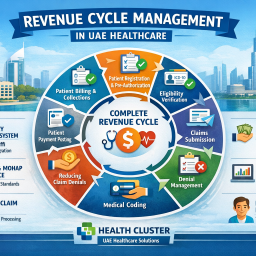
A successful MOH Sharjah RCM process follows several connected stages.
1. Patient Registration
Every revenue cycle begins with accurate patient registration.
The system captures:
- Emirates ID
- Insurance information
- Contact details
- Medical history
- Required demographic information
Accurate registration reduces billing errors later in the workflow.
2. Insurance Eligibility Verification
Insurance eligibility should always be verified before treatment.
Automated verification helps providers:
- Confirm policy validity
- Check coverage limits
- Review exclusions
- Reduce claim rejections
This step improves patient satisfaction while preventing unpaid services.
3. Pre-Authorization
Many medical procedures require insurer approval before treatment.
Automated Pre-Authorization workflows help healthcare providers:
- Submit requests faster
- Track approval status
- Reduce treatment delays
- Improve claims acceptance
4. Clinical Documentation Through EMR
Accurate clinical documentation is the foundation of successful medical billing.
Integrated Electronic Medical Records (EMR) ensure physicians record:
- Diagnoses
- Procedures
- Medications
- Laboratory orders
- Radiology findings
- Progress notes
Better documentation leads to cleaner insurance claims.
5. Medical Coding
Professional coding converts medical services into standardized billing codes.
Healthcare providers commonly use:
- ICD-10
- CPT Codes
Accurate coding improves reimbursement while reducing claim denials.
6. Claims Submission
The billing system generates electronic insurance claims using verified patient and clinical data.
Automation helps ensure:
- Complete documentation
- Correct coding
- Policy compliance
- Faster submission
Electronic claims processing significantly reduces manual work.
7. Claims Processing and Payment
After submission, insurance companies review each claim.
The outcome may be:
- Approved
- Partially approved
- Rejected
- Returned for correction
An effective Claims Management system tracks every claim until payment is received.
8. Denial Management
Even well-managed organizations receive rejected claims.
Strong Denial Management identifies:
- Missing documents
- Coding errors
- Eligibility issues
- Duplicate submissions
- Authorization problems
Instead of simply correcting rejected claims, advanced RCM Software UAE analyzes denial trends and helps prevent similar issues in the future.
9. Payment Reconciliation
Payments received from insurers are matched with submitted claims.
The finance team can quickly identify:
- Outstanding balances
- Underpayments
- Overpayments
- Pending reimbursements
Automated Payment Reconciliation improves financial accuracy.
10. Financial Reporting
Modern healthcare organizations rely on analytics to improve profitability.
Interactive dashboards provide insights into:
- Collection rates
- Claim approval percentages
- Average reimbursement time
- Revenue trends
- Denial rates
- Provider productivity
These reports support better business decisions and continuous revenue optimization.
Why EMR and HIS Integration Improves MOH Sharjah RCM
Disconnected healthcare systems often create duplicate work and billing errors.
An integrated EMR, Hospital Information System (HIS), Laboratory Information System (LIS), RIS, PACS, pharmacy management, appointment scheduling, and billing platform creates a single source of truth.
Benefits include:
- Faster patient registration
- Better documentation accuracy
- Automatic charge capture
- Improved coding accuracy
- Reduced manual data entry
- Real-time healthcare analytics
- Strong audit trails
- Better workflow automation
This integrated approach improves both patient care and healthcare revenue.
Common Challenges in MOH Sharjah Revenue Cycle Management
Many healthcare organizations still face operational challenges.
These include:
- Frequent insurance claim denials
- Incomplete clinical documentation
- Manual billing processes
- Delayed reimbursements
- Coding mistakes
- Limited financial visibility
- Poor interoperability
- Compliance risks
Healthcare providers that continue relying on disconnected systems often experience slower collections and higher operational costs.
Features to Look for in the Best MOH Sharjah RCM Software
When selecting MOH Sharjah RCM Software, healthcare providers should look beyond basic billing capabilities.
The platform should include:
- Integrated EMR, EHR, and Hospital Information System
- Riayati integration
- Automated insurance eligibility verification
- Electronic claims submission
- Intelligent denial management
- Claims resubmission workflows
- Revenue integrity monitoring
- Healthcare compliance support
- Audit trail
- Financial reporting dashboards
- Healthcare automation
- Cloud-based deployment
- Secure patient data management
A connected platform helps eliminate unnecessary administrative work while improving revenue performance.
How Health Cluster Supports MOH Sharjah RCM
Health Cluster provides a comprehensive Healthcare ERP designed specifically for healthcare providers across the UAE.
Its integrated platform combines:
- Electronic Medical Records (EMR)
- Hospital Information System (HIS)
- Practice Management Software
- Clinic Management Software
- Hospital Management Software
- Medical Billing Software UAE
- Revenue Cycle Management
- Insurance claims automation
- Laboratory Information System (LIS)
- RIS and PACS integration
- Pharmacy Management
- Appointment Scheduling
- Analytics Dashboard
Health Cluster also supports Riayati integration, enabling secure exchange of patient information while helping providers comply with MOHAP requirements and improve operational efficiency.
With automation throughout the revenue cycle, healthcare providers can:
- Reduce rejected claims
- Improve coding accuracy
- Accelerate reimbursements
- Increase revenue optimization
- Improve patient experience
- Strengthen healthcare compliance
- Support digital transformation in UAE healthcare
Frequently Asked Questions
What is the difference between medical billing and revenue cycle management?
Medical billing focuses on submitting claims and collecting payments. Revenue Cycle Management covers the entire financial journey, from patient registration to final payment and reporting.
Why is RCM important for clinics in Sharjah?
RCM helps clinics improve cash flow, reduce claim denials, automate billing, and comply with MOHAP regulations while delivering better patient care.
How does EMR integration improve RCM?
Integrated EMR systems provide accurate clinical documentation that supports cleaner claims, better coding, fewer billing errors, and faster reimbursements.
How can healthcare providers reduce insurance claim denials?
Providers can reduce denials by verifying insurance eligibility, obtaining pre-authorizations, maintaining accurate documentation, using correct ICD-10 and CPT codes, and automating claims validation.
What software supports MOH Sharjah RCM?
Healthcare organizations benefit from integrated platforms that combine EMR, HIS, medical billing, claims management, denial management, financial reporting, healthcare analytics, and Riayati connectivity into a single solution.
Conclusion
Healthcare providers in Sharjah need more than a billing system. They need a connected platform that supports clinical care, insurance workflows, regulatory compliance, and financial performance.
A modern MOH Sharjah RCM solution integrates Riayati, EMR, HIS, insurance claims processing, denial management, and healthcare analytics into one seamless workflow. This reduces manual effort, improves reimbursement rates, and strengthens long-term revenue growth.
If your hospital or clinic is looking to improve Revenue Cycle Management, reduce claim denials, and streamline Medical Billing while remaining compliant with MOHAP requirements, Health Cluster provides an end-to-end solution tailored for healthcare providers across the UAE.
Book a free demo with Health Cluster today and discover how our integrated MOH Sharjah RCM Software can help your organization optimize revenue, simplify billing, and deliver better patient care.