
Healthcare providers across Qatar are under constant pressure to deliver quality patient care while maintaining healthy financial performance. Hospitals, clinics, and medical centers must manage growing patient volumes, insurance claims, regulatory requirements, and billing workflows without delays.
This is where RCM Qatar, or Revenue Cycle Management Qatar, becomes essential.
An effective healthcare revenue cycle helps providers collect payments faster, reduce claim denials, improve cash flow, and streamline healthcare operations. From patient registration to the final reimbursement, every step affects revenue and patient satisfaction.
Healthcare providers in Doha and across Qatar are also investing in healthcare digital transformation, cloud-based software, automation, and AI-powered solutions to improve efficiency. Modern RCM software Qatar simplifies medical billing, coding, insurance verification, claims submission, and denial management while supporting regulatory compliance.
At Health Cluster, we provide an end-to-end Revenue Cycle Management (RCM) solution that helps hospitals, clinics, and medical centers automate financial workflows, reduce revenue leakage, and maximize reimbursements through an integrated platform. Our solution combines EMR with RCM, HIS with RCM, medical billing, claims management, analytics, and automation to support sustainable financial growth.
In this guide, you will learn how Revenue Cycle Management works in Qatar, why it matters, the key stages involved, common challenges, and how modern technology helps healthcare providers improve profitability.
What Is Revenue Cycle Management (RCM)?
Revenue Cycle Management (RCM) is the financial process that manages every step of a patient’s journey, from scheduling an appointment to receiving the final payment.
In simple terms, RCM ensures healthcare providers are paid accurately and on time for the services they deliver.
It combines clinical, administrative, and financial processes into one connected workflow.
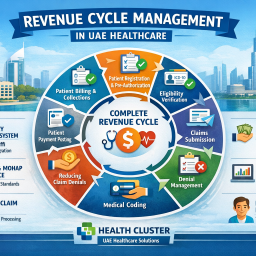
The healthcare revenue cycle usually includes:
- Patient registration
Accurate patient information is collected before treatment begins. - Eligibility verification
Insurance coverage is verified to reduce billing errors. - Prior authorization
Required approvals are obtained before specific treatments or procedures. - Charge capture
Every medical service is recorded correctly. - Medical coding
Services are translated into standardized ICD-10 coding and CPT coding for accurate billing. - Claims submission
Electronic claims are sent to insurance providers for reimbursement. - Payment posting
Payments are recorded and matched with submitted claims. - Denial management
Rejected claims are reviewed, corrected, and resubmitted. - Accounts receivable healthcare
Outstanding balances are monitored and collected.
Together, these steps create an efficient healthcare financial management process that supports long-term financial stability.
Why Revenue Cycle Management Matters in Qatar
Qatar’s healthcare sector continues to expand through new hospitals, specialty clinics, and digital healthcare initiatives. As patient expectations rise and insurance processes become more detailed, providers need better financial control.
Without an efficient Revenue Cycle Management Qatar strategy, organizations often face:
- Delayed reimbursements
- High claim rejection rates
- Billing errors
- Revenue leakage
- Increased administrative workload
- Poor patient financial experience
An optimized RCM Qatar process helps healthcare providers:
- Improve healthcare cash flow
- Reduce denied claims
- Increase clean claims
- Improve healthcare KPIs
- Shorten Days in AR
- Strengthen healthcare finance
- Deliver a better patient experience
Whether you operate a large hospital or a private clinic in Doha, an effective RCM system creates a stronger financial foundation while allowing clinicians to focus on patient care.
Healthcare organizations must also align financial workflows with MOPH Qatar regulations and broader healthcare compliance requirements. A structured RCM process supports accurate documentation, standardized coding, and complete billing records, reducing operational risks while improving reimbursement outcomes.
How Does RCM Work in Qatar?
The process begins before the patient enters the clinic and continues until every payment has been collected.
Step 1: Patient Scheduling and Registration
The revenue cycle starts when a patient books an appointment.
Administrative staff collect:
- Personal details
- Insurance information
- Medical history
- Referral information
Accurate registration prevents billing problems later.
Step 2: Insurance Verification
Insurance verification confirms patient eligibility before treatment.
This step checks:
- Active insurance coverage
- Policy limits
- Covered services
- Co-pay requirements
- Authorization requirements
Early verification reduces claim denials and improves reimbursement rates.
Step 3: Prior Authorization
Some treatments require approval before services are delivered.
Obtaining authorization early prevents payment delays and rejected claims.
Step 4: Clinical Documentation
Doctors record patient encounters inside the Electronic Medical Record (EMR).
Complete documentation supports:
- Accurate coding
- Proper billing
- Clinical compliance
- Better patient care
Incomplete documentation often leads to claim rejections.
Step 5: Medical Coding
Certified coders convert clinical documentation into standardized medical codes using ICD-10 coding and CPT coding.
Correct coding ensures providers receive appropriate reimbursement for the services delivered.
Step 6: Medical Billing and Claims Submission
The billing team prepares electronic claims using the coded information.
Claims are reviewed for errors before submission.
Clean claims are processed faster and reduce administrative work.
Step 7: Claims Management
Insurance companies review submitted claims.
Claims may be:
- Approved
- Partially approved
- Rejected
- Returned for correction
Efficient claims management Qatar helps organizations respond quickly and avoid payment delays.
Step 8: Payment Posting
Once payment is received, it is matched with the original claim.
Accurate payment posting helps finance teams monitor collections and identify outstanding balances.
Step 9: Denial Management
Rejected claims should never be ignored.
Instead, healthcare providers should:
- Identify the reason for denial
- Correct documentation or coding errors
- Resubmit claims promptly
- Track recurring denial patterns
Strong denial management improves long-term financial performance.
Step 10: Patient Billing and Collections
Any remaining patient balance is billed after insurance payments.
A transparent billing process improves patient trust while reducing delayed collections.
This complete workflow forms an end-to-end RCM solution Qatar that supports sustainable healthcare operations.
Key Components of an Effective RCM System
A successful Revenue Cycle Management Qatar strategy is more than medical billing. It connects clinical, financial, and administrative teams into one smooth workflow. Every step should work together to improve accuracy, reduce delays, and increase revenue.
Here are the core components of an effective healthcare RCM Qatar solution.
Patient Registration
The revenue cycle begins with accurate patient registration.
Collecting complete patient information helps prevent billing errors later. Even small mistakes, such as an incorrect insurance number or missing contact details, can result in claim rejections.
A good registration process includes:
- Full patient demographics
- Valid identification
- Insurance details
- Referral information
- Consent forms
Accurate registration builds the foundation for a successful revenue cycle.
Eligibility Verification
Insurance verification should happen before treatment whenever possible.
This step confirms:
- Active insurance coverage
- Covered services
- Co-payment requirements
- Deductibles
- Benefit limits
Proper eligibility verification reduces billing disputes and helps healthcare providers receive payments faster.
Charge Capture
Every consultation, procedure, laboratory test, medication, and medical supply should be captured accurately.
Missing charges directly affect hospital revenue.
An integrated Hospital Information System (HIS) and Electronic Medical Record (EMR) automatically record services, helping reduce manual work and revenue leakage.
Medical Coding
Medical coding converts clinical documentation into internationally recognized billing codes.
Using accurate ICD-10 coding and CPT coding ensures that healthcare providers receive the correct reimbursement while meeting payer requirements.
Poor coding can lead to:
- Claim denials
- Payment delays
- Compliance risks
- Reduced reimbursement
Medical Billing
Medical billing converts coded services into insurance claims.
Modern medical billing software Qatar automatically checks claims for common errors before submission. This increases the number of clean claims and reduces manual corrections.
Claims Management
Effective claims management Qatar involves much more than sending claims.
Healthcare organizations should continuously monitor:
- Claim status
- Pending claims
- Rejected claims
- Appeals
- Payment timelines
Real-time dashboards help billing teams identify bottlenecks before they affect cash flow.
Payment Posting
Every payment received from insurers or patients should be recorded accurately.
Payment posting helps healthcare providers:
- Match payments with claims
- Identify underpayments
- Detect outstanding balances
- Improve financial reporting
Denial Management
No healthcare organization can eliminate denials completely.
However, a structured denial management process can significantly reduce their impact.
Best practices include:
- Identify the root cause of every denial.
- Correct documentation quickly.
- Resubmit claims without delay.
- Monitor denial trends each month.
- Train staff based on recurring issues.
Organizations that actively manage denials often see higher reimbursement rates and better financial performance.
Accounts Receivable Management
Outstanding balances should be monitored daily.
Key metrics include:
- Days in AR
- Collection rate
- Outstanding claims
- Aging reports
Reducing Days in AR improves cash flow and supports long-term financial stability.
Common Revenue Cycle Challenges in Qatar
Healthcare providers across Qatar face several financial and operational challenges that can affect reimbursement and profitability.
Understanding these challenges is the first step toward improving the healthcare revenue cycle.
Frequent Claim Denials
Claim denials remain one of the biggest challenges for hospitals and clinics.
Common reasons include:
- Incorrect patient information
- Coding errors
- Missing documentation
- Expired authorizations
- Eligibility issues
- Duplicate claims
Every denied claim increases administrative costs and delays revenue collection.
Manual Billing Processes
Many healthcare organizations still rely on spreadsheets or disconnected systems.
Manual workflows often result in:
- Human error
- Duplicate work
- Delayed billing
- Missing charges
- Slow reporting
Modern healthcare management software Qatar automates these tasks and improves overall efficiency.
Revenue Leakage
Revenue leakage occurs when healthcare providers fail to bill for all services delivered or when claims are underpaid.
Common causes include:
- Missed procedures
- Incorrect coding
- Lost charges
- Billing delays
- Incomplete documentation
Even small errors can result in significant financial losses over time.
Limited Financial Visibility
Without real-time reporting, healthcare leaders struggle to understand their financial performance.
Modern healthcare analytics dashboards provide visibility into:
- Collection rates
- Claim approval rates
- Denial trends
- Revenue by department
- Outstanding balances
- Financial KPIs
This data supports faster and more informed decision-making.
Increasing Administrative Workload
Administrative teams spend countless hours reviewing claims, correcting errors, and following up with insurers.
Automation reduces repetitive work and allows staff to focus on higher-value tasks.
Compliance Requirements
Healthcare providers in Qatar must maintain accurate documentation and billing records while supporting regulatory compliance and payer requirements.
Integrated systems help standardize workflows and improve documentation quality, reducing compliance risks and simplifying audits.
Benefits of Cloud-Based RCM Software in Qatar
Healthcare providers are moving away from traditional, on-premises billing systems and adopting cloud healthcare software. Cloud-based RCM software Qatar offers greater flexibility, security, and scalability while reducing the burden of IT maintenance.
For hospitals, clinics, and medical centers, cloud technology makes it easier to manage the entire healthcare revenue cycle from a single platform.
Access Information Anytime
Cloud-based RCM systems allow authorized users to securely access financial and operational data from any location.
This benefits:
- Multi-branch hospitals
- Clinic groups
- Finance teams
- Billing departments
- Healthcare executives
Teams can monitor claims, collections, and financial performance in real time without being tied to a single office.
Improve Collaboration
An integrated platform connects front-desk staff, clinicians, coders, billers, and finance teams.
Everyone works from the same data, reducing communication gaps and duplicate work.
This improves the entire patient journey while making healthcare operations more efficient.
Automatic Software Updates
Healthcare regulations and billing requirements continue to evolve.
Cloud platforms can receive regular updates without disrupting day-to-day operations.
This helps providers stay current with new billing rules, security improvements, and software enhancements.
Better Data Security
Healthcare organizations manage sensitive patient and financial information.
Modern cloud platforms include security features such as:
- Data encryption
- Role-based access control
- Audit logs
- Automatic backups
- Disaster recovery
These features help protect patient information while supporting healthcare compliance.
Scale as Your Organization Grows
Whether you operate one clinic or multiple hospitals, cloud-based healthcare management software Qatar can grow with your organization.
You can easily add:
- New branches
- More users
- Additional specialties
- New billing teams
- Expanded reporting capabilities
This makes cloud software a long-term investment for healthcare providers across Qatar.
How to Choose the Best RCM Software in Qatar
Selecting the right RCM software Qatar is one of the most important financial decisions a healthcare organization can make.
The right platform should improve efficiency while supporting future growth.
Here are the key features to consider.
End-to-End Revenue Cycle Management
Look for software that manages the complete revenue cycle, including:
- Patient registration
- Eligibility verification
- Prior authorization
- Medical coding
- Medical billing
- Claims submission
- Payment posting
- Denial management
- Accounts receivable
- Patient billing
Using one integrated solution eliminates the need for multiple disconnected systems.
Integrated EMR and HIS
Choose a platform that combines EMR with RCM and HIS with RCM.
When clinical and financial systems work together, providers benefit from:
- Better documentation
- Accurate charge capture
- Faster billing
- Improved reporting
- Reduced manual data entry
An integrated hospital information system also improves communication across departments.
Automation Features
Automation reduces repetitive administrative work and minimizes human error.
Look for features such as:
- Automatic eligibility verification
- Electronic claims submission
- Claim status tracking
- Smart work queues
- Automated payment reminders
- Real-time dashboards
These tools help healthcare organizations process more claims with greater accuracy.
AI-Powered Capabilities
Modern AI-powered RCM Qatar solutions provide intelligent support throughout the revenue cycle.
Key AI features include:
- Coding assistance
- Denial prediction
- Revenue forecasting
- Claims validation
- Financial analytics
These capabilities help providers reduce claim denials and improve reimbursement rates.
Reporting and Healthcare Analytics
Healthcare leaders need real-time visibility into financial performance.
The software should provide dashboards for:
- Revenue trends
- Clean claim rates
- Days in AR
- Collection performance
- Denial rates
- Outstanding claims
- Healthcare KPIs
These insights support better business decisions and continuous improvement.
Scalability
Your software should support future expansion.
Whether you add new providers, departments, or facilities, the platform should scale without requiring a complete system replacement.
Why Choose Health Cluster for RCM Qatar?
Managing the revenue cycle is about more than submitting claims. It requires connected workflows, accurate clinical documentation, intelligent automation, and continuous financial monitoring.
Health Cluster delivers a comprehensive Revenue Cycle Management Qatar solution designed to help healthcare providers improve operational efficiency and maximize revenue.
Our platform supports hospitals, clinics, specialty centers, and multi-site healthcare organizations with an integrated approach to healthcare financial management.
Complete End-to-End RCM Solution
Health Cluster manages every stage of the healthcare revenue cycle, including:
- Patient registration
- Insurance eligibility verification
- Prior authorization
- Medical coding and billing
- Electronic claims processing
- Claims management
- Payment posting
- Denial management
- Accounts receivable management
- Patient billing
This connected workflow reduces manual effort while improving reimbursement accuracy.
Integrated Healthcare Platform
Unlike standalone billing software, Health Cluster combines financial and clinical workflows into one platform.
Our integrated solution includes:
- Electronic Medical Records (EMR)
- Hospital Information System (HIS)
- Revenue Cycle Management
- Appointment Scheduling
- Pharmacy Management
- Laboratory Management
- Radiology Integration
- Healthcare Analytics
This unified platform eliminates data silos and improves collaboration across departments.
Actionable Financial Insights
Our advanced dashboards provide healthcare executives with real-time visibility into revenue cycle performance.
Track important metrics such as:
- Clean claim percentage
- Collection rate
- Days in AR
- Denial trends
- Outstanding receivables
- Revenue by department
- Financial performance indicators
These insights support faster decision-making and continuous revenue cycle optimization.
Built for Modern Healthcare
Health Cluster is designed to support healthcare organizations as they grow and adapt to changing industry needs.
Whether you operate a single specialty clinic or a large hospital network, our cloud-based platform delivers the flexibility, automation, and scalability needed to improve financial outcomes while supporting digital healthcare transformation.
Frequently Asked Questions
What is Revenue Cycle Management in Qatar?
Revenue Cycle Management (RCM) is the process of managing every financial step of a patient’s healthcare journey. It begins with patient registration and continues through insurance verification, medical coding, claims submission, payment posting, denial management, and patient billing. A strong RCM process helps healthcare providers in Qatar improve cash flow, reduce claim denials, and increase revenue.
How does RCM work?
RCM starts when a patient schedules an appointment. It includes registration, eligibility verification, prior authorization, charge capture, medical coding, billing, claims submission, reimbursement, payment posting, and collections. Every stage works together to ensure providers receive accurate and timely payments.
Is RCM different from medical billing?
Yes. Medical billing is one part of Revenue Cycle Management. RCM covers the entire financial process, from patient registration to the final payment, while medical billing focuses mainly on preparing and submitting claims.
Why is RCM important for hospitals?
RCM improves financial performance by reducing billing errors, speeding up reimbursements, lowering claim denials, improving healthcare cash flow, and increasing operational efficiency. It also supports a better patient financial experience.
What causes claim denials?
Claims are commonly denied because of incorrect patient information, coding errors, missing documentation, inactive insurance coverage, duplicate claims, or missing prior authorizations. Regular audits, staff training, and automated claim validation help reduce these issues.
How can AI improve Revenue Cycle Management?
AI automates repetitive tasks such as eligibility verification, coding assistance, claims validation, denial prediction, and financial reporting. This improves accuracy, reduces manual work, and helps healthcare providers maximize reimbursements.
What are the benefits of cloud-based RCM software?
Cloud-based RCM software offers secure remote access, automatic updates, real-time reporting, scalability, lower infrastructure costs, and improved collaboration across healthcare teams. It also supports business continuity through secure backups and disaster recovery capabilities.
Conclusion
As Qatar’s healthcare sector continues to evolve, financial efficiency has become just as important as clinical excellence. Hospitals, clinics, and medical centers need modern systems that simplify billing, reduce administrative work, and ensure timely reimbursement.
An effective RCM Qatar strategy helps healthcare providers optimize every stage of the healthcare revenue cycle, from patient registration and insurance verification to medical coding, claims management, denial prevention, and patient billing. By combining automation, AI, analytics, and integrated clinical workflows, organizations can reduce revenue leakage, improve healthcare cash flow, and deliver a better patient experience.
Health Cluster provides a comprehensive, cloud-based Revenue Cycle Management solution that brings together EMR, HIS, medical billing, healthcare analytics, and intelligent automation into a single platform. This enables healthcare providers to streamline operations, improve reimbursement accuracy, and focus more on delivering exceptional patient care.
Ready to Transform Your Revenue Cycle?
Whether you’re a hospital, specialty clinic, or medical center in Doha or anywhere in Qatar, Health Cluster can help you build a more efficient, profitable, and future-ready revenue cycle.
Contact Health Cluster today to schedule a personalized demo and discover how our end-to-end RCM solution can reduce claim denials, accelerate reimbursements, and maximize your healthcare revenue.