

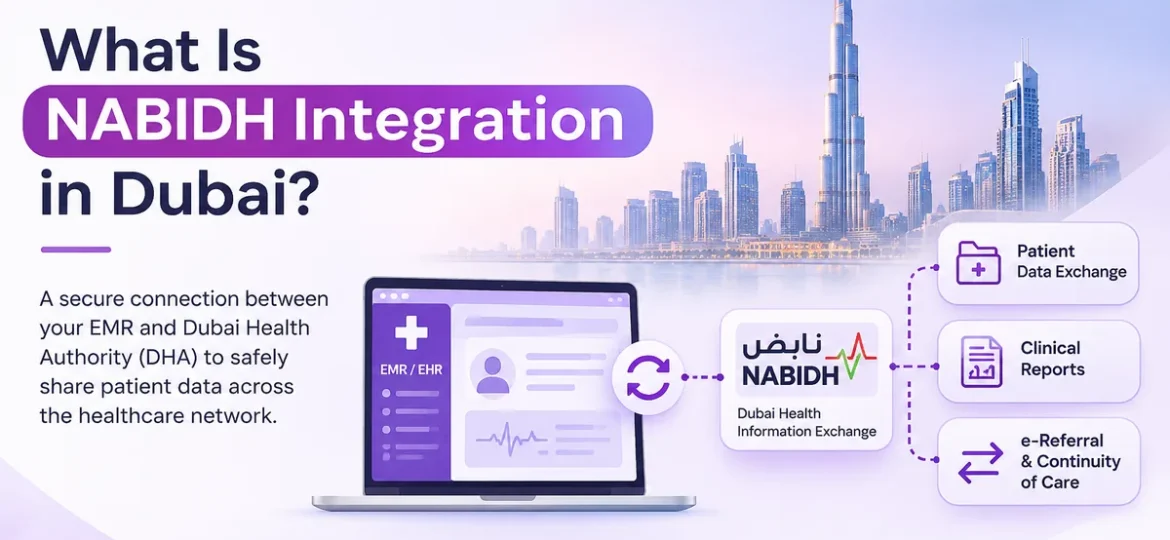
NABIDH DHA integration connects a healthcare facility’s Electronic Medical Record (EMR) or Health Information System (HIS) with Dubai’s Health Information Exchange (HIE), enabling participating healthcare providers to exchange relevant patient information securely.
NABIDH (Network & Analysis Backbone for Integrated Dubai Health) is managed by the Dubai Health Authority (DHA). Its purpose is to improve healthcare information sharing and support continuity of care across connected healthcare facilities.
For clinics and hospitals, NABIDH integration involves more than connecting software. It requires appropriate interoperability standards, clinical data mapping, secure communication, and compliance with applicable DHA requirements.
Is NABIDH Integration Mandatory for Clinics in Dubai?
DHA has issued Circular CIR-2025-00000101 (26 May 2025), addressing EMR systems compliant with NABIDH integration requirements and Single Sign-On (SSO) authentication.
The circular also provides supporting documentation identifying facilities mandated to integrate. Healthcare providers should check the applicable facility category rather than assume identical obligations for every organization.
Non-compliance with applicable DHA requirements can create regulatory and operational issues. Facilities should confirm their specific obligations directly with DHA.
What Are the Technical Requirements for NABIDH Integration?
DHA’s Standards for Interoperability and Data Exchange, Version 2 (DHA/HISHD/ST-02), issued on 2 April 2025 and effective from 2 July 2025, define the interoperability framework for healthcare information exchange.
Important technologies and standards include:
| Standard | Purpose |
| HL7 v2 | Recommended standard for accessing and submitting data |
| HL7 FHIR R4 | Modern healthcare data exchange |
| HL7 CDA R2 | Structured clinical document exchange |
| IHE PIX | Patient identifier cross-referencing |
| IHE PDQ | Patient demographic queries |
| XDS.b | Clinical document sharing |
The applicable standard and implementation profile depend on the exchange use case. Supporting a particular standard does not automatically establish NABIDH compliance.
Healthcare providers should also assess clinical terminology, patient identification, data quality, authentication, access controls, and information security against the relevant DHA policies.
How Does the NABIDH Integration Process Work?
NABIDH onboarding follows a DHA-led process supported by the healthcare facility and its EMR vendor.
The general process includes:
- Readiness assessment: Review the facility’s existing EMR and request DHA readiness assessment through the applicable onboarding process.
- Developer access: Following assessment, DHA provides the facility management with access to create a NABIDH developer account.
- Technical specifications: Review the relevant integration specifications and validate messages using the available HL7 Utility.
- EMR configuration: Configure the required interfaces, data mapping, and communication mechanisms.
- Testing: Validate message structures, patient identification, clinical information, and error handling.
- Onboarding: Submit the request to begin the onboarding process when technically ready and complete the applicable DHA validation requirements.
The actual implementation scope and timeline depend on the facility, EMR readiness, and DHA onboarding process.
Which EMR Software Supports NABIDH Integration?
EMR software must support the applicable DHA interoperability and technical requirements to be considered suitable for NABIDH integration.
When evaluating a vendor, healthcare facilities should look beyond claims such as “NABIDH-ready” or “NABIDH-compatible.”
Evaluate these capabilities:
- HL7 and relevant FHIR interoperability.
- Patient registration and identification.
- Clinical documentation and structured data.
- Diagnosis and medication data management.
- Laboratory and radiology workflows.
- Secure authentication and access controls.
- Audit logging and error monitoring.
- Integration testing and technical support.
Questions to ask your EMR vendor:
- Can you demonstrate an existing NABIDH connection?
- Which DHA interoperability specifications do you support?
- How do you handle rejected messages and patient matching?
- Does your solution support applicable SSO requirements?
- What implementation and ongoing support costs are involved?
A vendor’s technical capabilities, successful onboarding, and DHA acceptance are separate matters. Request evidence of the specific status being claimed.
How Can Health Cluster Help With NABIDH Integration?
Health Cluster provides healthcare technology solutions that clinics and hospitals can evaluate for their EMR and operational requirements.
Healthcare providers considering Health Cluster can arrange a technical discussion to assess their existing systems, clinical workflows, interoperability needs, and potential NABIDH integration scope.
The assessment can help identify required capabilities, technical gaps, and the next steps toward implementation.
The goal is to identify the facility’s existing capabilities, determine any integration gaps, and establish a practical implementation roadmap.
Contact Health Cluster to discuss your facility’s NABIDH integration requirements and arrange a product demonstration.
How Much Does NABIDH Integration Cost in Dubai?
NABIDH integration costs vary depending on the existing EMR, facility requirements, development effort, and implementation scope. There is no universal price applicable to every healthcare provider.
Key cost factors include:
- EMR licensing or software upgrades.
- Integration development and interface configuration.
- Clinical data mapping and validation.
- Infrastructure and security requirements.
- Testing and troubleshooting.
- Staff training and ongoing maintenance.
Before choosing a vendor, request an itemized quotation covering implementation, recurring charges, technical support, and any additional integrations.
How Can Healthcare Facilities Prepare for NABIDH Integration?
Before starting implementation, healthcare providers should:
- Confirm their applicable DHA integration obligations.
- Review the latest NABIDH technical specifications.
- Assess existing EMR interoperability capabilities.
- Check patient identification and clinical data quality.
- Review authentication and security controls.
- Identify required clinical interfaces.
- Assign technical and operational responsibilities.
- Plan testing, monitoring, and ongoing support.
Early preparation helps identify technical gaps and reduce avoidable implementation delays.
Frequently Asked Questions
1. What is the purpose of NABIDH integration?
NABIDH integration enables participating healthcare providers in Dubai to exchange relevant patient information through DHA’s Health Information Exchange, supporting continuity of care and healthcare interoperability.
2. Is NABIDH integration mandatory for all Dubai clinics?
DHA has specified facilities required to integrate through its circular and supporting documents. Each healthcare provider should verify whether its facility category is included.
3. How long does NABIDH integration take?
Implementation time depends on EMR compatibility, data quality, technical complexity, testing, and DHA onboarding. A project-specific assessment is necessary to estimate the timeline.
4. How much does NABIDH integration cost?
Costs depend on software licensing, integration development, data mapping, infrastructure, testing, and maintenance. Healthcare providers should request a quotation based on their actual technical requirements.
Final Thoughts
NABIDH integration is an important part of Dubai’s connected healthcare ecosystem. Choosing the right EMR requires evaluating technical interoperability, data security, clinical workflows, and applicable DHA requirements. If your clinic or hospital is planning an EMR implementation or upgrade, explore Health Cluster’s healthcare solutions and book a demo to discuss your NABIDH integration requirements.


