

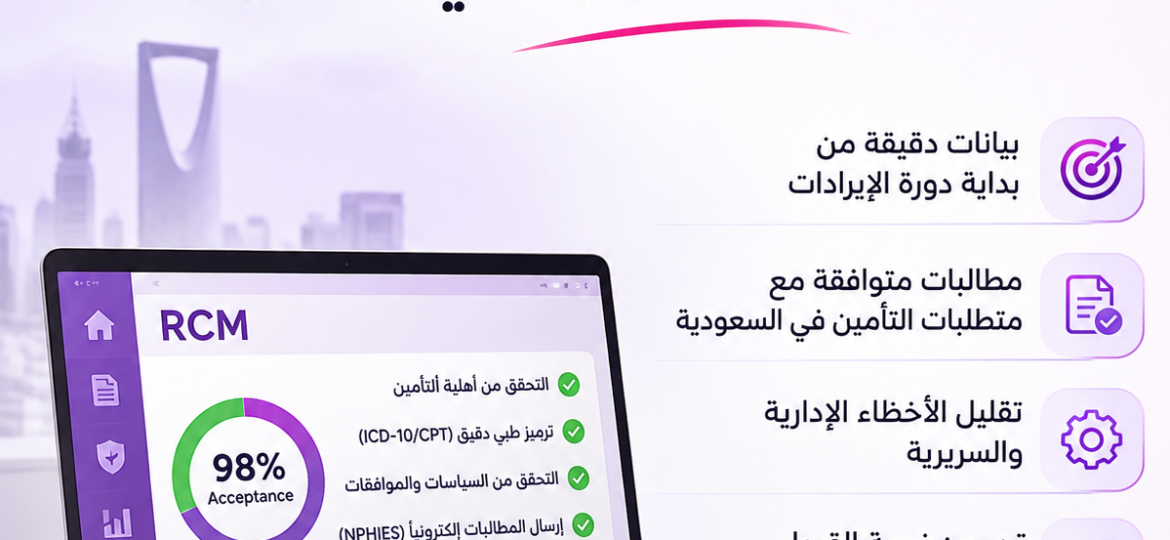
Hospitals and clinics in Saudi Arabia are facing increasing pressure to improve financial performance, reduce operational errors, and expedite payment collection. With the expansion of digital healthcare and the implementation of NPHIES requirements , managing medical revenue has become more complex than ever.
For this reason , using Revenue Cycle Management Software in Saudi Arabia has become a real necessity for healthcare facilities seeking to improve cash flow, reduce rejected claims, and achieve full compliance with health and insurance regulations.
A Revenue Cycle Management System automates the financial and administrative processes associated with the entire patient journey. This journey begins with appointment booking and patient registration, continues through insurance approvals and medical billing, and ends with payment collection and account closure.
In this article, we will review how the RCM program works in Saudi Arabia , its importance to hospitals and clinics, and how it contributes to reducing insurance claims rejections and improving the financial performance of health facilities.
What is a Revenue Cycle Management (RCM) program?
The Revenue Cycle Management program in Saudi Arabia is a specialized system that helps healthcare facilities manage all financial operations related to healthcare services.
This system is known globally as Revenue Cycle Management Software , or RCM Software for short .
The system covers the entire medical revenue cycle, including:
- Patient registration and insurance data verification.
- Pre -Authorization Management .
- Creating insurance claims.
- Submitting claims electronically.
- Follow up on pending claims.
- Denial Management .
- Payment collection.
- Accounts Receivable Management.
- Preparing financial and analytical reports.
Healthcare Revenue Cycle Management is one of the most important elements that directly affect the profitability of hospitals, clinics and healthcare centers.
Why do healthcare facilities in Saudi Arabia need a revenue cycle management system?
The Saudi healthcare sector has witnessed significant developments in recent years. The Kingdom’s Vision 2030 has also contributed to accelerating digital transformation projects in the healthcare sector and enhancing the efficiency of medical services.
Healthcare providers are now required to comply with the following requirements:
- Precious (NPHIES).
- Council of Health Insurance.
- Different insurance companies.
- Health compliance regulations and data management.
In this evolving environment, manual processes are no longer sufficient for managing medical claims or tracking payments.
This highlights the importance of Healthcare Financial Management Software and Healthcare RCM Platforms , which help healthcare facilities to:
- Reducing human error.
- Accelerating the medical revenue cycle.
- Improving the patient experience.
- Increase the speed of collecting dues.
- Improving financial performance.
- Increase the acceptance rates of insurance claims.
How does the medical revenue cycle work?
To understand the importance of Revenue Cycle Automation, one must first understand the basic stages of the medical revenue cycle.
1. Patient registration and insurance verification
The process begins when the patient is registered.
The system checks:
- Insurance eligibility.
- Coverage validity.
- Limits of benefits.
- Beneficiary data.
This helps prevent errors before treatment begins.
2. Obtain prior approvals
Some medical services require prior approval from the insurance company.
The RCM program, integrated with Nafees, helps to submit approval requests electronically and track their status instantly.
This reduces delays and prevents claims from being rejected later.
3. Proper clinical documentation
After the medical service is provided, the diagnosis and medical procedures are recorded within the EMR system.
The more accurate the clinical documentation, the greater the chances of the claim being accepted.
This is why the best healthcare facilities rely on the integration of RCM Software for Healthcare Providers Saudi Arabia with electronic medical record systems.
4. Creating insurance claims
Medical Claims Processing Software automatically generates claims based on services rendered.
Checking:
- Medical codes.
- Insurance coverage.
- Insurance company rules.
- Precious requirements.
5. Submitting claims
The system sends claims electronically through approved integration channels.
This process helps speed up Claims Submission and reduce manual errors.
6. Payment and Collection Management
After the claim is processed by the insurance company, payments are received and automatically reconciled with invoices.
This step contributes to improving Healthcare Payment Management and accelerating cash flow.
7. Accounts Receivable Management
Accounts Receivable Management systems track unpaid invoices and outstanding balances.
This helps improve cash flow and reduce delays in collection.
How does the RCM system reduce insurance claim rejections in Saudi Arabia?
Claim rejection is one of the biggest challenges facing hospitals and clinics.
Every rejected claim means:
- Delay in revenue.
- An increase in operating costs.
- Expends extra time for employees.
- Reduced financial efficiency.
Denial Management Software helps to address this problem at its root.
Check insurance eligibility before providing service
One of the most common reasons for rejection is the expiry of the insurance coverage or the ineligibility of the beneficiary.
The system checks the data immediately before treatment begins.
Identify errors before submitting a claim
Insurance Claims Management Software systems contain intelligent auditing tools.
These tools review:
- Medical codes.
- Patient data.
- Insurance information.
- Insurance company requirements.
Errors are detected and corrected before transmission.
Improving the accuracy of clinical documentation
Incomplete documentation is one of the main reasons for rejecting claims.
The integration between EMR and RCM helps ensure that medical records are consistent with billing and claims.
Automating the management of rejected claims
Instead of manually reviewing claims, the rejected claims management program identifies and categorizes the reasons for rejection and suggests corrective actions.
This reduces the time required to resubmit claims and increases the collection rate.
Compliance with NPHIES requirements
With the implementation of Nafees in the Kingdom, the requirements have become more precise.
NPHIES Compliant RCM Software ensures that claims comply with approved standards before being submitted.
This contributes significantly to reducing rejection rates.
Revenue Cycle Management (RCM) Program in Saudi Arabia: How does the RCM system reduce insurance claim rejections and increase revenues?
Hospitals and clinics in Saudi Arabia are facing increasing pressure to improve financial performance, reduce operational errors, and expedite payment collection. With the expansion of digital healthcare and the implementation of National Phies requirements, managing medical revenue has become more complex than ever.
For this reason , using Revenue Cycle Management Software in Saudi Arabia has become a real necessity for healthcare facilities seeking to improve cash flow, reduce rejected claims, and achieve full compliance with health and insurance regulations.
A Revenue Cycle Management System automates the financial and administrative processes associated with the entire patient journey. This journey begins with appointment booking and patient registration, continues through insurance approvals and medical billing, and ends with payment collection and account closure.
In this article, we will review how the RCM program works in Saudi Arabia , its importance to hospitals and clinics, and how it contributes to reducing insurance claims rejections and improving the financial performance of health facilities.
What is a Revenue Cycle Management (RCM) program?
The Revenue Cycle Management program in Saudi Arabia is a specialized system that helps healthcare facilities manage all financial operations related to healthcare services.
This system is known globally as Revenue Cycle Management Software , or RCM Software for short .
The system covers the entire medical revenue cycle, including:
- Patient registration and insurance data verification.
- Pre-Authorization Management.
- Creating insurance claims.
- Submitting claims electronically.
- Follow up on pending claims.
- Denial Management.
- Payment collection.
- Accounts Receivable Management.
- Preparing financial and analytical reports.
Healthcare Revenue Cycle Management is one of the most important elements that directly affect the profitability of hospitals, clinics and healthcare centers.
Why do healthcare facilities in Saudi Arabia need a revenue cycle management system?
The Saudi healthcare sector has witnessed significant developments in recent years. The Kingdom’s Vision 2030 has also contributed to accelerating digital transformation projects in the healthcare sector and enhancing the efficiency of medical services.
Healthcare providers are now required to comply with the following requirements:
- Precious (NPHIES).
- Council of Health Insurance.
- Different insurance companies.
- Health compliance regulations and data management.
In this evolving environment, manual processes are no longer sufficient for managing medical claims or tracking payments.
This highlights the importance of Healthcare Financial Management Software and Healthcare RCM Platforms , which help healthcare facilities to:
- Reducing human error.
- Accelerating the medical revenue cycle.
- Improving the patient experience.
- Increase the speed of collecting dues.
- Improving financial performance.
- Increase the acceptance rates of insurance claims.
How does the medical revenue cycle work?
To understand the importance of Revenue Cycle Automation, one must first understand the basic stages of the medical revenue cycle.
1. Patient registration and insurance verification
The process begins when the patient is registered.
The system checks:
- Insurance eligibility.
- Coverage validity.
- Limits of benefits.
- Beneficiary data.
This helps prevent errors before treatment begins.
2. Obtain prior approvals
Some medical services require prior approval from the insurance company.
The RCM program, integrated with Nafees, helps to submit approval requests electronically and track their status instantly.
This reduces delays and prevents claims from being rejected later.
3. Proper clinical documentation
After the medical service is provided, the diagnosis and medical procedures are recorded within the EMR system.
The more accurate the clinical documentation, the greater the chances of the claim being accepted.
This is why the best healthcare facilities rely on the integration of RCM Software for Healthcare Providers Saudi Arabia with electronic medical record systems.
4. Creating insurance claims
Medical Claims Processing Software automatically generates claims based on services rendered.
Checking:
- Medical codes.
- Insurance coverage.
- Insurance company rules.
- Precious requirements.
5. Submitting claims
The system sends claims electronically through approved integration channels.
This process helps speed up Claims Submission and reduce manual errors.
6. Payment and Collection Management
After the claim is processed by the insurance company, payments are received and automatically reconciled with invoices.
This step contributes to improving Healthcare Payment Management and accelerating cash flow.
7. Accounts Receivable Management
Accounts Receivable Management systems track unpaid invoices and outstanding balances.
This helps improve cash flow and reduce delays in collection.
How does the RCM system reduce insurance claim rejections in Saudi Arabia?
Claim rejection is one of the biggest challenges facing hospitals and clinics.
Every rejected claim means:
- Delay in revenue.
- An increase in operating costs.
- Expends extra time for employees.
- Reduced financial efficiency.
Denial Management Software helps to address this problem at its root.
Check insurance eligibility before providing service
One of the most common reasons for rejection is the expiry of the insurance coverage or the ineligibility of the beneficiary.
The system checks the data immediately before treatment begins.
Identify errors before submitting a claim
Insurance Claims Management Software systems contain intelligent auditing tools.
These tools review:
- Medical codes.
- Patient data.
- Insurance information.
- Insurance company requirements.
Errors are detected and corrected before transmission.
Improving the accuracy of clinical documentation
Incomplete documentation is one of the main reasons for rejecting claims.
The integration between EMR and RCM helps ensure that medical records are consistent with billing and claims.
Automating the management of rejected claims
Instead of manually reviewing claims, the rejected claims management program identifies and categorizes the reasons for rejection and suggests corrective actions.
This reduces the time required to resubmit claims and increases the collection rate.
Compliance with NPHIES requirements
With the implementation of Nafees in the Kingdom, the requirements have become more precise.
NPHIES Compliant RCM Software ensures that claims comply with approved standards before being submitted.
This contributes significantly to reducing rejection rates.
What is the importance of integrating RCM with NPHIES?
The NPHIES platform has become an integral part of the digital health system in Saudi Arabia. It aims to unify the exchange of health and insurance data among healthcare providers, insurance companies, and other stakeholders.
For this reason, using an integrated RCM program with Nafis has become one of the most important requirements for successful revenue management in the health sector.
Integration with NPHIES helps to:
- Submitting claims electronically in accordance with the approved standards.
- Manage pre-approval requests more quickly.
- Improving the accuracy of transmitted data.
- Reducing human error.
- Track the status of claims immediately.
- Accelerating payment and collection processes.
When all operations are directly linked to NPHIES, the need for manual input is reduced and the likelihood of errors leading to claim rejection is decreased.
What is the difference between a medical billing system and a revenue cycle management system?
Some people believe that medical billing software in Saudi Arabia and revenue cycle management software in Saudi Arabia perform the same function. However, there is a significant difference between them.
Medical billing program
It focuses primarily on:
- Creating invoices.
- Issuing claims.
- Payment recording.
- Fees and services management.
It covers a limited part of financial operations.
Revenue Cycle Management (RCM) System
Revenue Cycle Management Software Saudi Arabia covers the entire financial cycle.
It includes:
- Patient registration.
- Checking the insurance.
- Prior approvals.
- Medical billing.
- Claims management.
- Managing rejected claims.
- Financial collection.
- Accounts receivable management.
- Financial reports and analyses.
Therefore, Medical Billing Software Saudi Arabia is considered part of an integrated RCM system and not a replacement for it.
How does the RCM system help improve cash flow?
Cash flow is one of the most important indicators that reflects the health of a financial institution.
Whenever payments are delayed or claims are rejected, cash flow is directly affected.
Revenue Optimization Software helps improve cash flow by:
Accelerating the claims cycle
Claims are sent more quickly and accurately.
This reduces the time between providing the service and receiving payments.
Reducing rejected claims
Every claim that is accepted the first time contributes to speeding up collection.
This is why Claims Automation is considered one of the most important advantages of modern RCM systems.
Improving Accounts Receivable Management
All financial dues are tracked in real time.
The finance teams are also alerted about overdue invoices and the procedures required to collect them.
Improving financial performance
Healthcare Revenue Management Platform systems provide dashboards and analytical reports that help management make better financial decisions.
What features should be available in the best revenue cycle management software in Saudi Arabia?
When searching for the best revenue cycle management software in Saudi Arabia, you should make sure that a set of basic features are available.
Full integration with NPHIES
The system must support:
- Electronic claims.
- Prior approvals.
- Eligibility verification.
- Future NPHIES updates.
Insurance claims management
It must provide:
- Generate claims automatically.
- Data verification.
- Track the status of claims.
- Resubmitting rejected claims.
Managing rejected claims
Denial Management is considered one of the most important success factors.
The more accurate the analysis of the reasons for rejection, the greater the chances of recovering lost revenue.
Accounts Receivable Management
This feature helps to:
- Follow up on outstanding payments.
- Improving academic performance.
- Reducing accumulated debt.
Analysis and Reports
The reports provide a clear view of:
- Medical revenues.
- Rejection rate.
- Collection period.
- Financial performance.
- The performance of insurance companies.
Cloud solutions
Many healthcare facilities in Saudi Arabia now prefer Cloud-Based RCM Software because:
- Easy access.
- Lower infrastructure costs.
- Ongoing updates.
- High flexibility.
Can RCM be integrated with EMR and HIS systems?
Yes.
In fact, the integration of systems achieves the highest operational and financial value.
When Revenue Cycle Management System is integrated with:
- Electronic Medical Record (EMR) System
- Hospital Information System (HIS)
- Laboratory Information System (LIS)
- RIS/PACS radiology system
The data becomes more accurate and streamlined.
This leads to:
- Reduce duplicate entries.
- Reduce errors.
- Improving the user experience.
- Improving the efficiency of medical and financial teams.
- Optimize the entire revenue cycle.
How does Health Cluster help in managing the revenue cycle in Saudi Arabia?
Health Cluster offers an integrated digital platform specifically designed to meet the needs of healthcare providers in Saudi Arabia.
Health Cluster solutions were developed to support hospitals, clinics and medical centers by automating clinical, administrative and financial processes within a unified platform.
The Health Cluster platform helps with:
Efficient management of insurance claims
The system allows for the creation, submission, and tracking of claims electronically, while reducing errors and improving acceptance rates.
Integration with NPHIES
Health Cluster supports the requirements of Nafis and helps health facilities comply with national standards for claims and electronic exchange of health data.
Revenue cycle automation
The platform provides advanced tools for:
- Automated medical billing.
- Claims management.
- Rejection management.
- Financial collection.
- Accounts receivable management.
Improving financial performance
Smart reports and dashboards help to:
- Revenue monitoring.
- Analysis of the performance of insurance companies.
- Measuring achievement indicators.
- Identifying opportunities to improve profitability.
A unified healthcare platform
Customers benefit from an integrated system that combines:
- HIS
- EMR
- RCM
- Patient Portal
- Mobile Applications
- Telemedicine
- ERP Modules
This provides an integrated operational experience and helps support the goals of digital health transformation.
What is the best RCM program for hospitals in Saudi Arabia?
Choosing the best RCM program for hospitals in Saudi Arabia depends on several factors.
Among the most important are:
- The size of the healthcare facility.
- Number of monthly claims.
- NPHIES requirements.
- The required level of automation.
- Integration capabilities with other systems.
- Advanced financial reporting is provided.
- Support for managing rejected claims.
The system should provide a comprehensive view of all stages of the medical revenue cycle, from the moment a patient is registered until the last payment is collected.
What is the best RCM program for clinics in Saudi Arabia?
Clinics need more flexible and user-friendly solutions.
Therefore, Best RCM Software for Clinics Saudi Arabia should focus on:
- Operating speed.
- Ease of use.
- Insurance management.
- Prior approvals.
- Medical billing.
- Track payments.
It should also be able to expand as the clinic grows in the future.
Frequently asked questions about the Revenue Cycle Management program in Saudi Arabia
What is a revenue cycle management program in Saudi Arabia?
It is a digital system that helps hospitals and clinics manage all financial operations related to healthcare, including medical billing, insurance claims, collections, and accounts receivable management.
How does the RCM system reduce insurance claim rejections?
It verifies data and insurance coverage and detects errors before claims are sent, in addition to supporting the management of rejected claims and their proper resubmission.
What is the importance of integration with NPHIES?
Integration helps improve the accuracy of claims, speed up approvals, reduce errors, and achieve compliance with the requirements of the Saudi health sector.
Is the RCM system suitable for hospitals and clinics?
Yes. RCM systems can be customized to suit large hospitals, multi-specialty clinics, and small medical centers.
Can RCM be combined with EMR and HIS?
Yes. Integrating systems helps improve data accuracy, reduce errors, and enhance operational efficiency.
Conclusion
Managing medical revenue has become more complex with the expansion of health insurance and the implementation of NAFIS requirements in Saudi Arabia. Therefore, relying on manual processes is no longer a practical option for hospitals and clinics seeking growth and improved profitability.
The Revenue Cycle Management program in Saudi Arabia helps automate financial processes, reduce insurance claims rejections, accelerate collection, improve cash flow, and enhance regulatory compliance.
If you are looking for the best Revenue Cycle Management software in Saudi Arabia or RCM Software Saudi Arabia integrated with NPHIES and capable of supporting your health digital transformation goals, Health Cluster provides an integrated platform that combines insurance claims management, medical billing, electronic medical record and hospital information system within a unified solution that helps your facility achieve higher operational and financial efficiency.
Contact the Health Cluster team today to book a demo and discover how our integrated revenue cycle management platform can help your facility increase revenue, reduce rejected claims, and improve long-term financial performance.


