
Electronic Medical Record systems are no longer optional. In 2026, healthcare providers need EMR platforms that improve clinical efficiency, reduce documentation time, and support data-driven care. Regulatory pressure, patient expectations, and operational costs force clinics and hospitals to adopt smarter digital systems.
The top EMR systems in 2026 focus on automation, interoperability, and usability. Providers now expect AI-assisted documentation, real-time lab integration, and seamless data exchange across departments and third-party platforms. Systems that fail to deliver speed and accuracy fall behind quickly.
This list highlights EMR solutions that perform consistently across clinical workflows, billing processes, and patient engagement.
Types of EMR Systems
Not all EMR systems serve the same purpose. Understanding system types helps providers choose software that matches their operational needs.
Cloud-Based EMR Systems
Cloud-based EMRs offer flexibility and lower upfront costs. Providers access patient data from any location while vendors handle updates, backups, and security. Small and mid-sized practices prefer this model for scalability and faster deployment.
On-Premise EMR Systems
On-premise systems give full control over infrastructure and data. Large hospitals with in-house IT teams still use them. However, high maintenance costs and limited remote access reduce their appeal in 2026.
Specialty-Specific EMR Systems
These EMRs support specialties like cardiology, radiology, or mental health. They include customized templates, workflows, and reporting tools tailored to clinical needs.
Integrated EMR and Practice Management Systems
Integrated systems combine clinical records, scheduling, billing, and reporting. This reduces data duplication and improves operational visibility.
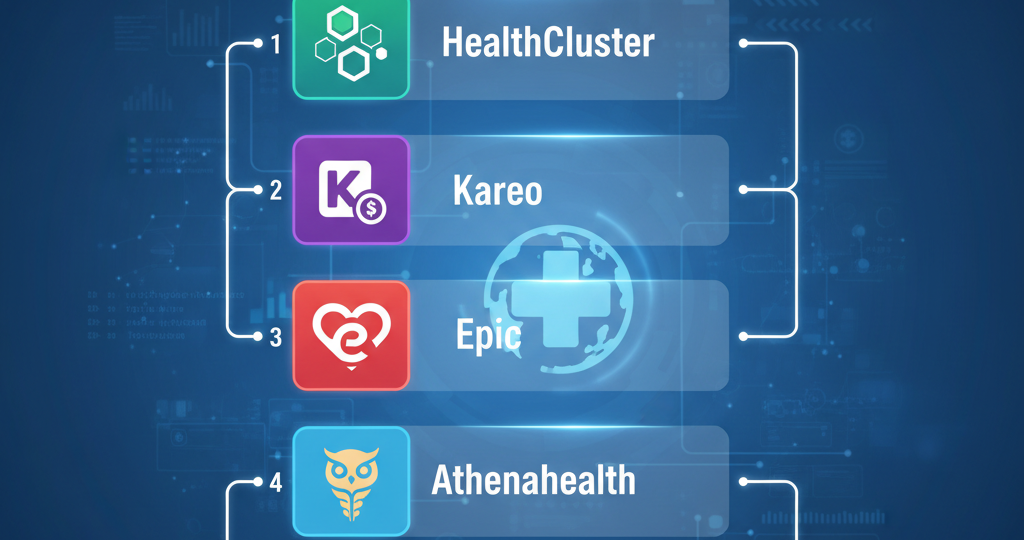
Top EMR Systems List
Below are leading EMR systems based on usability, feature depth, compliance, and long-term reliability.
Health Cluster
Health Cluster is a modern EMR and healthcare management platform designed for clinics, diagnostic centers, and growing healthcare networks. It focuses on workflow efficiency, data accuracy, and centralized patient records.
From an implementation perspective, Health Cluster fits organizations that want a clean interface, fast onboarding, and reduced operational friction. It supports clinical documentation, patient management, and reporting without the complexity of enterprise-heavy systems.
Health Cluster is particularly suitable for:
- Clinics transitioning from paper or legacy EMRs
- Mid-sized healthcare providers needing scalable systems
- Organizations prioritizing usability and speed
Its architecture aligns well with current interoperability and digital health standards.
Kareo
Kareo targets small practices and independent providers. It focuses on ease of use and fast onboarding. Kareo integrates scheduling, billing, and patient communication in a single dashboard.
Its strength lies in simplicity, not advanced customization. Clinics with basic workflow needs benefit most from Kareo.
Epic
Epic dominates large hospital systems and academic medical centers. It offers deep customization, enterprise-grade security, and extensive interoperability.
Epic requires significant investment and training. Organizations with complex workflows and large patient volumes gain the most value.
Athenahealth
Athenahealth delivers a cloud-based EMR with strong revenue cycle management. It continuously updates payer rules, which improves billing accuracy.
Providers appreciate its automation but may find customization limited compared to enterprise systems.
Allscripts
Allscripts supports both ambulatory and hospital environments. It offers flexible deployment models and open APIs for third-party integrations.
Its modular approach suits organizations that want configurable systems without full vendor lock-in.
Practice Fusion
Practice Fusion focuses on small and independent practices. It provides essential EMR functionality with fast setup.
The platform works well for basic documentation but lacks advanced analytics and automation features.
Cerner
Cerner serves large healthcare networks with complex data needs. It emphasizes population health, analytics, and interoperability.
Implementation requires planning and technical expertise. Large organizations benefit most from its data capabilities.
GE Healthcare
GE Healthcare offers EMR solutions integrated with diagnostic and imaging systems. Hospitals using GE medical equipment gain workflow efficiency.
The platform supports enterprise-level clinical environments rather than small practices.
eClinicalWorks
eClinicalWorks balances affordability and advanced features. It supports telehealth, patient engagement, and analytics.
Many mid-sized practices choose it for scalability and reporting depth.
Why Choose Health Cluster EMR System as Your Trusted EMR Partner?
Health Cluster EMR focuses on practical healthcare operations, not bloated features that slow providers down. It is built for clinics, diagnostic centers, and mid-sized healthcare organizations that want speed, control, and clarity.
Unlike legacy EMR systems, Health Cluster prioritizes workflow efficiency. Doctors can document faster, staff can manage patients without confusion, and administrators get usable reports instead of raw data dumps.
From hands-on implementation experience, Health Cluster performs well in environments where staff adoption is a real challenge. The interface is intuitive, which reduces training time and resistance from clinical teams. That matters more than flashy features that go unused.
Health Cluster also supports scalability. Clinics can start small and expand into multi-location operations without changing systems. Data remains centralized, structured, and accessible.
Security and compliance remain core strengths. The system follows modern healthcare data standards and supports controlled access, audit trails, and reliable backups.
Most importantly, Health Cluster aligns with real-world healthcare needs:
- Faster patient documentation
- Clear clinical workflows
- Centralized patient records
- Reliable reporting for management decisions
If you want an EMR that supports growth without complexity, Health Cluster is a strong and realistic choice.
Health Cluster vs CureMD. A Practical Comparison for USA Providers
Ease of Use and Adoption
Health Cluster prioritizes simplicity. Clinical staff adapt quickly with minimal training. This makes it ideal for small to mid-sized US practices that cannot afford long onboarding cycles.
CureMD offers broader functionality but comes with a steeper learning curve. It suits organizations with structured training resources.
Winner for usability: Health Cluster
Feature Depth and Customization
CureMD delivers advanced customization, billing intelligence, and automation. Large practices and multi-specialty groups benefit from its depth.
Health Cluster focuses on essential, high-impact features without overengineering workflows.
Winner for enterprise depth: CureMD
AI and Automation
Health Cluster uses AI where it matters. Documentation support, workflow efficiency, and usability.
CureMD applies AI more heavily across billing, analytics, and administrative processes.
Winner depends on need:
- Clinical simplicity: Health Cluster
- Administrative automation: CureMD
Billing and Revenue Cycle Support
CureMD has a strong reputation in US medical billing and RCM optimization. It actively helps reduce claim denials and improve reimbursements.
Health Cluster supports billing workflows but does not position itself as an RCM-heavy platform.
Winner for RCM: CureMD
Scalability and Growth
Health Cluster scales well for clinics growing into multi-location practices without system replacement.
CureMD scales better for large, complex healthcare organizations.
Winner:
- Small to mid-sized growth: Health Cluster
- Large enterprise growth: CureMD
Cost and Operational Control
Health Cluster typically results in lower operational overhead due to faster adoption and simpler workflows.
CureMD requires higher investment but delivers deeper administrative control.
Winner for cost-efficiency: Health Cluster
Final Verdict for USA Healthcare Providers
Choose Health Cluster EMR if you are:
- A US clinic or diagnostic center
- Focused on usability and fast adoption
- Prioritizing clinical efficiency over administrative complexity
Choose CureMD if you are:
- A multi-specialty or large practice
- Billing and revenue optimization driven
- Comfortable with complex systems
Experience the Future of EMR Systems
Modern EMRs must support predictive care, automation, and seamless data flow. healthcluster aligns closely with these expectations.
AI Integration
AI tools assist with charting, coding suggestions, and data analysis. They reduce manual effort and improve clinical accuracy.
Medical Scribe
Virtual medical scribes automate clinical notes in real time. Providers spend less time typing and more time with patients.
Customizable Templates
Custom templates adapt to specialty workflows. Providers document faster without sacrificing accuracy.
E-Prescribing
E-prescribing improves medication safety and reduces prescription errors. Integrated drug databases support compliance and patient safety.
Integrated Lab Results
Direct lab integration speeds up diagnosis and treatment decisions. Providers access results without switching systems.
Interoperability
Interoperability ensures seamless data exchange with hospitals, labs, pharmacies, and health information exchanges. This capability is essential in value-based care models.