
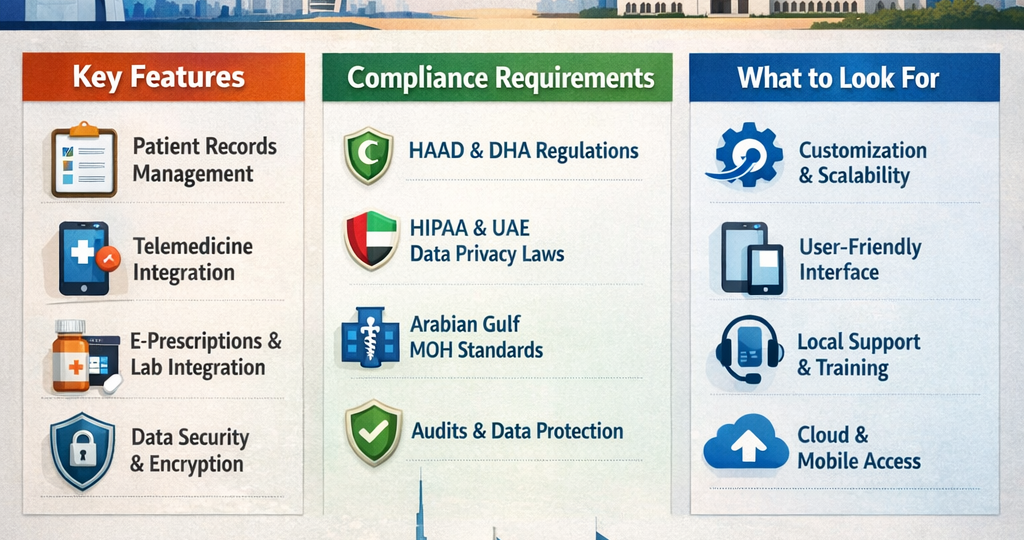
The UAE’s healthcare sector is growing fast. New clinics and hospitals are opening every year. And with that growth comes one major challenge: managing patient data the right way.
A generic, off-the-shelf EMR system often falls short. It may not support local compliance rules. It may not fit the specific workflows of your facility. And it may not connect with the national health networks your patients and regulators expect you to use.
That is why more healthcare providers across Dubai, Abu Dhabi, and beyond are choosing a custom EMR UAE solution instead.
This article breaks down what a custom EMR is, why it matters in the UAE, what features to look for, and how the right platform can set your facility up for long-term success.
What Is a Custom EMR?
An electronic medical record (EMR) is a digital system that stores patient health data. It replaces paper files with structured, searchable, and secure digital records.
A custom EMR goes one step further. Rather than using a ready-made product designed for a global market, a custom EMR is built or configured to match the specific needs of your clinic, hospital, or healthcare center. It accounts for your workflows, your specialty, your team size, and the regulatory environment you operate in.
In the UAE, that last point matters more than anywhere else.
Why Custom EMR Software UAE Is Different from Global Solutions
Most international EMR platforms are built for markets like the US or Europe. They are designed around HIPAA or NHS standards. When deployed in the UAE, they often require significant workarounds just to meet local requirements.
A custom EMR software UAE solution is built with the UAE market in mind. That means:
- It is designed to connect with national health information exchanges like Nabidh, Malaffi, and Riayati from day one.
- It supports Arabic language documentation and local insurance workflows.
- It is aligned with DHA, DOH, and MOHAP regulatory frameworks.
- It uses coding systems like ICD-10 and CPT codes used in UAE insurance claims.
A global product adapted to the UAE is not the same as a solution built for the UAE. The difference shows up in onboarding speed, day-to-day usability, and compliance audits.
Understanding the UAE’s Compliance Landscape
Before choosing any EMR system, healthcare providers in the UAE need to understand the regulatory environment. It is more structured than most regions in the world, and for good reason.
Nabidh
Nabidh stands for National Backbone for Integrated Dubai Health. It is a health information exchange platform launched by the Dubai Health Authority (DHA). Its purpose is to enable secure sharing of electronic medical records across both public and private healthcare facilities in Dubai.
Any clinic or hospital operating under the DHA must connect to Nabidh. A NABIDH-compliant EMR UAE solution needs to send and receive HL7-formatted messages, support patient consent management, and allow multi-location data exchange.
If your EMR cannot integrate with Nabidh, your facility cannot operate legally in Dubai.
Malaffi
Malaffi is Abu Dhabi’s health information exchange, developed by the Department of Health (DOH). It serves the same purpose as Nabidh, but for Abu Dhabi and its facilities.
A MALAFFI-compliant EMR must allow real-time sharing of patient records across healthcare providers in Abu Dhabi. Clinics operating in Abu Dhabi must connect to Malaffi as part of their licensing obligations.
If you operate in both Dubai and Abu Dhabi, your EMR needs to support both Nabidh and Malaffi simultaneously.
Riayati
Riayati is the UAE’s National Unified Medical Record (NUMR) platform. Unlike Nabidh and Malaffi, Riayati operates at a national level. It centralizes medical records for the entire UAE population.
Riayati EMR integration UAE is becoming essential for any healthcare provider that wants to offer continuity of care across all seven emirates. Patients treated in Sharjah can have their records accessed in Abu Dhabi, and vice versa.
ADHICS
ADHICS stands for Abu Dhabi Healthcare Information and Cyber Security Standard. It sets the data security and cyber hygiene requirements for healthcare providers in Abu Dhabi. An ADHICS-compliant EMR software ensures that your patient data is stored, transmitted, and accessed in line with these standards.
DHA Compliance
The Dubai Health Authority has its own set of licensing and operational standards. A DHA-compliant EMR system supports DHA workflows, insurance processing formats, and regulatory reporting requirements. This includes integration with the DHPO (Dubai Health Insurance Department) for insurance claim management.
The Role of Interoperability in Custom EMR UAE
Interoperability is the ability of different software systems to communicate and exchange data with each other. In healthcare, it is not optional. It is a requirement.
A UAE clinic today may need to share data with:
- National platforms like Nabidh, Malaffi, and Riayati
- Insurance companies and third-party administrators
- Laboratories and radiology centers
- Pharmacies
- Other hospitals within a health cluster or network
A custom EHR system built in the UAE with strong interoperability allows all of this to happen without manual data entry or paper transfers. Information moves seamlessly, securely, and accurately between systems.
HL7 and FHIR Standards
Two technical standards make this possible.
- HL7 (Health Level Seven) is a set of international messaging standards used to transfer clinical and administrative data between software systems. In the UAE, Nabidh specifically requires HL7-formatted messages for data exchange. This includes HL7-VXU messages for vaccination data and HL7-MDM messages for clinical documents.
- FHIR (Fast Healthcare Interoperability Resources) is a newer standard developed to make health data exchange even more accessible. It uses modern API-based architecture, which makes it faster and easier to integrate with third-party systems and mobile applications. FHIR is increasingly being adopted across the UAE as healthcare systems modernize.
A custom EMR Dubai or Abu Dhabi solution that supports both HL7 and FHIR gives healthcare providers the flexibility to connect with legacy systems and modern platforms at the same time.
Key Features to Look For in a Custom EMR UAE Solution
Not all EMR systems are built the same. When evaluating a tailored EMR solution UAE, here are the core features that matter most.
Specialty-Specific Workflows
A general practitioner clinic has different needs from a dental center or a multi-specialty hospital. A good custom EHR allows you to configure workflows, consultation templates, and documentation formats specific to your specialty. This reduces data entry time and ensures clinical notes are structured for meaningful use.
- General practice EMR: Needs fast registration, quick consultation templates, and prescription generation.
- EMR for dental clinics UAE: Needs charting tools, tooth diagrams, and treatment planning specific to dental workflows.
- Multi-specialty EMR UAE: Needs department-level configuration with referral management between specialties.
Appointment Scheduling and Patient Registration
A reliable EMR with appointment scheduling UAE reduces no-shows, minimizes wait times, and optimizes resource allocation. Automated reminders sent via SMS or mobile app keep patients informed. Digital patient registration reduces paperwork and data entry errors from the start of the patient journey.
Electronic Prescriptions
Digital prescriptions reduce medication errors. They link directly to the patient’s medical history, highlight drug interactions, and allow pharmacists to access the prescription securely. This feature is a fundamental part of any electronic medical records UAE system.
EMR with Billing UAE
Billing in the UAE is not simple. Insurance rules vary between DHA and DOH. Co-payment calculations, eClaims processing, and VAT compliance all need to work together. An EMR with billing UAE handles this inside the same platform, reducing errors and speeding up revenue collection.
Lab and Radiology Integration
When a doctor orders a test, the results should come back automatically into the patient’s file. An integrated lab module eliminates the need to log into a separate system. It speeds up diagnosis and reduces the chance of results getting missed or misattributed.
Patient Portal and Mobile App
Patients today expect access to their own health data. An EMR with a patient portal in the UAE gives patients the ability to view their records, download reports, book follow-up appointments, and communicate with their care team. A connected mobile app extends this to both patients and doctors on the go.
Data Security
Healthcare data is among the most sensitive data a system can hold. A strong custom EMR software UAE uses role-based access control, end-to-end encryption, and full audit trails. It meets ADHICS standards in Abu Dhabi and follows DHA data protection rules in Dubai.
Cloud-Based Architecture
A cloud-based EMR UAE offers significant advantages over on-premise systems. Updates happen automatically. Disaster recovery is built in. Multiple locations can access the same data in real time. Providers like Microsoft Azure are often used to host healthcare platforms in the region, offering both compliance and reliability.
Nurse and Clinical Staff Workflows
Good EMR design extends beyond doctors. A well-designed system streamlines nurses’ tasks such as documenting vital signs, requesting tests, and updating patient records. When nurses have an efficient workflow, they spend less time on administrative tasks and more time on patient care.
Custom EMR Dubai vs. Custom EMR Abu Dhabi: What Changes?
The UAE is a federation of seven emirates. While many regulations overlap, there are important differences between custom EMR Dubai and custom EMR Abu Dhabi deployments.
In Dubai, the DHA governs healthcare. Facilities must integrate with Nabidh and comply with DHPO for insurance. In Abu Dhabi, the DOH oversees healthcare. Facilities must integrate with Malaffi and follow ADHICS standards.
For providers operating in both emirates, the EMR platform needs to handle both sets of rules simultaneously. A solution that manages Nabidh and Malaffi from a single interface saves significant administrative overhead.
For facilities in other emirates like Sharjah, Ajman, or Ras Al Khaimah, MOHAP (Ministry of Health and Prevention) rules apply. The Riayati national platform ties these together.
A well-built, tailored EMR solution UAE accounts for this multi-jurisdiction complexity out of the box.
Custom EMR for Hospitals vs. Clinics
The scale and complexity of the facility also shape what is needed from a custom EMR.
EMR for private clinics UAE tends to focus on speed, simplicity, and cost-efficiency. A single-specialty or small multi-doctor clinic needs fast patient flow, easy billing, and streamlined insurance claims. A light, cloud-based system with good mobile access usually fits well here.
EMR for hospitals UAE is a different scope entirely. Large hospitals need a full hospital information system UAE (HIS) alongside the EMR. This includes inpatient management, operating theatre scheduling, pharmacy automation, laboratory information systems (LIS), and advanced reporting dashboards. The EMR sits within a broader ecosystem of interconnected modules.
Healthcare management software UAE at the hospital level also needs to support KPIs, population health monitoring, bed management, and department-level reporting. This is where a purpose-built HIS software UAE becomes essential.
Why Generic EMR Systems Often Fail in the UAE
Off-the-shelf global EMR products may look appealing because of their brand recognition or low initial cost. But many healthcare providers in the UAE have learned this lesson the hard way.
Common problems include:
- Compliance gaps: The system was not built for Nabidh, Malaffi, or Riayati. Integration requires expensive custom development work after deployment.
- Workflow mismatch: Templates and workflows are designed for Western clinical environments. Arabic language support is limited or absent.
- Insurance processing issues: The billing module does not understand UAE insurance formats, leading to claim rejections and delayed payments.
- Limited local support: When something goes wrong, support teams are in a different time zone and unfamiliar with UAE-specific requirements.
A bespoke EMR software Dubai or Abu Dhabi solution avoids these issues because the platform was designed with the UAE environment as its starting point, not an afterthought.
The Link Between Custom EMR and Health Information Exchange
Health Information Exchange UAE (HIE) is the process of sharing patient data electronically between healthcare organizations. In the UAE, this is not a future ambition; it is a current operational requirement.
Nabidh, Malaffi, and Riayati are all health information exchange platforms. They connect thousands of healthcare facilities across the country into a shared network of patient data.
When your EMR plugs into this network, your clinical team can:
- Access a patient’s complete history from previous visits at other facilities.
- Avoid duplicate lab tests because the results are already available.
- Make faster and more accurate diagnoses.
- Coordinate care across multiple facilities within a health cluster.
This is what digital health solutions UAE means in practice. It is not just about going paperless. It is about becoming part of a connected, intelligent health ecosystem.
Health Cluster’s Custom EMR UAE Solution
Health Cluster is a cloud-based EMR and hospital information system provider built specifically for the UAE and the wider GCC region. With over seven years of experience supporting healthcare providers across Dubai, Abu Dhabi, and beyond, Health Cluster has developed one of the most comprehensive and compliant EMR platforms in the region.
Here is what sets Health Cluster apart:
- Full compliance with Nabidh, Malaffi, ADHICS, and Riayati: Health Cluster’s EMR platform is built to meet all major UAE regulatory requirements. This includes HL7 messaging for Nabidh and FHIR-based integration for modern health information exchange.
- Multi-location HIE connectivity: The platform supports multi-location health information exchange, bridging facilities in Dubai and Abu Dhabi to both Nabidh and Malaffi from a single interface.
- Specialty-specific EMR solutions: Whether you run a general clinic, a dental practice, or a multi-specialty hospital, Health Cluster configures the platform to match your workflows.
- Integrated billing and insurance management: End-to-end insurance management is built into the platform, including eClaims processing, co-pay handling, and VAT compliance.
- Full HIS for hospitals: Beyond the EMR, Health Cluster provides a complete hospital information system covering inpatient management, LIS, pharmacy, OT scheduling, and advanced reporting.
- Patient and doctor mobile apps: Both patients and doctors get mobile access to records, appointments, and prescriptions.
- Around-the-clock support: Health Cluster’s team provides ground-level support for onboarding, integration, and ongoing operations.
Health Cluster is trusted by hundreds of healthcare brands, with a proven track record of helping clinics and hospitals in the UAE increase revenue, reduce administrative burden, and stay compliant as regulations evolve.
Conclusion
Choosing the right EMR system in the UAE is one of the most important decisions a healthcare provider can make. It affects clinical outcomes, operational efficiency, regulatory compliance, and financial performance.
A custom EMR UAE solution that is built for the local market, integrated with Nabidh, Malaffi, and Riayati, and configured for your specific facility type gives you the foundation to operate at your best.
Health Cluster has been helping UAE healthcare providers do exactly that for many years. From single-specialty clinics in Dubai to multi-specialty hospitals across the region, the platform is built to support every stage of your facility’s growth.
Ready to see how Health Cluster’s custom EMR can work for your facility? Book a free demo today and speak with a specialist who understands the UAE healthcare landscape inside out.